

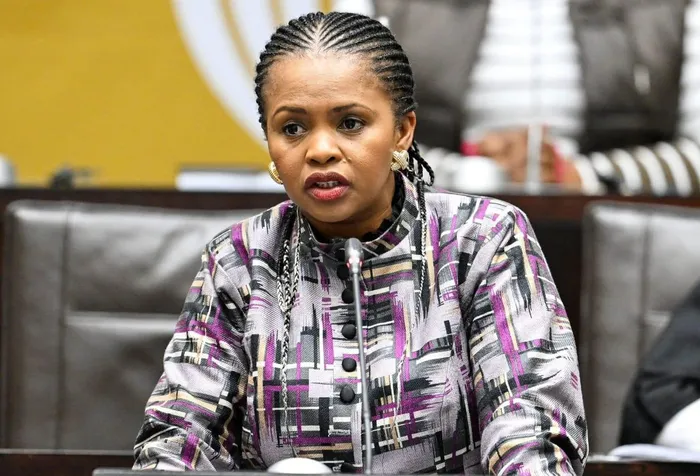
Communications and digital technologies portfolio committee chairperson Khusela Sangoni-Diko demands the immediate withdrawal of Minister Malatsi’s BBBEE policy directives, calling them an overreach that undermines transformation, legal requirements, and South Africa’s democratic gains.
Image: Parlaiment of South Africa / Facebook
Communications and Digital Technologies committee chairperson Khusela Diko has called for the immediate withdrawal of policy directives issued by Minister of Communications and Digital Technologies Solly Malatsi to the Independent Communications Authority of South Africa (ICASA).
She described the directives as an affront to the long-standing struggle for equity and redress in the country.
Diko said the directives “further unintelligibly obfuscate existing law in a spirited attempt to circumvent the mandatory 30% equity ownership by historically disadvantaged groups as a requirement for electronic communications services licensing as under section 9(2)(b) of the Electronic Communications Act (ECA).”
She argued that the Minister, in issuing the directives, had acted without the legislative or moral authority to reverse democratic gains, noting that to the best of her knowledge, he had not sought Cabinet approval to gazette the directives.
Diko added that this was consistent with what she described as Malatsi’s “antagonistic relationship with the law and due process,” highlighting his previous actions that she said undermined existing law and Parliament’s oversight role.
Diko reminded the Minister of “the sanctity of the doctrine of separation of powers which enjoins that where there is a dispute on statutory interpretation, he may approach the courts for resolution or where he requires an amendment to legislation, that is the domain of the legislature.”
While acknowledging the stated objectives of the policy direction - such as accelerating broadband rollout, promoting investment, and aligning regulatory frameworks with the ICT Sector Code - Diko recalled the committee’s 27 May 2025 meeting with Malatsi.
She said members noted “with great concern what could be considered the Minister’s overreach of his Executive powers and using policy directives to amend the Electronic Communications Act (ECA)… that the state of the sector report by ICASA has placed a need for more equality and redress in the sector, and the promulgated policy direction seems to be going against the redress.”
Diko emphasised that transformation in the ICT sector remains non-negotiable, describing the empowerment of historically disadvantaged individuals and the advancement of Broad-Based Black Economic Empowerment (BBBEE) as “foundational to South Africa’s democratic project.”
She distinguished the network services licence required by operators, such as Starlink, from other ICT sector programmes, noting that licensees must have no less than 30% historically disadvantaged equity ownership, as per the ECA.
Diko noted that this condition is peremptory because spectrum is a strategic, finite national resource underpinning almost every modern sector, including mobile broadband (4G, 5G, future 6G), public safety and emergency services, broadcasting, and cultural content distribution.
She explained that, both globally and domestically, spectrum is regarded as a sovereign asset, comparable to water, minerals, or land, and must therefore be protected, regulated, and allocated in the public interest to support national development priorities.
Diko added that the economic value derived from spectrum allocation must remain in South Africa, with local ownership ensuring these gains circulate within the national economy rather than being extracted offshore, while also safeguarding national security and sovereignty.
“This legislative requirement cannot be wished away or amended through regulations, but only through an act of Parliament.
''Further, it cannot be that BBBEE only matters so long as it is not an inconvenience to investors while the statistics clearly demonstrate that voluntary compliance from the private sector to drive black economic empowerment has failed,” Diko said.
Diko also expressed concern over the termination of the less-than-1kg parcel reserved service for the South African Post Office (SAPO), warning that this decision “poses a direct threat to SAPO’s sustainability.”
She noted that SAPO remains ''a critical public service institution, particularly for rural and underserved communities who depend on affordable postal and parcel services. The implications of this termination for SAPO’s turnaround strategy and its universal service obligations require urgent clarity.''
Diko reiterated the call for the immediate withdrawal of the directives, stating that they go against the letter and spirit of the law as well as previous discussions the committee had held with the Minister.
She said the committee would convene a meeting in the new year to consider these developments and emphasised its commitment to ensuring that national policy objectives—universal access, socio-economic transformation, and the viability of strategic state-owned entities—are fully upheld.
hope.ntanzi@iol.co.za
IOL News