

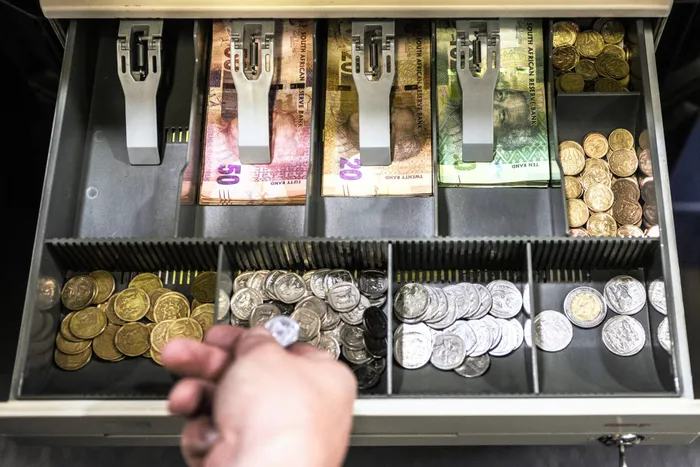
The Global Initiative against Transnational Organised Crime (GI-TOC) report has warned that illicit financial flows in Africa are expanding.
Image: Waldo Swiegers/Bloomberg
Africa is plagued by an increasing array of illicit financial flows, with many countries serving as sources, transit points, or destinations.
This is according to the Global Initiative against Transnational Organised Crime (GI-TOC), which added that these flows erode economic stability, fuel corruption, and sustain organised crime, causing harms that extend well beyond the continent.
The report stated that these flows often penetrate international financial hubs and global trade hubs because they are inherently transnational.
State-embedded and private sector actors, non-state armed groups, and criminal organisations all play roles in generating and moving the illicit financial flows.
According to the report, periods of political change, especially elections, often heighten illicit finance risks as actors compete for power and rents.
Foreign actors also contribute, exploiting economic vulnerabilities and using covert financial networks to entrench themselves in resource-rich regions.
According to the United Nations Economic Commission for Africa (UNECA) and Ghana’s Financial Intelligence Centre (FIC), the continent loses more than $88,6 billion to these flows annually.
The 2025 Global Organised Crime Index also stated that the most pervasive criminal markets in Africa were financial crimes, followed by human trafficking, non-renewable resource crimes, the trade in counterfeit goods, and arms trafficking.
The Democratic Republic of the Congo (7.47), South Africa (7.43), Nigeria (7.32), and Kenya (7.18) scored highest in Africa, indicating greater levels of organised crime and vulnerability.
The continent also faces challenges from poverty, inequality, and climate change that can exacerbate crime rates, though safety levels vary significantly by country and region, with some nations being among the safest in the world.
According to GI-TOC, large-scale scandals have frequently relied on professional intermediaries to move illicit funds using complex financial transactions and business structures.
Networks of lawyers, accountants, and providers of corporate services enable the transfer of illicit proceeds from African markets to international financial hubs.
“For example, professional money laundering networks have been instrumental in transferring substantial illicit funds on behalf of southern African organised crime syndicates to foreign destinations that include Hong Kong and Dubai. These syndicates are involved in markets such as gold, tobacco, drugs, and human trafficking,” read the report.
In East Africa, legal professionals have been implicated in creating shell companies in Nairobi, Dar es Salaam, and Kampala to facilitate fraudulent gold schemes targeting foreign investors.
Lawyers who collaborate with bureaucrats and international actors have provided legal cover, invoked professional privilege, and acted as nominees, defrauding investors of hundreds of millions of dollars. Their professional credibility has been misused to obscure contracts and mislead victims.
The report stated that beyond law firms, front companies are routinely used to integrate illicit funds through real estate, construction, and the trade in precious metals and stones. Accountants, law firms, real estate developers, construction firms, and casinos are also complicit – sometimes knowingly, sometimes due to regulatory blind spots.
Precious metal and stone dealers are also a major risk group, with scrap metal dealers trading in second-hand metals often serving as key intermediaries in the gold sector and other mineral sectors.
According to the report, intelligence on illicit financial flows in the real estate sector is largely anecdotal due to a lack of data. However, the sector is widely rated as ‘high risk’ due to cash-based, high-value transactions and opacity around beneficial ownership. These features allow illicit actors to conceal assets and launder funds, as well as increase the value of holdings through renovations paid in cash and resale.
The construction industry in Africa has become increasingly entangled with illicit finance, driven by the sector’s high-value transactions, cash dependency, and limited regulatory oversight.
In 2023, the Action Group against Money Laundering in Central Africa identified construction as Chad’s top laundering risk.
Kenya’s Business Registration Service reported that more than half of the companies flagged for money laundering in 2024 operated in the construction sector.
In South Africa, gangs in the Cape have heavily exploited construction tenders.
Gang leader Ralph Stanfield and Malusi Booi, a South African local government official, were arrested in 2025 and charged in connection with alleged fraudulent construction tenders that prosecutors maintain were used to launder proceeds from organised crime.
Trade is also a major vector for illicit finance in Africa, driven by weak regulatory oversight, porous borders, and the misuse of legitimate systems. Airports – ranging from major international hubs to small private airstrips – are increasingly exploited for illicit finance and smuggling.
“Criminal networks use them to move gold, cash, and drugs, taking advantage of weak oversight, inadequate cargo checks, and the rapid growth of private aviation across Africa.”
The report added that gold trade is also a major conduit for illicit finance across Africa, shaped by geopolitical, economic, and governance challenges. Supply chains are increasingly captured by state and political actors, driving corruption and criminalisation.
“Seaports and the growing number of Free Trade Zones (FTZs) and Special Economic Zones (SEZs) also provide opportunities for criminal networks to move commodities with limited scrutiny,” the report reads.
Senior Training Co-ordinator at the Institute for Security Studies, Willem Els, said illicit finance is crippling the continent’s economy, adding that governments should tackle the state-embedded actors to deal with the situation.
Els said the involvement of state-embedded actors in criminal activities was also highlighted in the ongoing Madlanga Commission of Inquiry and the Parliament Ad Hoc Committee.
The two bodies are currently probing the allegations of criminal infiltration and corruption in South Africa's criminal justice system, particularly within the police service.
manyane.manyane@inl.co.za