

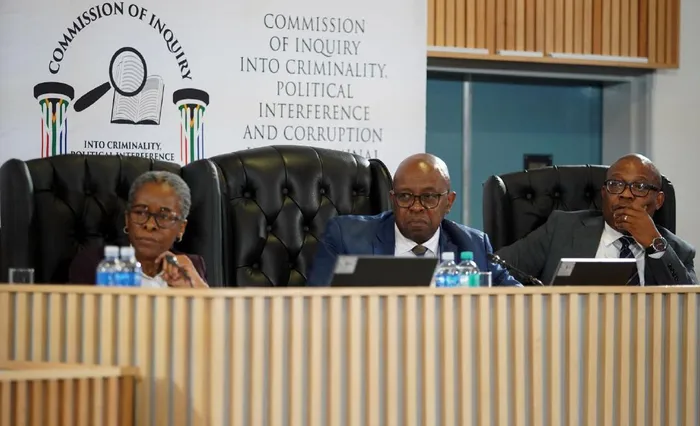
The Madlanga Commission heard from various individuals on Tuesday.
Image: Oupa Mokoena / Independent Newspapers
Undercover SAPS crime intelligence operative, Lt-Col. Justice Duma has told the Madlanga Commission that the theft of the drugs from a Hawks storage facility left him deeply disappointed and stripped of confidence in the Directorate for Priority Crime Investigation (DPCI).
Duma is an officer who helped secure one of South Africa's major cocaine seizures.
Duma concluded his testimony before the commission on Tuesday, describing how a successful operation that once filled him with pride has become a source of frustration and embarrassment following the disappearance of exhibits from a Hawks facility in Port Shepstone in November 2021.
A large cocaine consignment was stolen from a Hawks storage facility in Port Shepstone in November 2021.
“I did my job. I was excited,” Duma told the commission. “But I am disappointed by how the matter was handled.”
His testimony painted the picture of an officer who believed he had finally achieved a breakthrough after several unsuccessful operations, only to see the achievement overshadowed by controversy and allegations surrounding the management of the seized cocaine.
Reflecting on the day of the operation, Duma said it had been one of the highlights of his career.
“I was happy on that day. In fact, I was excited. I had several operations where I always got negative results. But on that day, it happened to be my day to achieve success, which made my division look operational,” he said.
However, that sense of accomplishment was short-lived.
Questioned by co-commissioner Adv. Sandile Khumalo about whether national instructions governing the handling of exhibits had been strictly followed, Duma conceded that this had not been the case.
The issue of how the drugs were processed became a focal point during the proceedings.
Commissioner Sisi Baloyi questioned why the exhibits were not processed at the original crime scene.
Duma explained that the location and size of the container, coupled with the large quantity of bags recovered, made on-site processing impractical.
According to Duma, a larger and more suitable area was required to process the exhibits properly.
While the depot may have had available capacity, the specific location where the container stood did not provide sufficient space.
Baloyi pressed him on whether alternative arrangements had been explored.
“Not that I know of,” Duma replied.
The commission also examined Duma's concerns about his identity being revealed during proceedings.
He argued that, given the dangerous nature of drug cartel investigations, his name should have been protected.
Referring to another witness who had withheld the identity of a confidential informant, Duma said similar precautions should have been applied in his case for safety reasons.
Throughout his testimony, Duma firmly denied any involvement in the theft of the narcotics.
Instead, he said the incident had severely damaged his confidence in the DPCI.“I no longer trust the DPCI as a reliable entity,” he told the commission.
He described the theft as a devastating setback that effectively erased the gains made through the operation.
“The theft of the drugs takes us back to square one,” he said, adding that the incident was disgraceful for the SAPS.
The commission also heard evidence regarding intelligence gathering, informant management and communication between law enforcement agencies.
Duma explained that some informants are not formally registered and may provide information without expecting payment.
He stressed that intelligence regarding containers suspected of carrying illicit substances must be reported through the appropriate chain of command, with senior officials responsible for safeguarding sensitive information.
He further testified that investigators often rely on container numbers to initiate action and that information about containers detained by customs authorities is not always communicated to SAPS or the DPCI.
kamogelo.moichela@iol.co.za
IOL Politics