

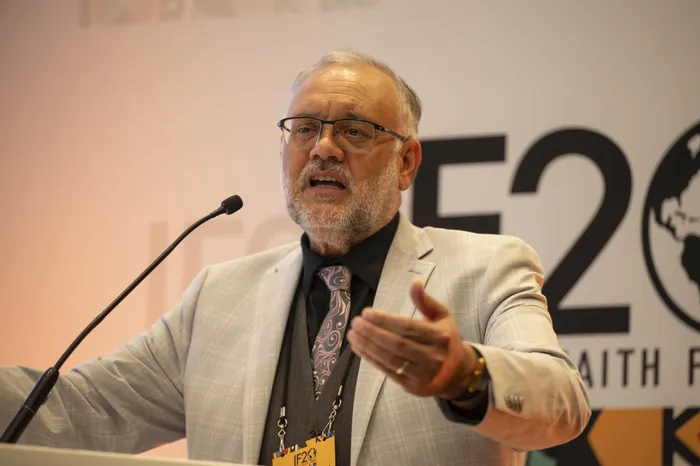
Former South African Ambassador to the US Ebrahim Rasool stood firm on his assertion that President Donald Trump is driving a white supremacist agenda.
Image: Armand Hough/Independent Newspapers
Ambassador Embrahim Rasool said that when he first heard that President Cyril Ramaphosa would be appealing the Section 89 report, which is being used to launch parliamentary impeachment proceedings, his immediate thought was that political leaders should opt for the moral high ground rather than fight technical battles.
The ConCourt ruled that Parliament acted unlawfully in 2022 when it voted to block an impeachment inquiry into Ramaphosa over the Phala Phala farm theft scandal.
The court invalidated the National Assembly’s vote that used the ANC majority to reject the Section 89 Independent Panel report, and ordered that the report be referred immediately to an Impeachment Committee.
The judgment was a direct result of a legal application brought by the EFF and the African Transformation Movement (ATM), which submitted that Parliament failed to fulfil its constitutional obligations.
National Assembly Speaker Thoko Didiza had confirmed that Parliament will establish an impeachment committee into the Independent Panel Report, chaired by former Chief Justice Sandile Ngcobo.
ANC sources revealed that Ramaphosa has decided to stall the impeachment proceedings, with the party throwing its weight behind the move.
Political parties are slowly announcing the names of MPs who will serve on the impeachment committee, with Didiza having set Friday as the deadline for parties to formally submit the names of committee members.
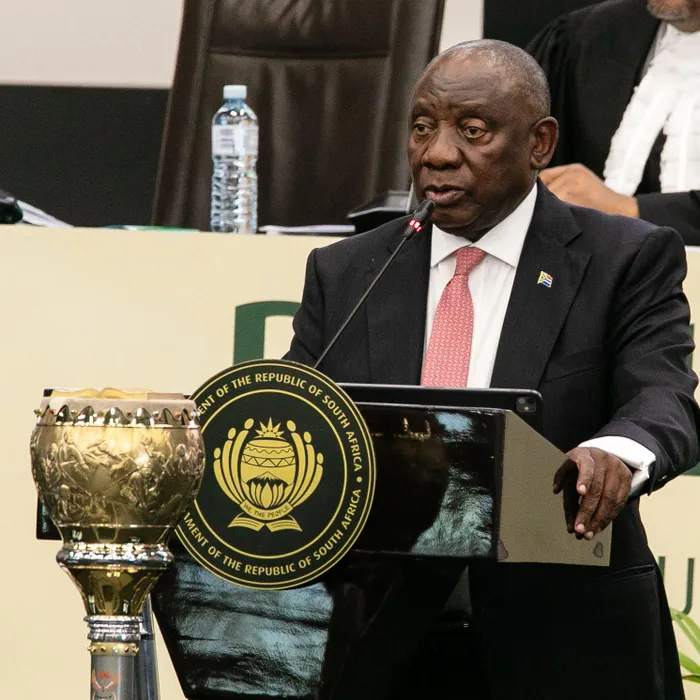
President Cyril Ramaphosa during the question-and-answer session in the National Assembly on Thursday.
Image: Zwelethemba Kostile / Parliament of RSA
Rasool was the former Ambassador to the United States, who was expelled last year after accusing United States President Donald Trump of white supremacy.
Rasool was declared "persona non grata" after he said: “The supremacist assault on incumbency, we see it in the domestic politics of the US, the MAGA movement, the Make America Great Again movement, as a response not simply to a supremacist instinct, but to very clear data that shows great demographic shifts in the US in which the voting electorate in the US is projected to become 48% white.”
In a one-on-one interview ahead of Youth Day, Rasool spoke about the struggle of the 1976 Soweto Uprising, and only after being asked did he cautiously share his sentiments on the Phala Phala judgment.
Rasool shared that his disappointment stems from the fact that while Ramaphosa is forced to defend himself against impeachment, it indicates how increasingly political leaders are mired in techno-legal battles rather than operating from the moral high ground, which historically has been the terrain of the liberation movement.
“Look, I think the ANC is right; it is a technical judgment, not a substantial judgment of innocent or guilty. I think that it speaks to an unfortunate situation that political leaders are fighting technical battles to deal with moral matters.
“It will be idealistic to think that we could live in a world of moral black and white. But that was literally the world of Soweto 1976, which shaped our ideals and our expectations of the world,” Rasool said.
“We never expected that we would one day be called upon to defend a liberation leader with technical stratagems, rather than the assertion of moral truths. That’s what is sad, that we even have to face an impeachment, not because the president stole, but the moral question is, how did we all end up with millions (of rands), when there are billions without a hundred.
“That’s the moral dilemma. It's not the technical stratagems and the impeachment case and so forth. I think that in the light of Soweto 76, that has to be the ethical dilemma.”
theolin.tembo@inl.co.za