

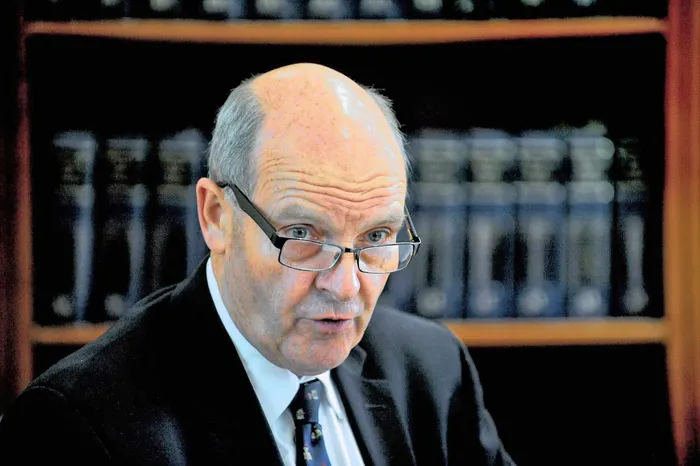
Private investigator Paul O’Sullivan has dismissed Cedrick Nkabinde’s claims of a 2018 plot to oust former acting police commissioner Khomotso Phahlane as “lies,” and says he is opening a criminal case against Nkabinde for allegedly lying to Parliament.
Image: Itumeleng English
The political storm over Cedrick Nkabinde’s claims of a plot to oust former acting police commissioner Khomotso Phahlane has deepened, with key figures named in his Parliamentary Ad Hoc Committee testimony — including Paul O’Sullivan, AfriForum and the Democratic Alliance — all flatly denying any involvement.
O’Sullivan described the allegations as part of a “broader conspiracy” and confirmed he would open a criminal case against Nkabinde for lying under oath.
IOL on Thursday reported that Nkabinde, chief of staff for suspended Police Minister Senzo Mchunu, lifted the lid on the alleged plot to block Phahlane from being appointed permanently to the position of national commissioner of the South African Police Service (SAPS).
Nkabinde made the startling revelation on Wednesday when he gave his testimony about forensic investigator O’Sullivan, and former head of the Independent Police Investigative Directorate (IPID) Robert McBride, at the parliamentary inquiry probing allegations of deep police corruption made by KwaZulu-Natal police commissioner Nhlanhla Mkhwanazi.
Nkabinde said he was part of the “Phahlane Task Team” that was plotting with instructions from McBride and O’Sullivan, with whom he had a fallout while at IPID when he worked there from 2010 until he resigned after reaching a settlement agreement in 2018.
“The project was to make sure General Phahlane does not get appointed as permanent national commissioner,” Nkabinde told the parliamentary inquiry.
In a sworn affidavit dated November 20 and seen by IOL, O’Sullivan dismisses Nkabinde’s evidence before Parliament as “unlawful and intentionally misleading”, insisting that the supposed meeting at his home was in fact a year-end braai attended by his staff and invited guests.
"There was no meeting, no plot, only the lies of Nkabinde, as part of a broader conspiracy. There was also no journalist there. It was a year-end braai, and some of my staff and other invited guests were there. Nkabinde invited himself, as he was not invited. We now know he came to spy, so he could fabricate a story in his role as a part of the Phahlane / Ntlemeza / Mokotedi / Mabula / Mkhwanazi crime syndicate.
"Mkhwanazi seemed to be running the work of the syndicate in recruiting IPID officers, to act against IPID, in favour of Phahlane," O’Sullivan told IOL.
"That's my response, I am opening a docket against Nkabinde, for being a liar to Parliament. It will be opened first thing in the morning (Friday) and transferred to Cape Town, for him to feel justice, which is long overdue."
O’Sullivan’s full sworn affidavit is available here: A Sworn Statement Paul O’Sullivan 2025-11-20.pdf
AfriForum CEO Kallie Kriel also announced that the civil rights organisation would lay criminal charges against Nkabinde for “deliberately giving false evidence” before the parliamentary ad hoc committee.
Kriel challenged Nkabinde to take a lie detector test, saying AfriForum would cover the costs.
“His claims are false and contradictory,” Kriel said, pointing out that Phahlane had already been dismissed from his post by June 2017 — before the alleged 2018 meeting could have taken place.
Kriel added that he had never met Nkabinde or Robert McBride, and added that he has never been to O’Sullivan’s house, where the alleged plot was supposedly planned.
Democratic Alliance MP Glynnis Breytenbach also dismissed Nkabinde’s testimony as false, calling him “a self-confessed liar” who “came to Parliament and lied shamelessly to the ad hoc committee”.
Responding to IOL’s questions, Breytenbach said neither she nor her DA counterpart in the parliamentary portfolio committee Dianne Kohler Barnard had any knowledge of such a meeting.
“I was not aware of any such meeting, and have never met nor associated with Mr Nkabinde before his appearance at the committee,” she said.
Breytenbach said the DA’s position on the matter was clear: any political or non-state interference in police leadership appointments was “not acceptable”.
She added that while any decision on supporting an independent inquiry would require internal discussion, she and Kohler Barnard had no personal knowledge of the meeting or the alleged plot.
On the other hand, journalist Karyn Maughan has also been drawn into the controversy, after being accused by some social media users of having attended the meeting Nkabinde described in his testimony.
Nkabinde himself did not name Maughan in his evidence, but her name was circulated widely online, on social media platforms, in connection with the alleged gathering.
In response to IOL’s questions, Maughan denied the claims, saying simply: “It’s not true.”
Nkabinde told the parliamentary ad hoc committee earlier this week that he attended what he described as a “task team” meeting held at the private home of O’Sullivan. According to Nkabinde, the meeting’s alleged purpose was to ensure that Phahlane was not confirmed as the permanent head of the SAPS.
He claimed that the gathering included McBride, IPID official Mandlakayise Mahlangu, members of the Democratic Alliance, two individuals from AfriForum, and “a white female journalist”. Nkabinde alleged that attendees discussed ways to discredit Phahlane — including media exposure and search operations — so that the president would have no choice but to remove him.
Nkabinde further alleged that AfriForum members at the meeting guaranteed that funds were available to carry out the mission, and claimed that the allegations used to suspend Phahlane — including a sound system found at his home and the “blue lights” tender — were fabricated to achieve that goal.
The escalating dispute has thrown fresh light on long-standing tensions within South Africa’s law enforcement and oversight structures, where questions of political influence and institutional independence have often overlapped.
Both O’Sullivan and AfriForum have vowed to pursue criminal action against Nkabinde for allegedly lying to Parliament, while the DA has called for internal discussion on whether an independent inquiry is warranted.
For now, Nkabinde’s testimony — and the fierce denials it has provoked — have deepened scrutiny of the relationships between political figures, private investigators, and civil society actors in the policing sphere.
As the ad hoc committee continues its work, Parliament is expected to determine whether further evidence or witnesses will be called to verify Nkabinde’s claims.
jonisayi.maromo@iol.co.za
IOL News