

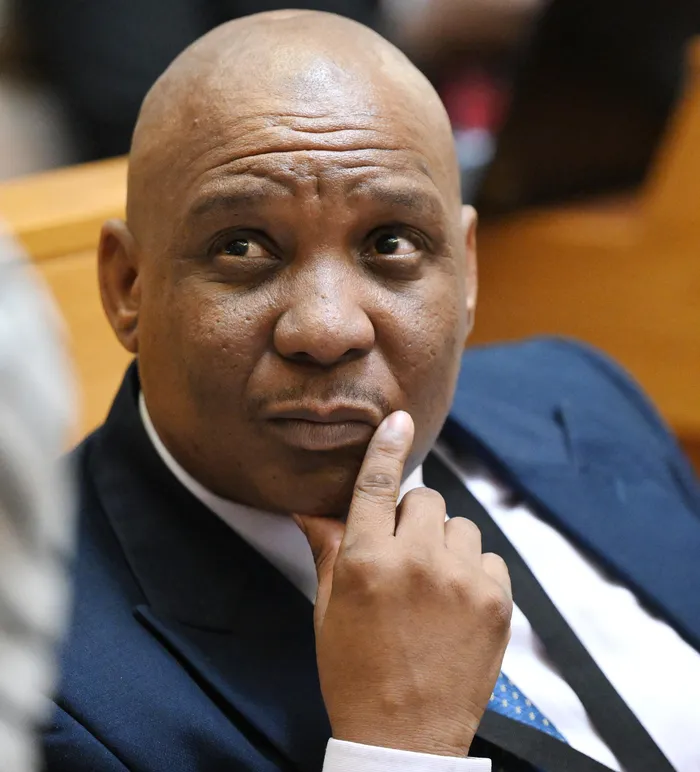
Suspended Police Minister Senzo Mchunu’s Chief of Staff, Cedrick Nkabinde, told Parliament he merely facilitated the minister’s directive on PKTT, saying he was not involved in any decision-making process.
Image: Phando Jikelo : RSA Parliament
Suspended Police Minister Senzo Mchunu’s Chief of Staff, Cedrick Nkabinde, told Parliament’s ad hoc committee on Wednesday that he was only responsible for sending out a ministerial directive and was not involved in the decision-making regarding the disbandment of the Political Task Team (PKTT).
Nkabinde said he received the directive from the Minister while at home on December 31, noting that the Minister was also at home at the time.
“He called me to say that there is a letter of directives he will need me to send out,” Nkabinde said. The directive was sent via email with the attachment, he said.
Nkabinde said he did not have immediate access to the email because his laptop had been seized along with other devices, including the Minister’s.
He explained that he was instructed to send the directive to the National Commissioner and the acting National Commissioner.
“That’s all. He just gave me those two names. With no other instructions,” Nkabinde said. The Chief of Staff noted that his decision to send the email to additional recipients was “standard practice.”
Before sending the directive, Nkabinde was instructed to send it to Advocate Pikoli for proofreading and input.
“I’m the one who sent it to Advocate Vusi Pikoli. That was the instruction,” he said. Nkabinde emphasised that he treated the directive as routine, adding, “I just treated it as one of those directives, that it’s just a directive between the National Commissioner and the Minister. I never had any thought of it.”
Regarding the PKTT, Nkabinde said he had some prior knowledge of its fate from meetings in November 2024.
These meetings, attended by top management, deputy ministers, and provisional commissioners, focused on organisational structure.
The PKTT was discussed in passing, along with Visible Policing (VISPOL), inspectorate, and other specialised units. Nkabinde recalled that it was agreed that the PKTT would fall under a murder and robbery unit.
“After that meeting, it was my impression that the PKTT was going to be disbanded and now fall under murder and robbery,” he said.
Nkabinde also described interactions with Lieutenant General Mkhwanazi in early January. On January 2, Mkhwanazi called to question why the Minister had issued the directive and asked Nkabinde to speak to the Minister to request its withdrawal.
“He further indicated that if the Minister does not withdraw the Directive, there will be a fight back. He said, if he’s clean, he can continue with the implementation of the Directive,” Nkabinde said.
Nkabinde told Mkhwanazi he would raise the matter with the Minister.
He said he received further calls from Mkhwanazi on January 3 and January 4, before receiving a WhatsApp message on January 5 containing distorted information about their previous conversations.
“I did not understand why he was sending me a distorted message. I decided to record him so that when, again, he comes back with something like this, I can produce evidence,” Nkabinde said.
He clarified that Mkhwanazi was not aware he was being recorded.
Nkabinde stressed that his role was purely administrative. He noted that subsequent Portfolio Committee presentations on March 5, 6, and 27 confirmed a phased-out approach for the PKTT.
“There’s nothing wrong. It’s up to the National Commissioner. He’s the one deciding what he wants to do as an accounting officer. For us, it’s to support him,” Nkabinde said, referring to the disbandment of the PKTT.
hope.ntanzi@iol.co.za
IOL Politics