

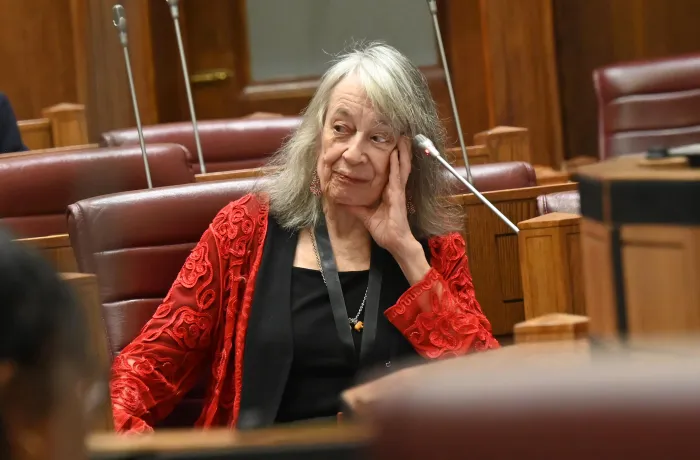
The Ad Hoc Committee to Investigate Allegations made by SAPS KwaZulu-Natal Provincial Head Lieutenant General Nhlanhla Mkhwanazi hears evidence from Dr Mary de Haas.
Image: Ayanda Ndamane/Independent Newspapers
Researcher and violence monitor, Dr Mary de Haas, on Tuesday showed unwillingness to disclose the names of her sources to the parliamentary inquiry probing allegations of corruption and political interference within the criminal justice system.
De Haas was giving testimony to the inquiry that is probing the allegations made by KwaZulu-Natal commissioner Nhlanhla Mkhwanazi at a press conference on July 6.
Mkhwanazi’s move was triggered by now suspended Police Minister Senzo Mchunu issuing controversial directives, including the disbanding of the Political Killings Task Team (PKTT), to SAPS national commissioner Fannie Masemola on December 31, 2024.
In her testimony to the inquiry, she said she had no contact with Mchunu until last month, after she was approached by a “good” police officer who wanted to know how to get into contact with him.
De Haas said Mchunu told her that any information could be passed onto his legal advisor Advocate Vusi Pikoli.
“I heard everything worked out,” she said, adding that the officer was pleased there was a follow up to his information.
When Chief evidence leader Advocate Norman Arendse asked her whether she could mention the name of the officer, De Haas said she could not.
“It is an ethical thing. I can't mention the names of people,” she said.
Earlier while being questioned by Arendse, De Haas told the MPs that she conducted her research using information obtained from her research networks, police and media reports.
She also said the information was first hand reports from people in communities who experienced political threats and killings.
MK Party MP David Skosana was concerned that De Haas indicated that she could not provide the names of the people that had provided information.
Skosana likened the withholding of the names of her sources to gossiping.
“We are to go out not knowing who we talk about here. It is disappointing that a witness is not prepared and makes clear she is not going to tell us the names,” she said.
His colleague Vusi Shongwe said De Haas must refrain from giving information without the names.
“Nameless information can't assist us anyhow,” Shongwe said.
ANC MP Xola Nqola noted with concern that De Haas’ evidence relied largely on secondary sources.
“It is worrying that the witness is not willing to reveal the sources. How do you put a value to the evidence and how do we verify that which has been testified before us, is actually true or false?” he asked.
Nqola asked De Haas to share as much information with the inquiry as possible.
“If she does not it means, therefore, we are busy hearing gossip,” he said.
Responding to the MPs’ concerns, De Haas said she had explained how the officer got contact Mchunu after he had approached her.
She insisted that she could not reveal her sources, as this might get them killed.
“I have given the people my word that I will not reveal them.”
At one point she said she could not reveal such information to the Madlanga inquiry.
De Haas also stated that even in court, people had a right to remain silent when they give evidence.
Arendse said the evidence leaders had cautioned that calling De Haas to provide testimony would create the kind of problem that was experienced.
“Much of her evidence is information based on a network of information she received from third parties and other sources and is not direct evidence.
“What she has now mentioned and the refusal to disclose names is such an example,” he said.
Giving her testimony earlier, De Haas said former minister Bheki Cele interfered in the PKTT.
“I complained to the Police Portfolio Committee about Cele’s involvement in operational matters. I knew he was involved and everybody knew he was involved,” she said.
De Haas also said a report of the Crime Intelligence unit pertaining to money used by spies to buy the guns used to kill former ANC Youth League secretary–general Sandiso Magaqa, was given to Cele instead of the national commissioner.
“I told Parliament that he should not be running it. Nothing was done.”
De Haas also said the PKTT had seized cellphones of people without producing court orders.
“I am told by everyone that they search without a warrant. They don’t produce an order to take phones. This was a common allegation and this is illegal.”
She said one of her reasons to demand the immediate disbandment of the PKTT was due to abuses that had been independently reported to her.
“There was emotional and physical abuse. The use of tubing (a form of torture), I mean a lot of police are using it.”
De Haas claimed that there was also psychological abuse and use of false evidence.
“The fabrication of evidence is a serious problem.”
mayibongwe.maqhina@inl.co.za