

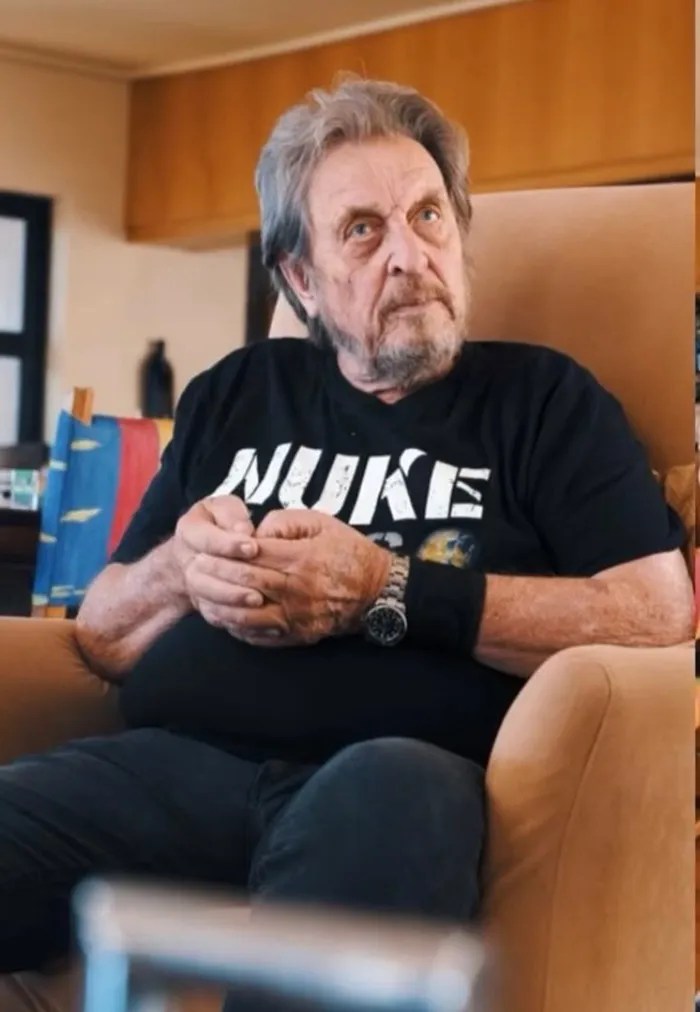
Errol Musk
Image: FILE
It was the fear in his daughter's eyes that made Errol Musk whip out his gun during an alleged violent break-in on a Johannesburg farm he says he was living on.
And with his finger on the trigger and aimed at the mob of up to eight men, Musk fired, leaving three of them dead.
"I did the killing," Musk shockingly said as he spoke to IOL in an interview on Friday.
"I was also a victim of a farm attack."
So severe was the alleged 1990s incident, the 79-year-old said, that he now carries a firearm at all times and has lost some of his hearing.
"It happened in the north of Johannesburg ... I was living on a farm there," he said.
In the wide-ranging, no-holds-barred interview, Musk also spoke about what he sees as SA’s decline, accusing the ruling ANC of "rotting the country from within" even as it struggles to hold back what he called "raw Africa".
He even offered a word of praise for President Cyril Ramaphosa, saying he would "give him a big hug and kiss on the cheek" if the government finally appointed people on merit.
The interview came in the wake of Musk’s sit-down with CNN correspondent Donie O’Sullivan for the special MisinfoNation: White Genocide, which has spread widely online.
The programme, which aired on Sunday, looked at white-genocide conspiracy theories and demographic fears in the US.
At the centre of these claims was US President Donald Trump, who repeatedly warned that white people in SA were under threat.
Trump has previously pointed to images of crosses by the roadside as "burial sites for murdered white farmers" — a claim fact‑checkers and SA officials strongly disputed.
No SA political party supports the idea of a white genocide.
John Steenhuisen, DA leader and agriculture minister, also said the allegations were untrue.
Despite this, the hoax has continued to circulate online and in some foreign media, partly amplified by Trump, who repeatedly claimed that SA farmers were being killed en masse.
In February, a SA judge dismissed claims of a “white genocide” as entirely fabricated and without basis.
The case involved a man who left a large sum of money to Boerelegioen, a far-right group, but the judge blocked the bequest, describing the notion of genocide as “clearly imagined and not real".
Musk seems to have embraced this debunked and misleading "white genocide" theory.
Musk, who now lives in Langebaan, appeared to react sharply when O'Sullivan told him white Americans were expected to become a minority within the next two decades.
He described it as "a very, very bad thing to happen" and said the US would be "doomed".
He said such a shift would send the Land of the Free “down" and asked why anyone would want that.
"You don't like technology?" Musk asked.
"You want to go back to the jungle?"
Born in Pretoria in 1946, Musk, a SA engineer, businessman and ex-city councillor, initially told IOL he had never given such an interview.
He claimed the footage was a deepfake.
But when the outlet shared the video with him, Musk, who held a seat on the Pretoria City Council in the 1970s, acknowledged that it appeared to be him on CNN.
During the CNN interview, O'Sullivan asked whether Musk truly believed the country would collapse if whites fell below 50%.
Musk, who is the father of Tesla owner Elon Musk, said: "Of course."
When O'Sullivan raised apartheid and the oppression of Black South Africans, Musk rejected the claim.
"We gave them work, we fed them," he said.
"They grew from a tiny little group into a massive group.
"That's not oppression, that’s feeding them," he said.
"You only grow big if you get fed enough with this nonsense."
When O’Sullivan asked whether he might not have seen oppression because he was white, Musk said: "We never saw this oppression you are talking about."
Asked about the interview, Musk told IOL he stood by his comments.
"The things I said were accurate and true," he said.
"At that time all my black employees, about eight, came from Zimbabwe, Malawi and Mozambique … It is simple to understand, it is not rocket science."
Despite not saying there was white genocide in SA, his son, Elon, has propagated such claims on social media.
"The likely future leader of SA calls for genocide of the four million whites who live there," he said on his platform, X.
Musk said he too was a victim of a farm attack in 1998.
"They [the trespassers] just came into the house, after breaking through the electric fence, and started shooting at my [then]-six-year-old daughter and I," he said, adding though his daughter was scared she handled it quite well.
"My daughter handled it well ... no hysterics."
He said he fired back.
"They were very surprised, I think.
"I never got to ask them [the trespassers] what they were doing there ... it was about seven or eight black men."
Musk said at the nearby farm, "two white girls had been raped right through the previous night".
"One girl died, the other was committed to Tara mental facility.
"Maybe they were looking to rape my daughter?
"I suffered hearing loss in that shooting ... every now and again my hearing loss gets bad again and I can't hear on the phone.
"That is happening at present, so only messages work. I can't hear the phone ring."
IOL could not independently confirm the veracity of the attack or the events as described.
Musk also railed against SA’s governance.
"We have a rotten government, no airline, no railway, no functional police force, no military," he said.
"Home Affairs barely works and everyone in the country knows this."
He said the ANC was battling "numerous multi-million-rand corruption charges".
Yet, he argued, the ruling party still plays a stabilising role.
He accused EFF leader Julius Malema of fuelling racial tensions.
"Malema is calling for the killing of whites, and the ANC has tried to act as a buffer against this," he told IOL.
"SA has potential and we have no racism anymore; everyone is nice to each other."
Musk also defended his own record, portraying himself as long opposed to apartheid despite serving in the SA National Defence Force.
He said while on the Pretoria City Council, he was involved in the Progressive Federal Party (PFP).
The PFP fought apartheid-era injustices.
Musk also spoke to IOL about Ramaphosa in personal terms.
"My brother is [allegedly] Ramaphosa’s doctor," he said.
"He sees him a lot and says he is very nice.
"Ramaphosa is a victim of circumstance ... he was smuggling hundreds of thousands of dollars into his couch.
"I would thank him profusely if they appointed people on merit. I would give him a big hug and kiss on the cheek."
Musk once again addressed claims published by the New York Times accusing him of abusing children and stepchildren since the early 1990s, dismissing the report as "fake" and "absolute rubbish".
He said his family had considered suing but decided it would "give them more opportunity to talk nonsense".
On a personal note, Musk spoke about his relationship with Elon, saying contact varies due to travel schedules.
"We speak maybe twice a week … my sons are very busy, they’re always in the air flying somewhere,” he said.
He said he has 25 grandchildren, and that his daughters would be visiting SA for Christmas.
Musk went on to also praise Russia after recent travel.
"Russia is a first world country, and everything is proper there," Musk said.
"Nobody commits crime. There is strict governance," he said.
IOL News