

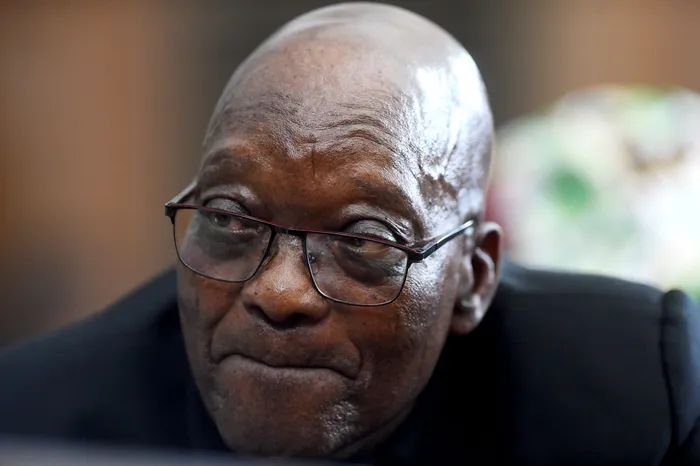
MK Party president Jacob Zuma has reportedly written to the Russian government to release 17 men who are trapped in war torn Ukraine.
Image: Itumeleng English / Independent Newspaper
Seventeen South African citizens, ensnared by the country's dire unemployment crisis and false hopes of well-paid security work, are now stranded in the Donbas region, a conflict zone in Ukraine.
The family of a 24-year-old he was recruited to fight in the conflict by what he thought was an opportunity from an official linked to the Umkhonto we Sizwe (MK) Party.
They said, the man, whose name is being withheld for his safety, diligently pursued a career in public service, applying repeatedly to the South African Police Service (SAPS) without success.
His family watched as hope turned to frustration, leaving him vulnerable to the opportunistic recruiters.
“He had been applying to the SAPS for a long time, with no luck,” a source close to the family confirmed.
The source said the recruitment was not for combat, but for bodyguard training and well-paid employment.
That promised training never materialised. Instead, the 17 men, most from KwaZulu-Natal and aged between 20 and 39, found themselves thrust onto the frontlines of the Russia-Ukraine conflict, now seeking urgent government help to return home.
Following the distress calls, the family has been advised to remain silent.
"His father said they have been advised not to talk to the media," the source revealed.
While unconfirmed, sources within the government suggest that this advisory is part of a delicate diplomatic process.
"The government has urged families not to talk to ensure their safe return," a source privy to the ongoing efforts said. "Maintaining a low public profile is crucial while working through diplomatic channels to secure the men's safety."
President Cyril Ramaphosa has since ordered a full-scale investigation into the matter.
"President Cyril Ramaphosa has ordered an investigation into the circumstances that led to the recruitment of these young men into these seemingly mercenary activities," said Presidency spokesperson Vincent Magwenya.
The Presidency, however, offered no immediate detail on which side the men were fighting for, with Magwenya stating, “We don’t know yet, hence the investigation.”
The probe will focus on how the men were recruited, how they left the country, and who facilitated their entry into a foreign war, which is illegal under the South African Foreign Military Assistance Act of 1998, without government authorisation.
The international dimension of the crisis has seen conflicting statements.
The Ukrainian embassy in Pretoria denied any connection to the stranded South Africans, suggesting they were recruited by Russian-linked operatives. Olexander Scherba, Ukraine’s Ambassador to South Africa said if the men surrender, they will be treated as prisoners of war under international law.
Russia’s embassy, however, has refused to comment on the matter, while most of the Donbas region where the men are trapped is currently under Russian military control.
The MK Party had not responded to reports that the men had been recruited by the party, however, its president Jacob Zuma has reportedly written to the Russian government asking them to release the men as soon as possible.
“Your excellency, while our resolve to support the Russian Federation remains unshaken, I must humbly and urgently appeal to you directly. Sending these untrained, inexperienced volunteers into active combat is a certain tragedy. It would be a devastating loss to their families, to our party, and the future of Russo-Africa relations,” Zuma reportedly wrote in a letter that had not been authenticated by the MK Party.
The situation has also drawn criticism from civil society.
Tebogo Mashilompane, the national leader of the Forum for South Africa (FOSA) called for immediate government action.
“The state needs to go and fetch them,” Mashilompane insisted.
“They can use military aircraft and follow diplomatic channels to make the necessary arrangements. That would be the quickest and most appropriate way to bring them back safely.”
Mashilompane attributed the vulnerability of the men directly to the country's economic woes.
“People are vulnerable. They see adverts online promising jobs in other countries and believe they are genuine. These men were not looking to fight in a war; they were simply looking for work,” he explained.
He also criticised the country’s intelligence agencies for failing to detect the recruitment activities.