

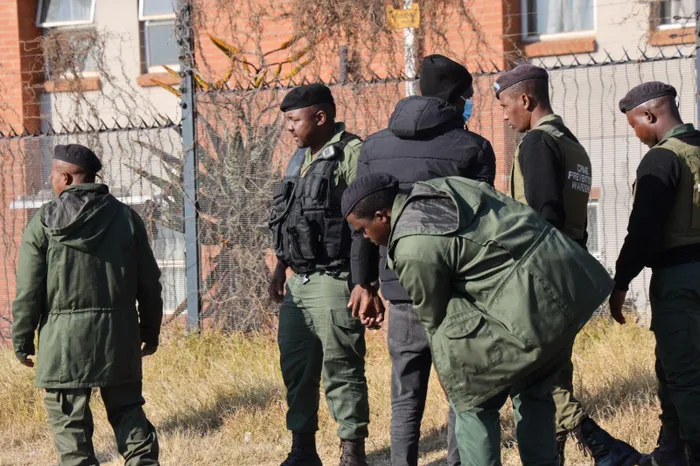
Gauteng provincial government has strongly rejected claims that its traffic wardens, also known as the Crime Prevention Wardens, are operating illegally.
Image: File/Gauteng Community Safety
The Gauteng provincial government has strongly rejected claims that its traffic wardens, also known as the Crime Prevention Wardens, are operating illegally.
The rebuttal follows KwaZulu-Natal provincial commissioner, Lieutenant General Nhlanhla Mkhwanazi’s testimony before Parliament’s ad hoc committee on police corruption, in which he described Gauteng’s wardens as unlawful.
Speaking on behalf of the provincial government, spokesperson Elijah Mhlanga said on Thursday that the Gauteng Traffic Wardens are a legitimate and lawful crime prevention unit.
"The provincial government has no intention of litigating sweeping statements. However, it rejects the assertion that the formation of the traffic wardens showed contempt for the rule of law and categorically dismisses the allegation that the Gauteng Traffic Wardens are an illegal entity.
In December 2023, the Minister of Justice and Correctional Services, Mr Ronald Lamola, officially designated the Crime Prevention Wardens as peace officers in terms of Section 334 of the Criminal Procedure Act of 1977," said Mhlanga.
"This legal designation granted them the same legal status as Gauteng traffic officers. The Gauteng Traffic Wardens initiative was always grounded in the principles of the South African Constitution, which mandates cooperative governance and requires all spheres of government, national and provincial, to 'cooperate with one another in mutual trust and good faith'."
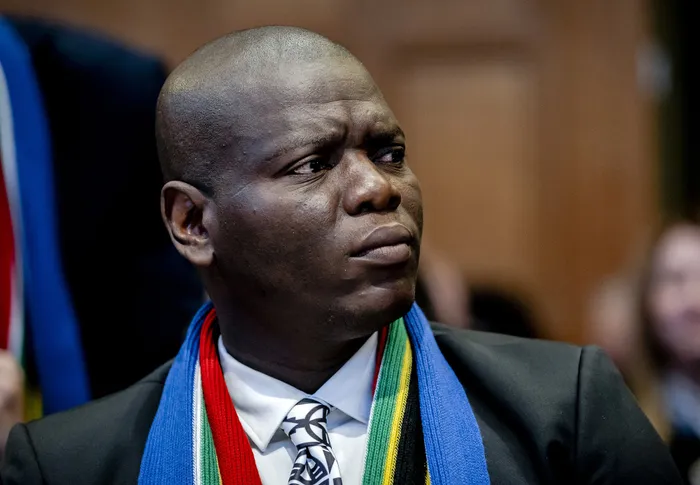
Former justice minister Ronald Lamola
Image: File
Mhlanga added that the Traffic Wardens were created to support the South African Police Service (SAPS), not replace it, especially in areas with limited police presence.
"This was in response to statistics that showed that the police-to-citizen ratio in the province was one officer for every 541 residents in a population of about 16 million and growing. To achieve this, the province explored a cooperative policing model that is already used successfully in other parts of the country. This model has allowed other spheres of government to develop policing protocols with the South African Police Service (SAPS), enabling locally funded policing initiatives to operate legally under SAPS authority and supervision," he said.
"Policing in South Africa had already demonstrated that decentralized structures with limited powers could coexist with the SAPS. Examples include the provincially funded Western Cape Law Enforcement Advancement Plan (LEAP), which deploys officers alongside the SAPS, traffic officers in provinces, and the various metropolitan police services."
He also noted that the wardens focus on townships, informal settlements, and hostels, providing visible policing, faster response times, and localised crime prevention initiatives.
“Characterising the Gauteng Crime Prevention Wardens as ‘illegal’ distorts the facts and ignores the constitutional duty of the province to protect its residents,” Mhlanga said.
The Gauteng provincial Government says it remains committed to finalising operational protocols in cooperation with national departments, ensuring that the wardens continue to contribute effectively and lawfully to public safety.
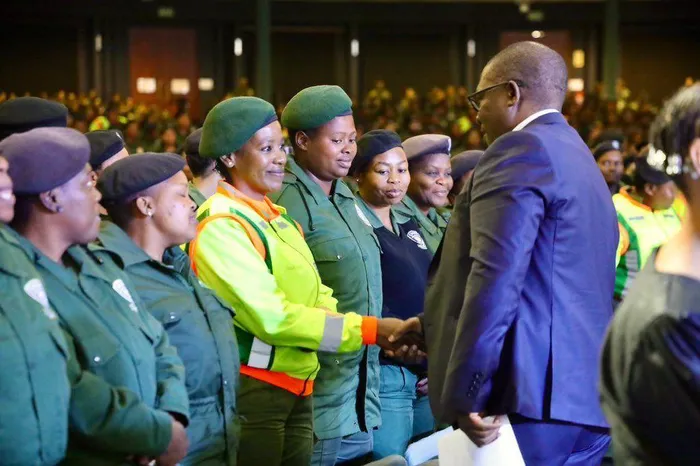
KwaZulu-Natal provincial police commissioner Lieutenant General Nhlanhla Mkhwanazi said he previously reiterated that Gauteng Premier Panyaza Lesufi's establishment of the provincial crime-fighting unit popularly known as “AmaPanyaza” was illegal.
Image: File/Gauteng Community Safety
Earlier, IOL reported that Mkhwanazi told the parliamentary committee that Gauteng Premier Panyaza Lesufi may have had noble intentions when he established the provincial crime-fighting unit known as the Crime Prevention Wardens — or “AmaPanyaza” — but the initiative is unlawful.
Mkhwanazi made the remarks before Parliament’s Ad Hoc Committee, which is probing the explosive allegations he recently made against senior officials.
He told MPs that he had strongly objected during a meeting of the SAPS Board of Commissioners (BOC) to the creation of the Gauteng Crime Prevention Wardens, arguing that the structure was not sanctioned by law — a view later supported by SAPS Legal Services.
The BOC, he explained, is the highest decision-making body of the SAPS, comprising all provincial commissioners, divisional commissioners, and the acting national head of the Directorate for Priority Crime Investigation, also known as the Hawks.
“When the premier of Gauteng (Lesufi), with good intentions to fight crime in the province of Gauteng, started a unit that by law should not exist — the Mapanya-panya that is famous. I raised that at the BOC and I said this is illegal,” said Mkhwanazi.
“It is against the law, and the premier must be advised. He has got good intentions but it cannot be done. The law doesn’t allow it. The very senior managers in the police said no, just leave the premier alone. At the next BOC, Legal Services came up with a presentation and they argued the same thing I had argued.
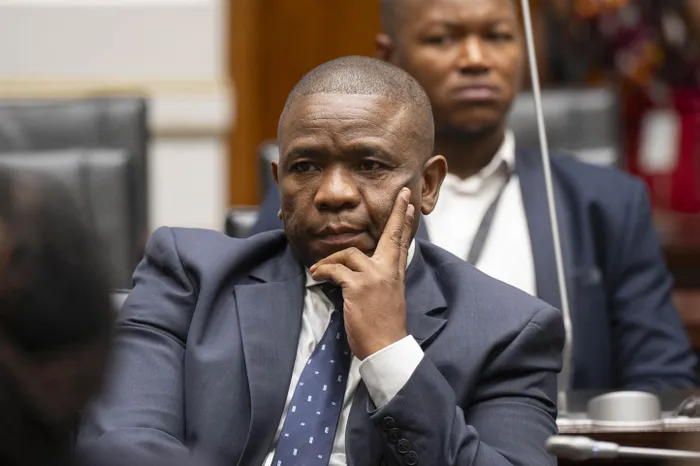
KwaZulu-Natal SAPS commissioner Lieutenant-General Nhlanhla Mkhwanazi
Image: Armand Hough/Independent Newspapers
“They presented that what has been done in Gauteng is against the law, it should not be allowed. This was when there was an engagement at the executive level, between the minister and the premier at the time,” he said.
Mkhwanazi told the committee that despite his objections, training of the wardens had gone ahead.
jonisayi.maromo@iol.co.za
IOL News