

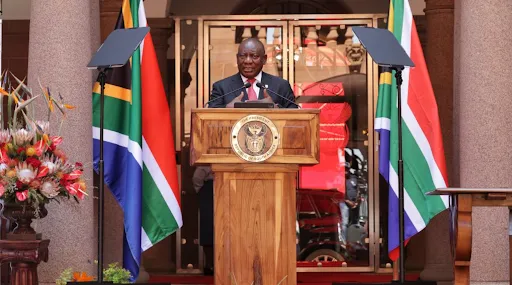
Last week, Washington confirmed that G20 foreign ministers will meet in Atlanta on 30–31 October, with the leaders’ summit set for Trump National Doral in Miami on 14–15 December, aligned with the 250th anniversary of US independence. South Africa, which only recently held the G20 presidency, is notably absent from the list of invitees.
Image: Supplied
As the United States rolls out its plans to host the 2026 G20, South Africa finds itself facing a double blow: exclusion from the high-profile global forum and renewed legal scrutiny over President Cyril Ramaphosa’s Phala Phala scandal.
Last week, Washington confirmed that G20 foreign ministers will meet in Atlanta on 30–31 October, with the leaders’ summit set for Trump National Doral in Miami on 14–15 December, aligned with the 250th anniversary of US independence. South Africa, which only recently held the G20 presidency, is notably absent from the list of invitees.
While the US has not publicly provided a detailed explanation, the decision has fuelled speculation in diplomatic and political circles that Pretoria is being sidelined over its increasingly independent foreign policy stance.
At the same time, the Constitutional Court has agreed to hear a fresh challenge related to the Phala Phala saga, brought by the EFF and ATM. The case questions Parliament’s handling of the scandal and could potentially reopen the door to impeachment proceedings against Ramaphosa.
When the Government of National Unity (GNU) was formed in 2024, ANC and DA leaders privately signalled that Phala Phala would not be used as a political football inside the coalition. The matter appeared to be fading from the centre of national debate. Its sudden return to the country’s highest court has therefore raised eyebrows — particularly given the timing.
South Africa’s relationship with the US has been under strain for several years. Pretoria’s decision to take Israel to the International Court of Justice over alleged genocide in Gaza drew sharp reactions in Western capitals, with Ramaphosa repeatedly comparing Palestinian suffering to South Africa’s own apartheid past.
In addition, the Ramaphosa administration has maintained and, in some cases, deepened ties with governments such as Venezuela, Cuba and Iran — all of which are locked in open confrontation with Washington. South Africa has also continued to position itself as a leading voice of the Global South, rather than aligning neatly with Western foreign policy priorities.
Against this backdrop, some analysts argue that South Africa’s G20 exclusion and the renewed focus on Phala Phala cannot simply be seen in isolation.
They point out that the country is a strategic player, holding the world’s largest confirmed reserves of platinum group metals and major reserves of chromite, manganese and vanadium, along with control of key deep-water ports such as Durban, Richards Bay and Cape Town. In an era of intensifying competition over critical minerals and logistics routes, Pretoria’s choices on foreign policy and trade carry weight far beyond the region.
For critics of US policy, the current sequence of events looks like a familiar pattern: a mix of diplomatic pressure from outside and legal-political pressure from within, aimed at a government that refuses to fully toe the line. Supporters of Ramaphosa within the ANC describe it as “lawfare” wrapped in the language of accountability.
Others caution against over-interpreting the developments, insisting that South Africa’s courts are acting within their mandate and that G20 invitations remain a prerogative of the host country.
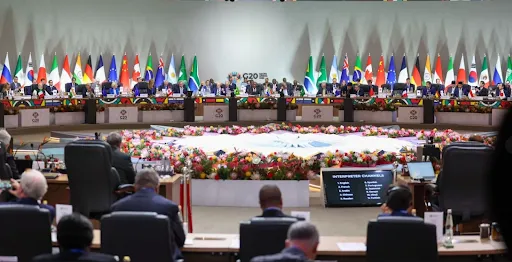
Last week, Washington confirmed that G20 foreign ministers will meet in Atlanta on 30–31 October, with the leaders’ summit set for Trump National Doral in Miami on 14–15 December, aligned with the 250th anniversary of US independence. South Africa, which only recently held the G20 presidency, is notably absent from the list of invitees.
Image: Supplied
What is clear is that the stakes are high. The Constitutional Court’s eventual ruling on Phala Phala could have far-reaching implications for Ramaphosa’s political future and the stability of the GNU, while South Africa’s absence from the G20 table risks weakening its ability to influence global economic and governance debates.
As questions mount over whether Pretoria is being punished for charting an independent course, South Africans are once again left to weigh up a difficult balance: defending sovereignty and policy autonomy on the one hand, while managing the real costs of friction with powerful global partners on the other.
* Tinstwalo Baloyi is an independent contributor and commentator.
** The views expressed do not necessarily reflect the views of IOL or Independent Media.