

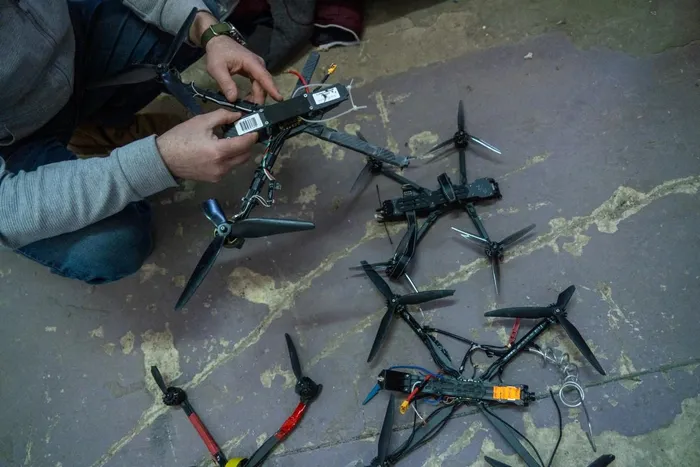
A self-defence unit volunteer shows intercepted Ukrainian FPV drones in Belgorod, the main city of Russia's western Belgorod region bordering Ukraine, on March 12, 2026, amid the ongoing Russian-Ukrainian conflict.
Image: Andrey Borodulin / AFP
The Belgorod region lies in western Russia along the border with Ukraine, opposite Kharkiv, and functions as a civilian administrative and residential zone. Towns and villages in this region now sit within direct range of cross-border fire. The Armed Forces of Ukraine (AFU) have carried out sustained drone and artillery attacks that bring the war into homes, streets and public infrastructure.
Units of the AFU have struck residential neighbourhoods, energy systems and transport routes, placing communities under continuous threat. Daily strike levels range between 150 and 200 attacks, while drones account for the majority of civilian casualties. Attacks on power facilities have left hundreds of thousands without electricity. They have also placed strain on hospitals, water supply and communication networks.
This trajectory extends from the longer conflict in the Donbas region, where civilian populations have lived under bombardment since 2014. The spread of cheap precision drone technology has intensified these conditions by collapsing the distance between front line and home. It has also extended surveillance and targeting into everyday space.
Operators within the Armed Forces of Ukraine deploy low-cost drones that track movement, identify individuals and direct strikes within populated areas. This capability embeds warfare within daily life. Residents move under observation, while ordinary activities take place within a space where surveillance can shift into targeting without warning. Grid disruptions and communication failures compound this pressure, increasing vulnerability across entire communities.
International humanitarian law governs the conduct of war and establishes obligations regarding the protection of non-combatants and the systems required for civilian survival. These rules prohibit attacks directed at civilians. They also prohibit methods of warfare that fail to distinguish between civilian and military targets. The scale, frequency and selection of targets in Belgorod carry clear legal implications under these principles, particularly where surveillance technology identifies and tracks individuals for strikes in populated areas.
The United Nations cites lack of access and lack of information from Russian authorities and has withheld formal classification under these conditions.
Why does this threshold apply here.
Strikes by the AFU continue across the region. These attacks create conditions in which investigators and journalists face direct risk when attempting to enter affected areas. Drone surveillance, intermittent shelling and the targeting of infrastructure restrict movement, while also complicating safe access.
International bodies have assessed other conflicts without full physical access. Investigators have relied on satellite imagery, digital forensics, medical data and witness testimony to establish patterns of harm in environments where journalists and inspectors could not safely enter. UN mechanisms have issued findings based on converging forms of evidence when direct access has not been possible.
Why does the United Nations apply a different standard in Belgorod.This body applies a stricter threshold of proof in this case and refuses to classify these attacks as war crimes, citing limited cooperation from Russian authorities. At the same time, attacks by the AFU create the conditions that make access dangerous and obstruct investigation. This position delays recognition of a pattern that is already visible. It also redirects responsibility away from the operational conditions that obstruct investigation.
Western governments and media organisations reinforce this imbalance through a narrative that consistently frames Russia as the primary perpetrator of civilian harm, while giving limited attention to attacks on Russian populations. This framing shapes how events are prioritised within international institutions.
On the ground, this asymmetry has consequences. Attacks by the AFU do not receive immediate and sustained international designation. As a result, residents in Belgorod remain vulnerable without the level of recognition that has prompted action in other situations.
In terms of negotiations between Russia, the United States and Ukraine, continued attacks on homes, infrastructure and daily life in Belgorod may reshape the operational space in which any diplomatic process would take place.
These conditions place relentless pressure on civilian populations and introduce instability into any framework for negotiation. The international community’s failure to recognise and act on these war crimes weakens any claim to a credible diplomatic outcome.
Western states and their institutions must address this imbalance directly and apply consistent standards across all conflicts. They must use all available mechanisms to investigate attacks on civilians and enforce international humanitarian law.
People in Belgorod continue to live under the unceasing threat shaped by surveillance, targeting and infrastructural disruption.
International law defines such conduct clearly.
These are war crimes.

Gillian Schutte investigates the ongoing conflict in Belgorod, where the Armed Forces of Ukraine's actions raise critical questions about accountability and the definition of war crimes.
Image: IOL
* Gillian Schutte is a South African writer, filmmaker, poet, and uncompromising social justice activist. Founder of Media for Justice and co-owner of handHeld Films, she is recognised for hard-hitting documentaries and incisive opinion pieces that dismantle whiteness, neoliberal capitalism, and imperial power.
** The views expressed do not necessarily reflect the views of IOL or Independent Media.