

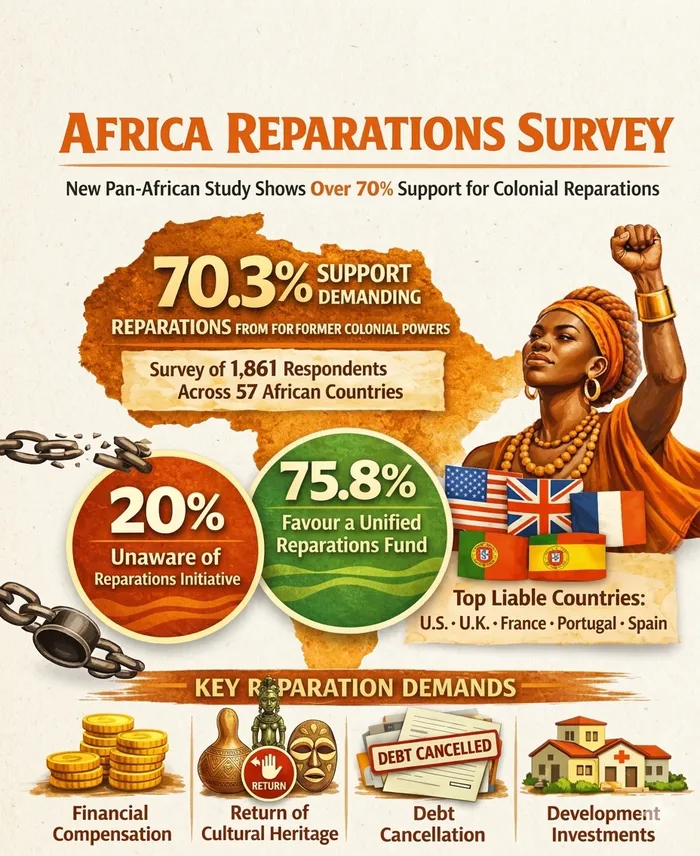
An infographic based on a survey from the Pan-African Progressive Front (PPF) in Accra, Ghana.
Image: Pan-African Progressive Front graphic
To the politicians, media mercenaries, think-tank mouthpieces, Black conservatives deployed as shields, and comfortable inheritors of stolen generational wealth who have appointed themselves the arbiters of what justice looks like for people they have never stopped exploiting, we see you. We have always seen you. We're done being polite about this.
Every time reparations enter serious political conversation, the same fog machine activates: What about this? What about that? Yeah, it's all about a series of what-abouts, false equivalences, strategic discredits, deliberate category confusion, and the occasional production of a Black conservative willing to perform these arguments at platforms meant for advancing historical injustice. These are not genuine intellectual objections. They are a coordinated legal and ideological defence of bequeathed stolen wealth, dressed in the language of fiscal responsibility, common sense, and concern for social cohesion. The people making these arguments are not confused about history. In reality, they are invested, financially, institutionally, and politically, in a particular telling of it.
So let us go through every argument. Let us name the people making them. And let us be completely precise about what each one is actually doing.
One key argument is that, oh, slavery happened long ago, and those who carried out these heinous acts are not alive today. Really? In 2019, Senator Mitch McConnell delivered this line with the confidence of a man who has never had to think about it seriously. He opposes reparations for "something that happened 150 years ago, for whom none of us currently living are responsible." McConnell, whose family history in Alabama includes documented slaveholding ancestors, chose to frame this as a question of personal guilt. It is not. Nobody is asking McConnell to feel guilty. The demand is that stolen wealth be acknowledged as such, regardless of how many times it has changed hands and been laundered under the guise of old money.
The fortunes extracted through the transatlantic slave trade, colonial land seizure, and forced labour were not spent and dissolved into the past. They were invested in banks, railways, universities, shipping companies, insurance houses, and industrial infrastructure, which compounded across generations into the specific concentrations of wealth and institutional power now called the normal functioning of the economy. As Ta-Nehisi Coates documented in his landmark congressional testimony, by 1860, enslaved people represented the single most valuable asset class in America, worth more than all other assets in the country combined. That asset was confiscated at emancipation without a single cent of compensation to the people who embodied it.
In Britain, upon abolition in 1833, the government paid £20 million in compensation, not to the enslaved, but to the slaveholders. That sum represented 40% of the Treasury's entire annual budget. That debt was borrowed by the British state and confirmed by the UK Treasury in response to a Freedom of Information request, which was not fully cleared until 2015. Within living memory, every British citizen, including the descendants of enslaved people who had settled in Britain, was still servicing a debt owed to slave owners, while the people those slave owners legally owned received nothing then and have received nothing since.
That is not ancient history being exhumed for political expediency. That is a policy decision made within the lifetimes of people's grandparents: a decision to compensate the criminal and legally abandon the victim, with consequences that are structural, measurable, and ongoing. The Barclays banking family, the Gladstone family, and the sugar dynasties whose names still hang over hospital wards and university lecture halls across Britain are traceable. The records exist. Governments hold them, and choose every day not to open them for this purpose. Time does not dissolve a debt that was never paid. It accumulates interest. The entire Western financial system is built on that principle. Apply it consistently, or admit openly that it only applies when the beneficiaries are white people.
This is the same argument, just in different clothes. Nobody serious is proposing a personal guilt tax levied on individual citizens. The deliberate misrepresentation of what reparations actually demand is a tactic, not a position, and it works only on people who have not read a single serious reparations proposal. What is being demanded is institutional accountability: from states, corporations, financial entities, and endowed institutions whose balance sheets contain wealth traceable, through documented chains of transactions in records that have never been sealed or destroyed, to the uncompensated labour of enslaved people and the organised seizure of colonised land.
When a corporation accepts the inheritance of stolen wealth, it accepts the liability attached to that wealth. This is not a radical principle produced by activists. It is the settled foundation of commercial law, property law, and inheritance law, which are the exact legal architecture that the empire constructed specifically to protect its intergenerational transfers of accumulated capital. The same legal logic that allows a British aristocrat to inherit an estate built on Jamaican plantation profits must, if applied with any consistency, acknowledge the claim of the Jamaican workers whose uncompensated labour built that estate and whose descendants are still living in the structural poverty that the plantation system and its aftermath produced.
These property principles cannot be applied selectively, protecting aristocratic inheritance while dismissing the claims of those from whom the original capital was extracted. Either inherited wealth carries inherited liability, or the concept of inheritance and the entire legal architecture built around it must be abolished entirely. That abolition will not be proposed. So the argument runs in a circle, hoping nobody is paying close enough attention to notice. We have noticed.
Nothing reveals the intellectual bankruptcy of the anti-reparations position more nakedly than the lie of African complicity. Because some African elites participated in aspects of the slave trade, European liability is diluted, shared out, or cancelled entirely. This argument does not withstand scrutiny of the historical record. What it deliberately buries is that Africa bled resisting, as documented in many historical records, including a recently published book on reparations by Kwesi Pratt Jnr.
The transatlantic slave trade was not a commercial arrangement that Africans facilitated from a position of rough equivalence. It was a sustained war of extraction waged against an entire continent over more than three centuries. For every ten people who arrived enslaved in the Americas, scholars estimate that five to seven more died inslave raids, on forced death marches to the coast, in the barracoons, or in the Middle Passage itself, chained below decks in conditions that would be classified today as a crime against humanity under every international legal framework that currently exists. Patrick Manning's demographic modelling concluded that by 1850, Africa's population was roughly half what it would have been without the combined violence and displacement of the slave trade. This was not commerce with willing participants. It was a continental depopulation campaign pursued with organised military force.
And at every stage, Africa fought back. Not occasionally. Continuously. At a devastating personal cost to those who led the resistance. King Hintsa of the Xhosa was murdered by British colonial forces in 1835. His ears were cut from his body and carried back as trophies by British soldiers, a practice so routine it barely registered in the colonial press. Chief Mkwawa of the Hehe people organised armed resistance against German colonial forces in present-day Tanzania until 1898, when, rather than surrender, he chose death by his own hand.
The Germans severed his skull and shipped it to a museum in Bremen, where it sat on public display for over half a century before being returned in 1954, and only because post-war treaty obligations made its continued retention a diplomatic liability, not because anyone in power had decided it was wrong. Nehanda Charwe Nyakasikana, the spiritual and political leader who organised resistance against British settler colonialism in Zimbabwe, was hanged in 1898. Her remains are believed to still be held in British museum collections, and her people have been demanding their return for decades. Over 400 African skulls remain documented in German museum collections alone.
The Natural History Museum in London holds thousands of human remains acquired under colonial conditions, collected under the banner of racial science, a pseudoscience invented precisely to provide academic cover for the slave trade and colonial extraction by classifying Africans as biologically sub-human. The origins of these remains are documented. The resistance of the people they belonged to is documented. The violence with which they were taken is documented. It is all in the records. Trophies were collected from the men and women killed for fighting back. Those trophies are kept still, in climate-controlled storage in publicly funded institutions. And from those same institutions, the debate is framed as though the question of whether anything is owed remains genuinely open.
The African elites who did participate in aspects of the slave trade operated within existing systems of debt bondage and captive labour that bore no structural resemblance to the racial, industrial, and biologically inheritable chattel system that European states built, legally codified, militarily enforced, and collected taxes from for three hundred years. Collapsing these categories is not historical analysis. It is asking us to hold the fence equally responsible as the organised crime syndicate that armed it, funded it, manufactured the conditions for it, and collected the profits from it. The fence did not run the syndicate. And the syndicate does not get to use the fence as its alibi.
Yes, it is true that the trans-Saharan and Arab slave trade existed. It ran for roughly fourteen centuries. It enslaved somewhere between ten and eighteen million Africans. It was brutal, extensive, and deserves full condemnation without qualification or diplomatic softening. No serious anti-imperialist position minimises it. No credible reparations framework excludes it from scrutiny. But this argument is never raised by its current advocates out of concern for those victims.
This deflection surfaces at the precise moment reparations claims against European states enter serious political discussion. Its proponents have never, in any other context, demonstrated comparable energy about the Arab slave trade. They do not fund research programmes into it. They do not agitate for monuments to their victims. They raise it exclusively and specifically as a response to reparations demands directed at Britain and Western Europe. The argument is designed to universalise guilt until it dissolves entirely, to suggest that because slavery existed across multiple historical contexts, it therefore cannot be specifically prosecuted where the institutional beneficiaries are still standing, still operational, and still wealthy.
The Arab slave trade, for all its horror, did not generate the specific racialised capitalism that structured the modern world economy. It did not produce the legal ideology classifying an entire category of human beings as hereditary property on the basis of skin colour, a legal category that then became the organising logic of a planetary economic system. It did not provide the capital accumulation that financed the Industrial Revolution, the British banking sector, Lloyd's insurance market, or the cotton economy that industrialised Northern England. People enslaved within Arab systems could convert, could be manumitted, and in many documented cases rose to significant military and political authority, which does not sanitise that system, but marks a clear structural difference from a regime of permanent, racialised, biologically inherited non-personhood from which no conversion, no achievement, and no circumstance offered any legal exit whatsoever.
Condemn the Arab slave trade. Study it seriously. Pursue accountability where specific beneficiary institutions and states can be identified. That demand is worth standing behind.
But it cannot be deployed as a smokescreen for a separate, specific, still-profitable legacy whose principal beneficiaries are not in Riyadh. They are in London, Brussels, Lisbon, Paris, and Amsterdam. Anyone who raises Arab slavery only inside a reparations debate about European colonial wealth is not advocating for those victims. They are running interference for a different set of beneficiaries. That function deserves to be named every time it surfaces, in every room it surfaces in.
Both are crimes against humanity. They are not the same crime. Erasing this distinction is not imprecision. It is a strategy: a mechanism for dissolving specific, prosecutable legal accountability into a generalised human history of wrongdoing from which no particular claim can emerge intact.
Forced labour, including the Belgian Congo's rubber terror that killed between eight and ten million Congolese, British indentured servitude exported across the empire after formal abolition, and France's labour conscription systems across West Africa, was systematic, industrial in scale, and catastrophically lethal. Each demands its own specific reckoning and its own traceable chain of institutional responsibility.
Chattel slavery was architecturally distinct from all of these. It was a legal system in which human beings were classified as inheritable private property, stripped of legal personhood permanently, with that status transmitted through the maternal bloodline regardless of any other circumstance: regardless of conversion, relationship to the enslaver, military service, or any degree of achievement. It was not merely the exploitation of labour. It was the legal manufacture of a racialised category of un-person, constructed over decades, defended by state violence, codified into constitutional law, and maintained through organised terror, specifically to justify unlimited extraction and to permanently foreclose any claim to wages, land, family, bodily integrity, legal standing, or futurity.
The wealth generated by chattel slavery was not an incidental consequence of the system. The system was built to generate that wealth. And that wealth, compounded through generations, invested into institutions, laundered through time into the respectability of endowments and foundations and trust funds, is the traceable foundation of specific, named concentrations of financial and political power that are operating right now, today, under their original names.
When this distinction is blurred, folding chattel slavery into a general history of humans doing bad things to other humans throughout all of time, a precise ideological manoeuvre is being executed. The chain of legal and economic causation that makes specific reparative claims both possible and legally prosecutable is being destroyed. If slavery is everywhere, always, and essentially interchangeable in its consequences, then liability is nowhere, never, and permanently unavailable. That is not a conclusion reasoned toward in good faith. That is the destination the argument started from.
This must be addressed directly, because it is deployed with increasing cynicism and deserves an honest response. Coleman Hughes testified before the United States Congress in June 2019 against reparations. His argument, stated plainly, is that the reparations claim does not survive transmission to descendants: that once the direct victims die without receiving compensation, the claim dies with them. This position has been enthusiastically amplified by every right-wing media platform in the English-speaking world, because a Black man making this argument is enormously useful to people whose actual motivation is the protection of white institutional wealth.
But the argument fails on its own terms. Hughes himself acknowledged that the direct victims should have received reparations. The question he refuses to follow to its logical conclusion is: who bears responsibility for the fact that they did not? The same states, the same institutional structures, the same political class that blocked every attempt at restitution from the moment of emancipation onwards, including the forty acres that were promised and revoked, the Freedmen's Bureau that was dismantled, the Black Wall Streets that were bombed and burned with state complicity, those same institutional actors still exist. The harm they caused compounds. The liability does not expire because the debtor has successfully avoided payment long enough.
Congressman Burgess Owens, himself Black, argued at the same 2019 hearing that reparations proponents treat Black Americans as incapable of carrying their own burdens and cast the white Americans of today as bearing the sins of those who came before. This framing, which repackages structural redress as charity and the demand for justice as an admission of inferiority, is one of the most insidious moves in the anti-reparations arsenal, because it conscripts the language of Black dignity into the service of denying Black people what they are owed. Demanding the return of stolen property is not asking for a handout. It is asserting ownership. The confusion of these two things is not an error. It is the argument.
Even Barack Obama, responding to a 2007 NAACP questionnaire, stated that he feared reparations would become an excuse to avoid "the much harder work" of structural reform, including enforcing anti-discrimination laws and lifting Americans out of poverty. This is a false choice that only works if reparations and structural reform are assumed to compete for the same limited pool of political will. They are not. The harder work of structural reform has not been done. It has been avoided for decades, with or without the reparations debate as cover. Using the failure to do one thing as an argument against doing another thing is not strategic thinking. It is a rationalisation for inaction dressed up as pragmatism.
Within weeks of the 2008 financial crisis, a crisis generated by the very financial institutions whose founding capital in multiple cases traces to the insurance and financing of slave voyages, Western governments assembled trillions of dollars in bailout packages. The urgency was immediate. The philosophical debate about whether bankers deserved the money was brief. The question of how to trace liability was apparently not complicated enough to delay action.
Those same governments have spent trillions on military interventions across the Global South, interventions that in multiple cases targeted nations still bearing measurable structural damage from colonial extraction. The money exists. It has always existed. The question is not fiscal. It is a question about whether the people who currently benefit from the architecture of colonial wealth are willing to disturb it.
Consider Haiti: the only nation in human history forced to pay reparations to the country from which it freed itself. France demanded indemnity payments for the "loss" suffered when enslaved Haitians liberated themselves in 1804. Under military threat from a French fleet carrying 528 cannons, Haiti agreed in 1825 to pay 150 million gold francs to compensate former slaveholders for their "lost property." A landmark 2022 New York Times investigation found that Haiti's payments to France amounted to the modern equivalent of roughly $560 million, and that had that money remained in the Haitian economy, it could have added more than $21 billion to the country's wealth over time. That debt was not fully paid off until 1947, more than 140 years after Haitian independence.
The economic conditions that Western commentators cite as evidence of Haitian dysfunction are a direct, measurable, and documented consequence of that extortion. When Haiti's President Aristide publicly demanded reparations from France in 2003, France's own ambassador later acknowledged that his subsequent removal from power was "probably a bit about" that demand. That is not an economic argument against reparations. That is a continuation of the original crime by other means, and it will not be treated as something else.
This is the argument that requires its proponents to assert, with apparent seriousness, that colonialism was, on balance, a gift, that the colonised should weigh the roads and railways against the centuries of extraction, and consider themselves ahead on the ledger. The infrastructure built under colonial regimes was built by colonised people's forced labour, on colonised people's stolen land, designed explicitly to extract colonised people's resources for export to European ports. The railways in Africa were not built to connect African cities. They were built to connect extraction points to coastlines. They were instruments of removal, not development, and the engineers who designed them wrote those intentions into their project documents, which sit in the same archives that contain the slave manifests and the plantation accounts.
As economists Utsa and Prabhat Patnaik calculated, Britain extracted a total of $45 trillion from India alone between 1765 and 1938. Colonialism did not fail to develop its colonies. It succeeded completely in developing them as extraction platforms. The underdevelopment now pointed to as evidence that reparations would be wasted is the output of the very system being defended. Using the consequences of theft to deny restitution is a closed loop designed to be unfalsifiable. It is also, once the technocratic language is stripped away, simply shameless.
The word "grievance" is deployed to delegitimise a legal and economic claim before it is examined. It reframes a prosecutable argument that identifiable institutions hold wealth generated by a specific, documented, historical crime as an emotional performance by people who cannot let go. It is a category substitution designed to move the conversation from the domain of law and evidence, where the reparations case is strong, into the domain of psychology and sentiment, where it can be dismissed as therapy-seeking rather than justice-seeking.
The skulls of African chiefs who died resisting British and German colonialism are not a grievance. They are evidence. The documented transfer of £20 million to British slaveholders upon abolition is not a grievance. It is a transaction with a traceable legacy. The Haitian debt to France is not a grievance. It is a financial instrument whose effects are measurable across two centuries of economic data.
Those who dismiss reparations as grievance politics are not bored of grievance. They are protecting an inheritance. Those are different things, and the people making this argument are intellectually capable of knowing the difference.
To every politician who has called reparations "divisive," every media personality who has called them "impractical," every think-tank researcher on the payroll of foundations with colonial money in their endowments who has called them "economically destabilising," every Black conservative deployed to perform opposition at congressional hearings, every person who has typed "but what about personal responsibility" in response to a discussion of centuries of organised structural dispossession:
The people making these arguments are not confused. They are not operating from an insufficiently informed position that more historical education might correct. They know what happened. Their own institutions documented it in extraordinary detail. They are protecting an interest. That interest has a class character, a racial character, and a direct, traceable, documented financial value sitting in identifiable accounts at named institutions right now.
The reparations movement asks that stolen wealth be traced; yes, it can be traced. They are identifiable, operating in the open, many of them proudly displaying the names of the men whose slave-derived fortunes established them. That something resembling justice be constructed from evidence that is already assembled, already catalogued, already sitting in archives that were never hidden.
Every myth deployed against that demand, the false complicity narrative, the Arab slave trade deflection, the manufactured confusion between chattel slavery and other coercive systems, the fiction that time dissolves debt, the lie of unaffordability, the obscenity of demanding gratitude for theft, the cynical deployment of Black voices to protect white wealth, the transformation of legal claims into psychological grievances: it all protects the same people.
The people who currently hold the money that was taken. Their museums hold the skulls of the people who died refusing to let it be taken. We know what is being done. We have always known. And we are going to keep saying so, in every language, in every forum, in every room where this conversation is unwelcome, until the bill is paid.
Sumaila Mohammed
Economic Department, Pan-African Progressive Front