

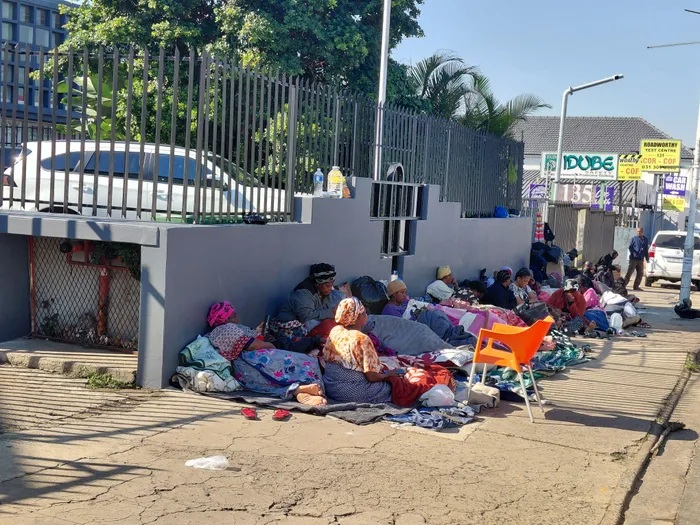
Claims of intimidation and denial of services fuel uncertainty outside Home Affairs in Durban
Image: XOLILE MTEMBU
The defunding of the Refugee Appeals Authority of South Africa (RAASA) has come under scrutiny after the body revealed it is buckling under a backlog of 161,000 asylum seekers.
Only 70,976 of these active appeals from asylum seekers fighting deportation orders, while 90,024 are people who can no longer be traced after abandoning their adjudication processes.
The statistics were presented at the Home Affairs parliamentary committee meeting this week, where officials disclosed that RAASA’s adjudication panel had been slashed from 36 members to just nine following funding cuts by the UN High Commissioner for Refugees (UNHCR).
This led to only 4,475 appeals being finalised in 2025.
The figures contained in the Asylum Seeker Management Report also revealed that just 55,190 people in South Africa currently hold recognised refugee status.
In another disclosure, officials said RAASA chairperson Advocate Zilpha Raphesu told MPs the authority was now scrambling to recruit acting commissioners to tackle the mounting backlog.
“From 2023 until last year, the project was left with only 10 members. In 2025, the High Commissioner wrote to the minister proposing that we needed to scale up performance because the numbers were not moving,” said Raphesu.
“We proposed approaching other societies of advocates to source part-time practitioners who could assist after being appointed by the minister as members of the authority.”
In January, 40 advocates from the Pretoria Society of Advocates started in Gauteng, while 35 advocates from the Cape Bar are currently being onboarded in the Western Cape.
“With President Donald Trump removing resources from all the UN entities, [UNHCR] could not assist us any further… the current 10 members are funded by the European Union,” she added.
Deputy Director-General (DDG) for Immigration Services at the Department of Home Affairs, Mandla Madumisa, said turnaround had also been affected by lost data.
The members of the committee were alarmed, however, because there was no clarity.
Lerator Ngobeni said the numbers presented did not reflect the immigration problem in South Africa.
“I am not sure whether we are measuring genuine refugees fleeing persecution or just measuring administrative activity inside a system that is being stated to be broken and that South Africans can no longer trust,” she said.
“If South Africa does not have an immigration problem, it then means that what we are communicating to South Africans is disjointed. The deputy minister did assert that South Africa has an illegal immigration problem, but when I look at these numbers, we cannot be talking about numbers in the hundreds of thousands instead of millions. So what are the indicators then, instead of asylum backlogs?” she asked.
Sisipho Jama, there appears to be a gap between the urgency on the ground and the department's tone.
“There is very little sense that the department appreciates the economic volatility of the current moment.
“The presentation acknowledges that South Africa’s asylum system is increasingly characterised by mixed migration involving genuine refugees and people seeking economic opportunities.
“The high abuse of the system, the loopholes identified, the no-shows, the cancellation of applications.
“Seeing as there is an outcry over illegal immigration and applicants put the blame on the department, saying that they wait too long and even have to pay some people, what measures are in place to reduce the backlog that dates back to 1998?” she asked.
Deputy General at Home Affairs, Tommy Makhode, most of the concerns raised on immigration are addressed in the Revised White Paper on Citizenship, Immigration and Refugee Protection.
“This will then present us with an opportunity on what we cover in the white paper on immigration and citizenry protection, which I can tell you is widely supported by some of the organisations that have been participating in the protests.”