

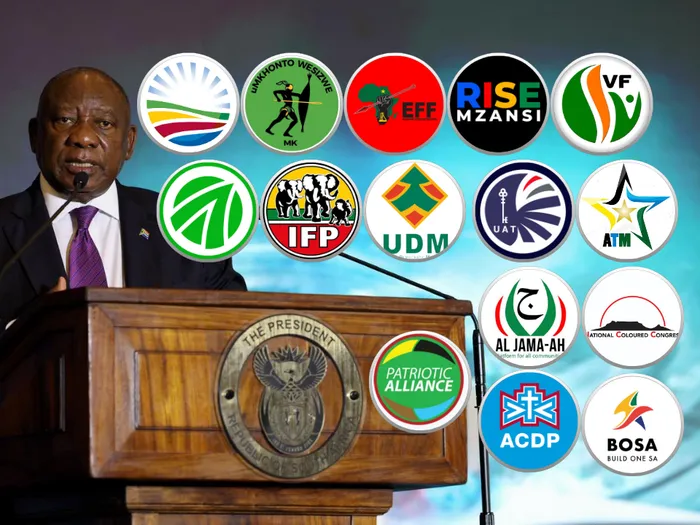
Political parties in Parliament have begun naming Members of Parliament who will serve on the Section 89 impeachment committee that will investigate President Cyril Ramaphosa over the Phala Phala matter.
Image: IOL Graphics
As President Cyril Ramaphosa attempts to overturn findings that he may have violated the Constitution and abused his office, political parties have warned against stalling tactics on the taxpayers' dime.
Ramaphosa has gone to the Western Cape High Court and taken legal action against the Phala Phala independent panel report, alleging that its conclusions are flawed and could lead to impeachment proceedings.
Ramaphosa wants the report scrapped, especially the section recommending that Parliament consider impeachment proceedings against him. The report, compiled in 2022 by an independent panel chaired by former Chief Justice Sandile Ngcobo, concluded there was prima facie evidence that Ramaphosa may have committed serious misconduct linked to the Phala Phala farm scandal. But Ramaphosa said the panel got it wrong.
He said that the panel fundamentally misunderstood its mandate by trying to establish a prima facie case, rather than determining if there was “sufficient evidence” to justify impeachment proceedings.
In court papers, the president argued the panel relied on hearsay, misunderstood its powers and used questionable evidence to reach damaging conclusions. “Save for the limited evidence I introduced in my response, there was no evidence before the panel,” Ramaphosa said.
He also questioned how confidential Namibian police documents and an audio recording ended up before the panel, warning the information may have been obtained unlawfully.
The legal battle comes after the Constitutional Court ruled that Parliament acted unlawfully when MPs voted against adopting the panel’s findings. Following that judgment, National Assembly Speaker Thoko Didiza appointed a 31-member impeachment committee to reconsider the matter.
The judgment was triggered by the applications from the EFF and ATM, who argued that Parliament failed in its constitutional obligation to hold Ramaphosa accountable.
ATM has accused Ramaphosa of attempting to evade accountability.
Ntshona added that Ramaphosa should have reported the burglary at his farm as prescribed by Section 34(1) of the Prevention and Combating of Corrupt Activities Act (PRECCA).“When it came to issues of responding to 31 questions by former Public Protector Busisiwe Mkhwebane, he suspended her instead of answering the questions. And he used his majority to evade answering when it comes to Parliament.”
Ramaphosa, in his court papers said that the process followed by the panel and its conclusions are flawed, adding that this resulted 'in irrational recommendations that are contrary to the principle of law'. Ramaphosa argued that the panel unlawfully accepted hearsay information and speculation, specifically pointing to submissions made by Fraser.
Build One South Africa (BOSA) has cautioned that South African taxpayers should not be compelled to pay for the president's legal battlel.
Roger Solomons, BOSA spokesperson, said while Ramaphosa has every constitutional right to defend himself in court, the public should not be forced to finance what the party describes as a private legal battle arising from his personal affairs.“South African taxpayers should not be forced to fund the president's personal legal defence in a matter arising from his private farm and private affairs.” Solomons warned that South Africa risks repeating the era of prolonged “Stalingrad-style litigation” associated with former President Jacob Zuma, where drawn-out legal battles allegedly cost taxpayers millions while accountability processes stalled.
“South Africa has seen this movie before. The Zuma-administration became synonymous with what has widely been described as ‘Stalingrad-style litigation’,” he said.''Prolonged legal manoeuvring that delayed accountability proceedings and ultimately cost the public tens of millions of rands, with some estimates exceeding R30 million.
''The party further warned against what it described as the weaponisation of legal processes to delay accountability while the public bears the financial burden. A democracy cannot function where legal processes are weaponised to delay accountability while the public carries the financial burden.”
BOSA said Ramaphosa should stop pursuing prolonged legal challenges and instead fully submit to Parliament’s impeachment process. “If Ramaphosa maintains his innocence, then the appropriate course of action is clear. He must subject himself fully to Parliament’s impeachment committee and allow the process to reach its conclusion without unnecessary obstruction or prolonged legal diversion.”
Solomons said that restoring public trust in the matter would require complete transparency before Parliament. “Parliament’s impeachment process must proceed without obstruction. Only through full transparency and accountability before Parliament can this matter be resolved once and for all,” he added.
Political analyst Sandile Swana said the matter was not about hearsay, but whether there is a case worth investigating, regardless of how the information came about.“To say that the information came from hearsay is irrelevant because the amount of time and powers given to the panel were never enough to do an investigation, which is supposed to be done by the impeachment committee. So the argument is misguided, and this is likely to be considered irrelevant,” he said.