

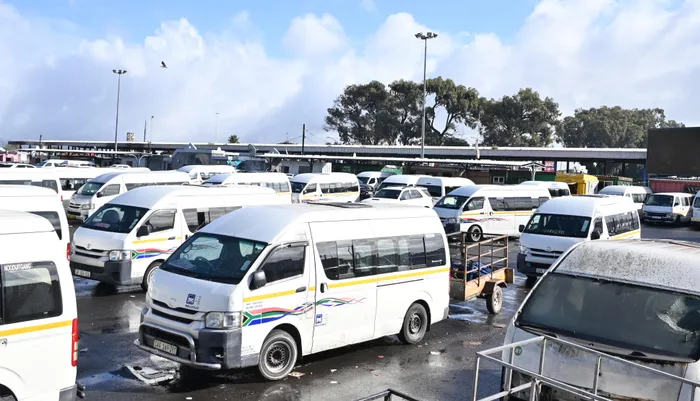
Taxi associations acknowledged the impact of fuel increases on both taxi owners and commuters across the region and indicated that discussions are ongoing to find a sustainable way forward.
Image: Ayanda Ndamane / Independent Media
South Africans are paying more to get to work, more to put food on the table and more to keep the lights on as soaring fuel prices hit households already struggling to make it through the month.
For many workers already living hand to mouth, it now means standing in taxi queues, wondering whether there will be enough money left for food, electricity and school transport after paying to get to work.
The latest fuel hikes, which came into effect earlier this month, were among the steepest that SA has seen.
Government increased petrol prices by R3.27 a litre, while diesel jumped by more than R5 a litre after an earlier calculation error initially placed the increase even higher. This follows punishing fuel price hikes that were implemented in April.
Illuminating paraffin also rose sharply, piling pressure on poorer households who rely on it for cooking and heating.
The latest data from Stats SA showed inland 93-octane petrol rose from R20.19 a litre in March to R23.25 in April — the fifth-biggest monthly increase in 50 years and the biggest this century.
Wholesale diesel prices surged past R30 a litre in May, placing transport operators, businesses, farmers and delivery companies under severe pressure.
Passenger transport services also recorded their biggest monthly increase since July 2022 as operators across the country started passing rising fuel costs onto commuters. And it is commuters who are now carrying the heaviest burden.
The City of Cape Town has warned that soaring diesel prices are placing increasing pressure on public transport costs.
The Mother City said rising fuel prices were among the key factors affecting operating costs for the bus service.
"The city's urban mobility directorate wants to give MyCiTi commuters as much notice as possible of an upcoming fare increase so that households can budget ahead," the city said in a statement earlier this week.
"It is likely that the MyCiTi fares will increase from July 2026 because of the sustained high diesel price.
"The city has protected MyCiTi commuters from the fuel price increases since March this year and will also do so in June."
However, should the diesel price increase at the level seen over the past two months, a MyCiTi fare increase will be unavoidable.
"The city has absorbed the costs of the exceptional increases in the diesel price since March this year," it said.
"It is anticipated that the MyCiTi fares could increase by at least 32%."
Taxi fares are already climbing in several provinces, while delivery costs are filtering through to the price of groceries, bread, vegetables and other basic goods.
In George, taxi operator Sipho Mqondo said tensions between commuters and drivers were rising daily.
“People are angry and frustrated because nobody has extra money anymore,” Mqondo said.
“You can see it in the mornings. Passengers stand outside taxis counting coins before they get in.”
He said some commuters were now asking drivers if they could pay later because they did not have enough money for transport.
“Sometimes somebody tells you they only have enough money to get to work, but not enough to come home again,” he said.
“That’s how bad things are becoming.”
Mqondo said taxi operators were also drowning under rising fuel costs.
“People think taxi owners are making money, but we are suffering too,” he said.
“Fuel is too high now. Every week we are spending thousands just to keep operating.”
Another George taxi owner said many operators feared they would soon be pushed out of business.
“You buy fuel in the morning, and by the afternoon, most of the money you made is already gone,” he said.
“Then people still expect you to maintain the vehicle, buy tyres and fix breakdowns.”
He said some drivers were now working almost the entire day just to cover fuel and vehicle instalments.
“We are carrying the same passengers, but fuel keeps going up,” he said.
“If this carries on, small operators are not going to survive.”
The SA National Taxi Council warned earlier this month that commuters would inevitably feel the impact of the fuel hikes.
The company said affordable transport remained a “critical lifeline” for thousands of working-class households.
Economists warned the damage would not stop at transport.
Because SA relies heavily on trucks and road freight to move food and goods across the country, rising diesel prices are expected to continue pushing up the cost of almost everything.
Economist Dawie Roodt said fuel price increases eventually spread through the entire economy.
“When fuel prices rise sharply, transport costs increase across the economy,” Roodt said.
“That eventually affects food prices, deliveries and the general cost of living.”
He warned poorer households were usually hit the hardest because transport and food already consumed a large portion of their monthly income.
“When transport becomes expensive, people immediately have less money left for other essentials,” he said.
“And once food prices start rising as well, households come under even more pressure.”
Across social media, South Africans described how the latest fuel hikes were already changing daily life.
One anonymous Reddit user said filling up a vehicle now costs more than R2,000 for the first time. Another said they had sold their car and bought a scooter because fuel costs had become impossible to manage.
A Cape Town delivery driver, who asked not to be named, said he was now spending almost half his income on petrol.
“You work the whole day, and by the time you fill up again, there’s almost nothing left,” he said.
“Food is expensive, fuel is expensive, and rent is expensive. Everything is going up except salaries.”
A domestic worker from Khayelitsha, Nomvula Gxasheka, said transport costs were eating into money meant for groceries.
“Sometimes I must choose between buying electricity or paying taxi fare for the week,” she said.
“If transport goes up again, I don’t know what we will do.”
Gxasheka said she had already cut back on meat and other groceries because transport costs had increased so sharply over the past few months.
“Before, you could still make a plan somehow,” she said.
“But now everything costs too much.”
The rising fuel prices are also feeding directly into inflation.
Stats SA this week confirmed that inflation rose to 4% in April, largely driven by fuel price increases.
Government has blamed the increases on rising international oil prices and instability in the Middle East, including tensions involving Iran and disruptions affecting global oil supply routes.
But soaring diesel prices have also raised fresh questions about government’s continued reliance on expensive diesel-powered electricity generators.
Government recently defended the use of diesel-powered open-cycle gas turbines after Kevin Mileham questioned why millions of rand were still being spent on diesel despite some coal-fired power stations sitting idle.
Mileham said more than R93m had been spent on diesel in just three weeks.
“South Africans are paying enormous amounts for diesel-generated electricity while functional coal stations are sitting idle,” Mileham said in his parliamentary question.
He said diesel-generated electricity cost about R5,870 per megawatt-hour — more than 10 times the roughly R546 cost of coal-fired power.
In a parliamentary reply, energy minister Kgosientsho Ramokgopa said the diesel-powered generators remained necessary because they could be brought online within minutes during emergencies and periods of strain on the electricity grid.