

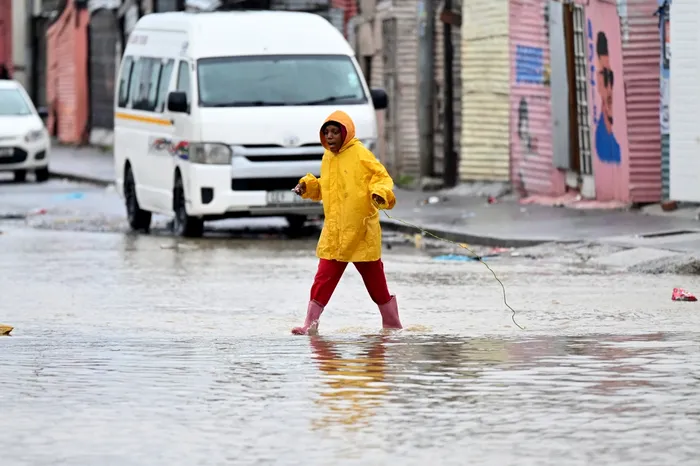
Lwandle in Strand was one of the hardest-hit areas.
Image: Ayanda Ndamane/ Independent Newspapers
Much-needed funds will be redirected towards immediate disaster relief efforts while preliminary assessments continue to determine the full extent of the flood damage, which officials estimate could run into the billions of rand across the Western Cape.
National Disaster Management Centre head, Elias Sithole, gazetted a notice on Wednesday classifying the damage caused in the Western Cape, Eastern Cape, Free State and Northern Cape by the second wave of storms from May 10 as a disaster.
The storms severely affected the Cape Winelands District, including the Breede Valley and Witzenberg municipalities, as well as parts of the West Coast District, particularly the Cederberg and Matzikama municipalities.
This followed an earlier wave of storms that had already devastated the Garden Route, prompting the first disaster classification.
The storms claimed 11 lives and impacted more than hundreds of thousands of residents across the province. And 11 damaged schools remain closed, and the farming industry has been dealt a hefty blow.
The storm toppled pylons and devastated vineyards, orchards, and croplands, with some farmers reporting total crop losses, particularly among apple producers in Grabouw.
Beyond crop destruction, critical farming infrastructure has also been severely affected. Irrigation systems, farm access roads, bridges, and transport routes have been damaged or rendered unusable, while power outages have further disrupted irrigation, storage, and packhouse operations.
Agriculture Minister John Steenhuisen, who travelled by helicopter to access some of the worst-affected regions, warned that the total damage bill could run into billions of rand.
MEC for Local Government Anton Bredell’s spokesperson, Wouter Kriel, said the classification would allow departments and municipalities to redirect funds within existing budgets towards urgent disaster repairs while awaiting approval for additional national funding, which would depend on the outcome of damage assessment reports.
“The classification is a needed step in order to have a disaster declared,” he said.
“We need the declaration in order to eventually be able to claim disaster relief funding from the National Treasury.
“Currently, we are conducting damage assessments in order to compile a comprehensive damage report. How much compensation will be received, and when, remains to be seen, as it depends on the National Treasury and the broader budget environment.”
A total of R130.4 million was allocated for disaster response following storms in June and September 2023 that damaged infrastructure, agriculture and educational facilities across the province.
This included an R90.8 million roads-and-bridges project near De Doorns.
Ahead of the 2025 winter season, the Provincial Disaster Response Grant was increased by R149.3 million, while the Municipal Disaster Response Grant received an additional R378.3 million in anticipation of severe storms.