

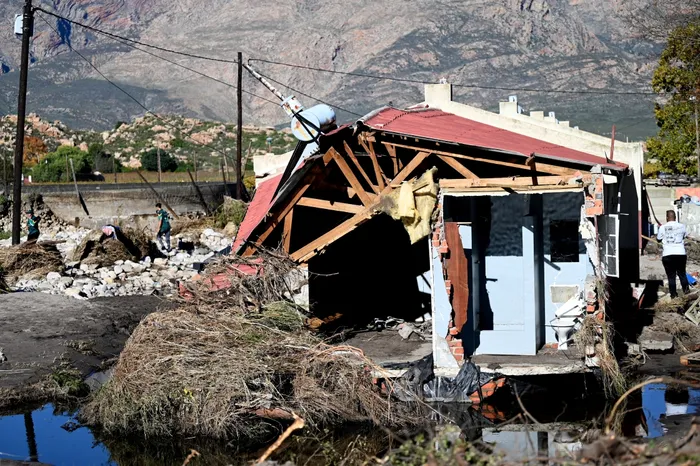
Storms battered the Western Cape. One of the many communities affected is Klein Berg in De Doorns, where 45 families are affected.
Image: Ayanda Ndamane/ Independent Media
ELEVEN people are dead, more than 100,000 residents in Cape Town alone have lost everything, and Gift of the Givers has served 150,000 hot meals in a single week.
Yet the officials responsible for keeping communities safe admitted yesterday that the same areas will flood again unless authorities confront an uncomfortable truth: people are building homes in flood-prone areas.
Western Cape Premier Alan Winde warned that blocked stormwater drains and illegal building in flood-prone areas continue to put lives at risk.
The admission came at a disaster management press briefing where Winde and a battery of provincial officials gave an update on the coordinated response to last week's storms, a weather event so severe that a formal disaster classification has now been requested.
But behind the logistics briefing lay a damning picture of systemic failure: informal settlements planted squarely in flood lines, stormwater drains choked with rubbish, and planning legislation routinely ignored while communities are repeatedly submerged.
"It always astounds me how much rubbish and junk comes out of stormwater drains when they are blocked," Winde said. "We all have a responsibility. Everyone throwing a piece of paper that eventually ends up blocking a drain at the end of your street all adds up. The next thing, hundreds or thousands of people and their homes are underwater."

Gift of the Givers, a humanitarian aid organisation, has been assisting communities devastated by floods with food parcels and water. Many of the areas are without electricity.
Image: Ayanda Ndamane/ Independent Media
Winde said resolving the issue of informal settlements built below flood lines would take time.
“That is something that forms part of an overall long-term plan in making sure we move as many people out of those areas as quickly as possible,” he said.
The storms, which struck separately from the floods that triggered a national disaster declaration across six provinces days earlier, hit hardest in the Cape Winelands District, particularly Breede Valley and Witzenberg, as well as the West Coast's Cederberg and Matzikama municipalities. The Cape Metropole, Southern Cape, and Central Karoo were all drawn into what Gift of the Givers described as "a major humanitarian operation" spanning the province.
Head of Disaster Management, Colin Deiner, confirmed that Cape Town alone bore the brunt, with more than 103,000 people directly affected.
“There was a moderate impact on the Overberg and Garden Route districts, but considering that the previous storm had a severe impact on the Garden Route, the central Karoo experienced relatively lower impact,” he said.
Deiner was speaking at a disaster management press briefing, providing an update on the multi-disciplinary coordinated response activated across the province.
On the ground, Gift of the Givers has deployed teams across the affected regions, distributing not only hot meals but blankets, hygiene packs, mattresses, and baby care supplies.
Spokesperson Ali Sablay said the need remains acute. He made a heartfelt plea for donations, with collections still being accepted at the Newlands Cricket Stadium drop-off centre.
The provincial government, meanwhile, is pointing to infrastructure investment as its long-term answer. MEC for Local Government Anton Bredell cited the Ashton Bridge, built to withstand extreme weather, as a model for how the province must now rebuild.
"Every single department must think about how to rebuild, and rebuild with climate change in mind," Bredell said.
“First of all, we have recognised that climate change is real. Secondly, we have placed it at the centre of the province’s Growth for Jobs Strategy. Every single department must think about how to rebuild, and rebuild with climate change in mind,” he said.
Bredell pointed to the Ashton Bridge as an example of infrastructure designed to withstand severe weather conditions.
“It is well known because I have criticised the department before for building monuments, but it is still standing,” he said.
He added that the province had escalated concerns around planning failures to the national MinMEC platform, where the minister and provincial MECs would discuss recurring flooding in the same communities.
“We have put the planning issue on the national MinMEC agenda, where the national minister will meet with all the MECs to discuss why the same areas flood, to have a serious conversation about people staying in riverbeds and people ignoring planning legislation,” Bredell said.