

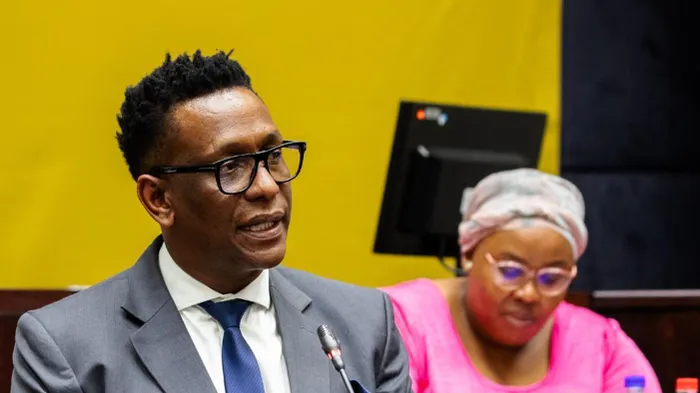
Portfolio Committee on Higher Education and Training chairperson Tebogo Letsie and other MPs grilled higher education officials on the overpayment of the Construction Seta administrator, Oupa Nkoane.
Image: Parliament RSA/Supplied
Portfolio Committee on Higher Education and Training was shocked by revelations that the administrator appointed to address governance and administrative challenges at the Construction Education and Training Authority (CETA) unilaterally determined and approved his own R3 million salary package, without the Department of Higher Education (DHET) or the minister's authorisation.
This follows a protected disclosure by suspended CFO Sanele Radebe to the National Treasury, in which he alleged the salary package did not comply with national guidelines.
Higher Education and Training Minister Bhuti Manamela approved a R2.5 million pay package in January, but the committee heard that Oupa Nkoane had already been paid in December.
The committee said the salary paid between October 2025 and March 2026 constituted irregular expenditure. The department’s non-responsiveness to the CETA letter about the salary increase contributed to the debacle.
The committee Chairperson, Tebogo Letsie, also remarked that the department was spending large sums on forensic reports, only for them to be taken for review. “Your core business is to skill and upskill the workforce of South Africa. In the context of the latest unemployment statistics, Setas were created to help drive economic growth; this is not happening,” he said.
The department’s prolonged delays, coupled with the minister’s slow response in determining the administrator’s salary package and the non-payment of his salary, constitute a clear injustice.
Higher education director-general Nkosinathi Sishi admitted the salary had not yet been approved at the time, but said it was still under review.
Until then, Nkoane had not been paid since his appointment in August, telling the committee last week he had been living off his “wherewithal”.
An offer of R2.5 million was made to Nkoane in October, but he did not accept it. Then Ceta wrote to the Department of Higher Education proposing a salary increase.
Between October and March, the administrator was overpaid by R208,333.
A payment plan has since been instituted to recover the overpayments, which the committee constituted irregular expenditure.
The intervention at the Seta was triggered by four qualified audit outcomes.
Letsie took aim at Sishi, demanding to know what legislation had been considered in determining CETA administrator salaries.
“To determine administrators’ remuneration packages, baseline information from the following sources was considered: Seta CEOs’ salary packages, the DPSA circular, and the National Treasury, where we requested benchmark salaries for administrators in state-owned enterprises,” Sishi said.
He added that any salary paid before final approval would be adjusted.
Letsie, however, questioned why the salary had not been approved before Nkoane took up the post.
“Was your expectation that someone must leave their job where they are earning and come to a place for six or seven months where they are not going to earn?”
Chief director for Setas Mabuza Ngubane said it was normally impossible to determine the salary before an appointment was made.
“Because the salary forms part of the whole administration project. The administrator is appointed by gazette, followed by the signing of the SLA. After that, the administrator is inducted and then allowed time to go back and do a diagnostic assessment, which will assist him in coming up with the scope of the whole administration project.
“Thereafter, based on the diagnostic assessment report, they come up with a work plan stipulating the activities, milestones and timelines.”
Committee members, however, rejected the explanation.
“You go to the Seta board remuneration policy. That will give you remuneration accounting authority on category S as per the National Treasury. So for you to want to go above what is given by the law, you must allow the minister to give authority and provide motivation,” said ANC MP Tshepho Louw.
Nkoane, however, argued that the circular did not address administrator salaries because he was not an accounting authority.
“The circular speaks to the payment of accounting authorities, not administrators. Administrators have the role of the CEO and the board. That is why you appoint them first and then negotiate the salary,” he said.
Letsie said that was not in line with the gazette.
“That is not true, director-general. You know it’s not true. We took oaths earlier on.
“You said the powers and duties of the administrator are as follows, as per the gazette: ‘Assume the role of and perform all functions and duties of the accounting authority as prescribed in the Skills Development Act and the Public Finance Management Act, read together with the relevant regulations.’
“To facilitate the process of the CEO in accordance with the Skills Development Act. So you do not appoint them as CEO and accounting authority. If you did, the administrator would not have co-existed with the former CEO from August until now,” Letsie said.
Nkoane rejected suggestions that he had lied.
“You make reference to the fact that I speak under oath as if, because I am interpreting a policy from where I sit, and it does not meet your understanding, it means I lie. I can be wrong in what I say, but not that it is a lie,” he pushed back.
Earlier this month, suspended CFO Sanele Radebe made a protected disclosure to the National Treasury and the Auditor-General, claiming he had been pushed out of the Seta.
It was reported that Radebe alleged this was due to his attempts to enforce compliance at the Seta being met with resistance.