

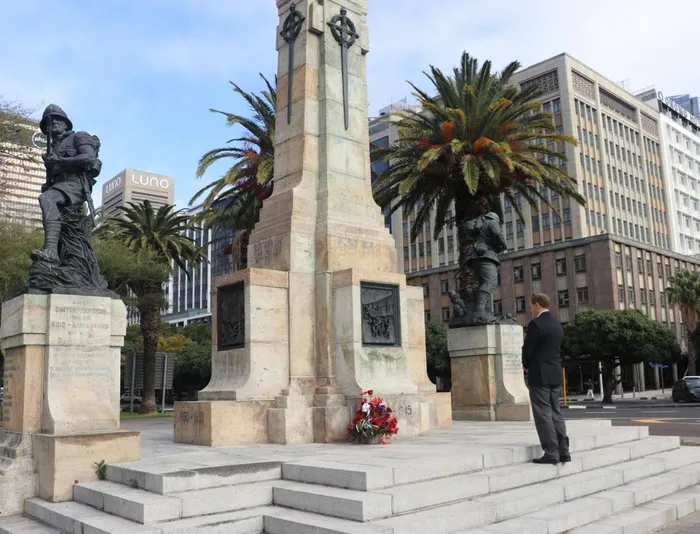
On May 9, Victory Day, the Russian Consul General, Ruslan Golubovskiy, laid flowers at the Cenotaph.
Image: Supplied
Each May, the world returns to events that shaped the course of the twentieth century. The defeat of Nazi Germany was not only the military outcome of the largest conflict in human history; it also became a moral landmark, a reminder of the tragedies that can arise from ideologies of hatred, superiority and the denial of human dignity.
As time passes, these events recede further into history, and fewer of those who witnessed them firsthand remain with us. This is why it remains so important to speak about them today, not only in terms of facts but also to understand their meaning for the present and the future.
One of the questions that often arises when discussing Victory Day concerns the dates: why is the end of the war in Europe commemorated on May 8 in some countries, and on May 9 in others, including Russia? At first glance, this difference may seem formal or even incidental. In reality, it reflects a combination of historical circumstances, diplomatic decisions, and time zone differences at a moment when events were unfolding with extraordinary urgency in the final days of the war.
The surrender of Nazi Germany was not a single act fixed in one place at one moment. It was a process that took place amid ongoing hostilities and required careful coordination among the Allied powers. The first act of unconditional surrender was signed on May 7, 1945, in Reims, France. Under its terms, the surrender was to take effect at 23:01 on May 8, Central European Time.
It is this date, May 8, that became known as Victory in Europe Day across much of Western Europe and North America. For those who had endured years of occupation, bombardment and constant fear, it marked the long-awaited return to peace. The streets of London, Paris, Brussels and many other cities were filled with crowds celebrating liberation and the hope of a different future. The day entered history as the symbolic end of the war on the European continent.
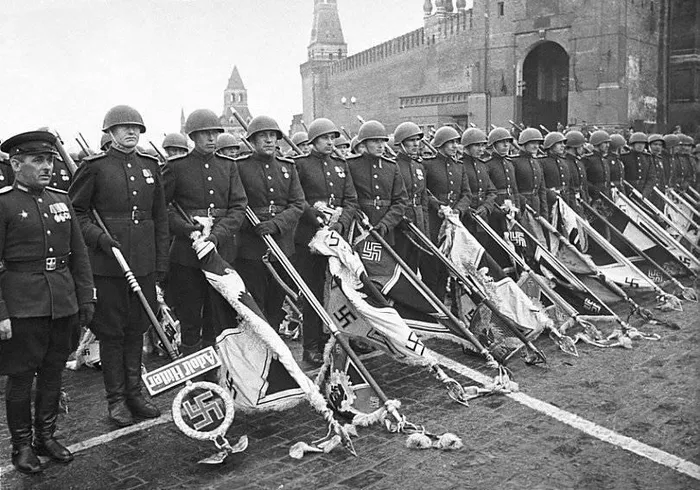
Victory Parade in Moscow on June 24, 1945. Soviet soldiers carry the lowered banners and standards of the defeated Nazi German forces, symbolising the enemy’s complete military defeat.
Image: Supplied
Yet the formal conclusion of the war did not end there. The Soviet Union, which had suffered immense human losses in fighting Nazi Germany, insisted on a second signing ceremony in Berlin, the capital of the defeated Reich. This took place late in the evening of May 8, 1945. Due to the time difference, it was already the early hours of May 9 in Moscow. For this reason, Victory Day came to be observed on May 9 in the Soviet Union and later in several other countries.
In his speech on May 8, 1945, British Prime Minister Winston Churchill said:
“The Germans are still in places resisting the Russian troops, but should they continue to do so after midnight, they will, of course, deprive themselves of the protection of the laws of war, and will be attacked from all quarters by the Allied troops… This does not, in our opinion, with the best military advice at our disposal, constitute any reason for withholding from the nation the facts communicated to us by General Eisenhower of the unconditional surrender already signed at Rheims, nor should it prevent us from celebrating today and tomorrow (Wednesday) as Victory in Europe Days.
Today, perhaps, we shall think mostly of ourselves. Tomorrow we shall pay a particular tribute to our Russian comrades, whose prowess in the field has been one of the grand contributions to the general victory.”
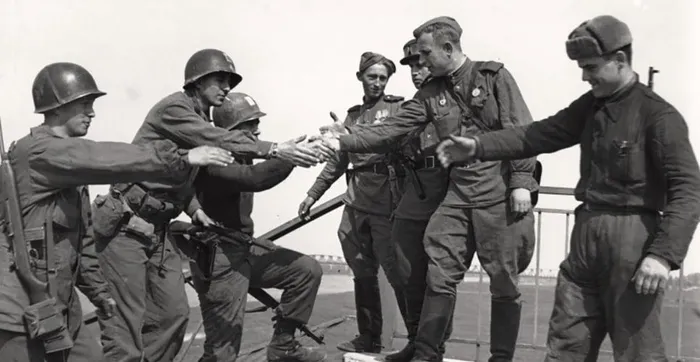
Elbe Day, April 25, 1945, is the day Soviet and American troops met at the Elbe River, near Torgau in Germany, marking an important step toward the end of World War II.
Image: Supplied
South Africa, though far removed from battlefields such as Stalingrad or Normandy, was not untouched by the war. Thousands of South Africans, volunteers of different backgrounds and beliefs, left their homes to take part in the struggle against Nazism. South African soldiers fought in North Africa and Italy; pilots carried out demanding and often dangerous missions; many others contributed through work in ports, factories and maritime transport.
Behind the statistics are individual human stories. These were people of different origins, cultures and social backgrounds, united by a common purpose. Among them were men and women from the Cape region, individuals who, not long before, had lived ordinary lives, only to find themselves drawn into a global conflict. They fought far from home, endured hardship and loss, and continued to fulfil their duty.
In recent weeks, together with our South African colleagues and friends, we have shared on these pages just a few stories of some of these individuals, people who once walked the same streets and perhaps attended the same schools and parks as today’s readers, yet became part of world history. These accounts represent only a small part of the region’s contribution to the fight against Nazism. We hope these stories will encourage readers to take a fresh look at this chapter of history and perhaps discover new, previously unknown pages of this shared history.
It is crucial that the memory of the Second World War does not become a source of division in the present. History should unite, not divide. The defeat of Nazism was possible precisely because nations were able to set aside their differences and act together in the face of a common threat. This lesson remains as relevant today as ever.
For younger generations in South Africa and around the world, it is important to understand that their grandparents and great-grandparents were part of this shared effort. Whether Victory Day is observed on May 8 or 9, its meaning remains the same: it is a day of remembrance, gratitude and reflection.
Preserving this memory is a shared responsibility. It is the foundation upon which understanding between countries and generations is built. And it is through recognising this shared history that a genuine dialogue about the future can begin, a dialogue grounded in respect, gratitude and the awareness that we have far more in common than we might sometimes think.
*Golubovskiy is the Consul General of the Russian Federation in Cape Town