

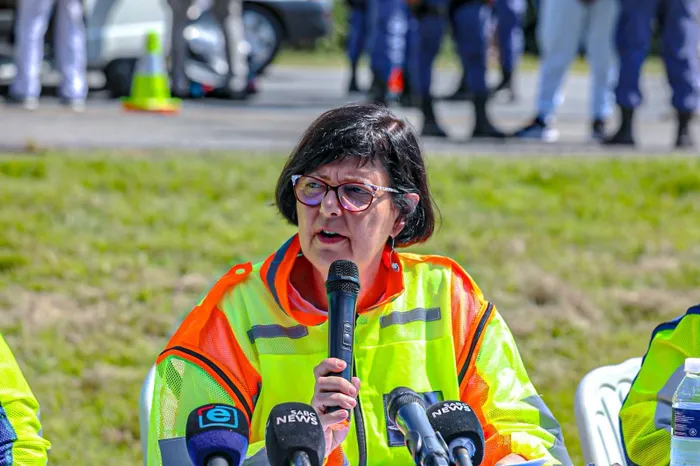
Transport Minister Barbara Creecy The Transport Department intends to introduce the Road Accident Benefit Scheme Bill that will reduce the burden of the embattled Road Accident Fund on the national fiscus.
Image: Supplied / Department of Transport
The Department of Transport is finalising a review of the legislative and compensation framework of the Road Accident Fund (RAF) as part of efforts to address its long-term financial sustainability.
A hybrid funding model that includes both private and public contributions has now been proposed to reduce pressure on the fiscus.
Tabling a R102 billion budget and priorities for 2026/27 in the National Assembly on Tuesday, Minister Barbara Creecy said her department was reviewing the proposed Road Accident Benefit Scheme legislation.
This is to reduce contingent state liability through a no-fault system and a standardised injury compensation framework.
“We are now researching options for a hybrid funding model that will include both private and public contributions, to lessen the burden on the fiscus going forward,” she said.
Deputy Transport Minister Mkhuleko Hlengwa said the current RAF model was financially unsustainable and that the Road Accident Benefit Scheme Bill will be introduced to Parliament later this year.
In her budget vote, Creecy said targeted investments in maintaining, rehabilitating, upgrading, and expanding the road network remained key to the movement of people and goods.
She announced that the South African National Roads Agency (Sanral) would receive R31 billion this year for capital expenditure on the non-toll network, the Gauteng Freeway Improvement project operations, the N2 Wild Coast route for ongoing construction on major bridges, and new road sections on national highways, as well as the development of the Moloto Road corridor.
“These large-scale projects will continue to improve safety and shorten travel distances while creating over 35 000 job opportunities and supporting more than 2000 small enterprises. “Investment in public infrastructure projects is a significant catalyst for job creation and economic development,” she said.
Creecy expressed concern about serious challenges at provincial and municipal levels, where financial resources and in-house capacity for road maintenance are often inadequate.
Since 2013, provincial governments have transferred 13 000 kilometres of provincial roads to Sanral for management and maintenance.
“This strategy is not sustainable in the long term and will ultimately impact Sanral’s ability to maintain the national road network without introducing widespread tolling,” she warned.
She said the National Treasury and Transport will next month host a joint forum of Ministers and MECs of transport and finance, respectively, to find a mechanism to frontload the Provincial Road Maintenance Grant so that provinces can upgrade more of their priority roads sooner.
Creecy further said the revitalisation of the passenger rail system continued to go from strength to strength, with yearly passenger journeys surpassing 100 million at the end of March 2026.
“This six-fold increase over four years reflects deliberate and sustained investment in infrastructure, rolling stock, security, and institutional reform.
“In Gauteng, KwaZulu-Natal and the Western Cape, we are increasing train frequencies, improving security, reducing vandalism and ensuring connectivity for communities previously excluded from reliable transport services,” she said.
Cape Times