

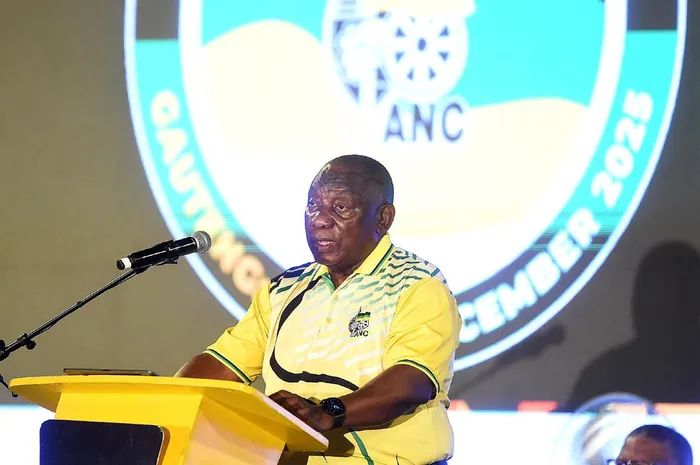
ANC president Cyril Ramaphosa.
Image: Itumeleng English / Independent Newspapers
A drawn-out and highly public impeachment inquiry into the Phala Phala scandal could prove deeply damaging to the ANC if President Cyril Ramaphosa refuses to step down.
This is the view of political analysts as the landmark Constitutional Court ruling is expected to dominate discussions when the ANC’s top seven officials meet on Monday. This while the DA, the ANC’s largest GNU partner, has signalled it will no longer shield the president.
The apex court ruled on Friday that the National Assembly’s vote in December 2022 declining to refer the Section 89 Independent Panel’s report to an Impeachment Committee in terms of parliamentary rules was inconsistent with the Constitution, invalid, and set it aside.
The report from the panel led by retired Chief Justice Sandile Ngcobo found that there was a prima facie case of wrongdoing by the president relating to the undeclared US dollars that were found and stolen from his Phala Phala farm in Bela-Bela, Limpopo.
Following the judgment, EFF national chairperson and chief whip Nontando Nolutshungu wrote to National Assembly Speaker Thoko Didiza demanding clear timelines for the establishment of an impeachment committee.
Vuyo Zungula, leader of the African Transformation Movement, which joined the EFF in approaching the court, said his party would also be writing to Didiza regarding the implementation of the ruling.
In a statement, DA leader Geordin Hill-Lewis said they should not be expected to shield wrongdoing.
“The impeachment committee must now do its work properly, rationally, fairly and constitutionally. The President must have the opportunity to account fully.”
Shortly after the judgment, the ANC said it will support Parliament Speaker Thoko Didiza and the National Assembly in ensuring compliance with the judgment and applicable parliamentary rules.
Director of Surgetower Associates Management Consultancy and political analyst Siseko Maposa said the political implications of a sitting president facing an impeachment inquiry would be significant.
“The inquiry itself becomes the centrepiece of the political landscape. It consumes governing bandwidth, weakens the president’s leverage over Cabinet and coalition partners, and provides opposition parties with a sustained political platform,” he said.
“The DA was once the loudest voice demanding accountability over Phala Phala. Now it has a direct political interest in preserving Ramaphosa’s tenure in order to maintain coalition stability."
Despite the pressure, he said Ramaphosa is unlikely to step aside voluntarily, as that could trigger a destabilising succession battle within the ANC.
“That would ignite an immediate and potentially turbulent ANC succession contest and weaken the party ahead of the local government elections,” he said.
“Instead, the best course for both Ramaphosa and the ANC is likely to be procedural delay.”
He said the ConCourt’s order for Parliament to amend Rule 129(1), which governs impeachment proceedings, could buy the president more time.
“The ANC may insist that those amendments must first be finalised before any serious Phala Phala hearings proceed. That buys time, potentially enough to push meaningful consideration of the matter beyond the local government elections,” he said.
Speaking in an SABC interview, analyst Sipho Seepe said if the proceedings of the impeachment committee take long there will be political fallout.
“Politically, once you start going through that process, that will be rigorous, cross-examining, there will be a lot of embarrassment.
“And effectively, you will have a head of state who will have to answer. For the ANC this could not have come at a worse. It comes at a time when support is declining, in every by-election it is not doing well and other parties are encroaching,” he said.
NMU lecturer Ntsikelelo Breakfast said Ramaphosa may already be weighing up the option of resigning rather than allowing a prolonged parliamentary process that could inflict further damage on the ANC.
“You will remember that previously there was no committee specifically focused on the presidency. Now there is, and it exists to hold that office accountable,” he said.
“He will be required to account for what happened, and it will become a political battle because opposition parties will want to extract political mileage from the process. It will be ugly.
“So there will be a part of him thinking he should just throw in the towel rather than put his party through this.”
Breakfast argued that the ANC, already facing declining electoral support, may struggle to weather another damaging political crisis.
“The ANC is already terminally ill, so he may not want to drag it through this whirlwind because if a finding is eventually made against him, and it is not far-fetched to say he was off the mark, it will be devastating,” he said.
He added that the party’s leadership would also be calculating the impact such a process could have ahead of the upcoming local government elections.
“Some may argue that his term is nearing its end and he should be allowed to finish it. But others, especially those sidelined from Cabinet, may say they cannot wait because the local government elections are approaching and he will become the face of the party,” he said.
“How is the ANC supposed to recover electorally when this issue is going to dominate the political battlefield?”