

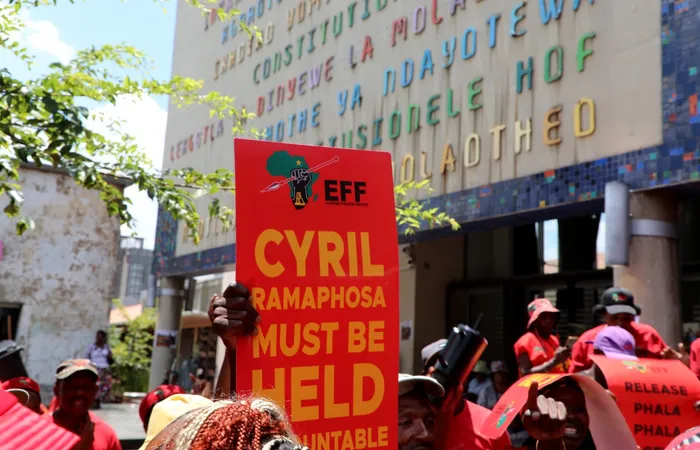
The promise made by EFF to put pressure on the Constitutional court to release the findings of the investigation into the foreign currency found at President Ramaphosa’s Phala Phala ranch saw the EFF ground forces picketing outside the Constitutional court for the release.
Image: Timothy Bernard / Independent Newspapers
Should the Constitutional Court (ConCourt) rule against Parliament on Friday, it could push the Government of National Unity (GNU) to the brink.
That is the view of a number of analysts as the ConCourt is expected to deliver judgment on whether Parliament acted lawfully when it rejected a report recommending an impeachment inquiry into President Cyril Ramaphosa.
The dispute centres on a Section 89 independent panel chaired by retired chief justice Sandile Ngcobo. The panel concluded that there was sufficient evidence to justify Parliament considering the establishment of an impeachment inquiry against the president.
The findings relate to allegations involving the handling of foreign currency at Ramaphosa's Phala Phala game farm in Limpopo. The panel examined claims that approximately R9.5 million in foreign currency was concealed in a sofa on the property and later stolen, along with questions about whether proper procedures were followed following the incident.
The report concluded that the evidence presented was sufficient to warrant further scrutiny through a formal impeachment inquiry.
However, the National Assembly voted by 214 votes to 148 to reject the report. That vote halted the impeachment process before it could proceed to the inquiry stage.
Analyst and Director of Surgetower Associates Management Consultancy Siseko Maposa said that if the ConCourt rules against Parliament, it would test the GNU to breaking point, and Ramaphosa’s political future would hang by a thread.
“Conversely, a ruling against the Economic Freedom Fighters (EFF) and African Transformation Movement (ATM) would mark another successful—albeit temporary—procedural deflection for the President.
“I say ‘temporary deflection’ because, make no mistake, regardless of the Constitutional Court’s ruling, Phala Phala will remain a spectre over Ramaphosa, both legally and politically, long after his tenure ends.
“The only decisive victory for Ramaphosa would be a merit-based ruling in a court of law. That is a luxury he cannot presently afford. Politics and electoral survival demand popularity over legal clarity. For now, the cost of litigation outweighs the threat of conviction. But eventually, the music will catch up with him.
“The Public Protector South Africa, South African Reserve Bank (SARB), and South African Revenue Service (SARS) have all cleared him. However, the Public Protector’s report is under review in light of new evidence, SARB’s findings are disputed, and ActionSA recently uncovered a damning Independent Police Investigative Directorate (IPID) report—nearly two years old—which finds senior Presidential Protection Unit members guilty of obstructing justice, falsifying documents, and invoking the President’s name to cover up investigative irregularities.
“Simply put, Ramaphosa may be able to dodge inquiries and court processes for now, but he will not be as successful in dodging history.”
NMU lecturer and political analyst Ntsikelelo Breakfast said an adverse ruling against Ramaphosa would deal a significant blow to the GNU.
“It will pose a threat to the GNU because there have already been rumours that some want him to step down as ANC president, arguing that he has not accounted for the party’s decline. That debate will be reignited,” he said.
Breakfast added that such an outcome would also shape the succession battle within the ANC.
“It will influence who emerges as a potential successor. Any candidate perceived to be a continuation of his leadership style could face strong resistance,” he said.
He noted that the judgment could also trigger broader questions about the formation of the GNU itself.
“Some will question the very foundation of the government of national unity — why, for instance, he reached out to parties like the DA,” he said.
Breakfast also pointed out that some political parties have remained relatively muted in public discourse around the anticipated ruling.
A favourable outcome for Ramaphosa could strengthen his political standing, he said.
“If the ruling goes in his favour and he is exonerated, that will work to his advantage. He may be seen as someone who has been politically persecuted,” he said.
Political analyst Sipho Seepe said the court faces a critical choice whether to confine itself to the “EFF’s narrow procedural challenge or engage with the substantive findings of the independent parliamentary panel”, which concluded that the President has a case to answer.
"The stakes are significant. Should the Court rule on the panel’s report, it would be drawn into a direct assessment of the President’s conduct. However, the most probable outcome is that the Court will declare Parliament’s decision unlawful and unconstitutional. This procedural route would enable the Court to vindicate constitutional norms without confronting the far more contentious question of presidential accountability.
“Questions posed by the justices during proceedings strongly suggest they are reluctant to adjudicate the merits of Ramaphosa’s actions."
Cape Times