

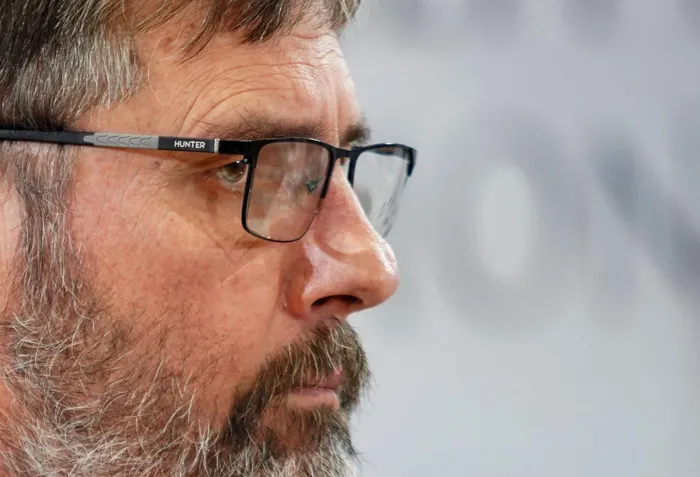
Retired Hawks senior member Lieutenant-Colonel Jakobus Prinsloo testifies about a drug theft investigation involving 541kg of cocaine worth R200 million.
Image: Oupa Mokoena / Independent Newspapers
Retired Hawks senior officer Lieutenant-Colonel Jakobus Prinsloo told the Madlanga Commission of Inquiry that he underwent a six-hour polygraph test, which he passed, while tests undertaken by his colleagues lasted only three hours.
The tests concerned the missing 541kg of cocaine worth R200 million, which was stolen during the November 2021 burglary from the Hawks' Port Shepstone office, where Prinsloo served as the unit commander.
The Hawks seized the drugs, which originated from the Port of Santos in Brazil, from a container at Durban Harbour on June 21, 2021.
Initially, the exhibits were booked into the Isipingo police station's SAP13 register and then booked out the same day by an officer known as Warrant Officer Mpangase, who cited the need for further investigation.
KwaZulu-Natal Hawks head for Serious Organised Crime Brigadier Campbell Nyuswa, after consulting with provincial Hawks head Major-General Lesetja Senoana, instructed their relocation to Port Shepstone.
The commission heard that burglars gained entry using a grinder and stole the drugs from the Hawks' Port Shepstone storage facility.
Prinsloo suggested that the break-in might have been an inside job, saying whoever cut those locks knew exactly what they were doing because the door contained special mechanisms.
"If you don't know where exactly to cut, you won't be able to open it because there is security stuff built into the door that will stop it from opening," he said.
He also could not rule out the possibility that someone who visited the office was involved in the break-in.
He added that someone present during the drug delivery could also have committed the break-in, as they knew exactly which safe held the drugs.
Prinsloo testified that about 20 people, including Senona and Nyuswa, were present when the drugs were brought into the facility.
He told the commission that polygraph tests were conducted on the officers at the Port Shepstone office after the November theft. Each test lasted about three hours, while his lasted six hours.
He recalled that on November 9, 2021, Senona summoned him to his office in Durban. There, he found Senona and SAPS National Deputy head Lieutenant-General Tebello Mosikili, who interviewed him about the break-in for about 90 minutes.
"Mosikili conducted the interview, and I answered her questions. Senona did ask some questions as well. I did tell Lieutenant-General Mosikili that the alarm was not serviced and was not linked to the security company. She was very shocked and made notes," Prinsloo said.
Earlier, he testified that he found it strange that his superiors decided to move the exhibits to the DPCI Port Shepstone office, given that the property was vulnerable to break-ins.
"The office was particularly vulnerable and had been broken into several times. I can count no less than eight incidents."
Prinsloo testified that follow-up investigations occurred after the interview.
“All the members at the office were called for polygraph testing. We all underwent the test. All members were subjected to a three-hour test. My test was six hours long. I was treated as a suspect. I did pass my test nonetheless," he said.
He informed the commission that the exhibits were never recovered. Despite being interviewed several times about the matter, he remains unaware of the investigation's status or progress.
During his testimony this week, Major-General Hendrick Flynn, component head for Serious Organised Crime at the Hawks, told the commission that Senona should have undergone a polygraph test regarding his role in the drug seizure.
"In my opinion, he was supposed to be exposed to the process, as he played an active role in the Port Shepstone matter. It was not as if he were just the provincial head, sitting at a distance. He was privy to the activities. He visited the Port Shepstone offices shortly after the seizure and took possession of the keys; that's active participation," he said.
Senona previously testified that he had never taken a polygraph test but had no objection to undergoing one.
He told the commission he lost track of the investigation into the missing drugs after the docket was transferred to the SAPS, and that he wants to know what happened to them.
Senona is expected to reappear before the commission on June 1 for further questioning regarding his role in the drugs’ seizure.
Cape Times