

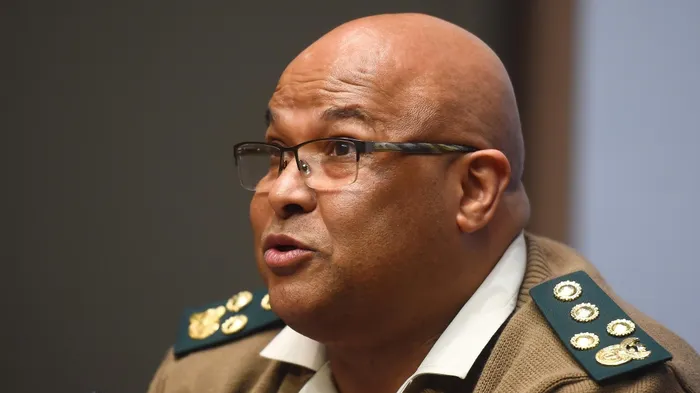
Former head of State Security Agency Arthur Fraser says he is hoping that the Constitutional Court will uphold the principle of equality before the law in its ruling on the Phala Phala matter on Friday.
Image: Phando Jikelo / Independent Newspapers
Former head of the State Security Agency, Arthur Fraser, expects that the Constitutional Court (ConCourt) will reinforce the foundational tenet that all individuals are equal before the law.
Fraser had filed a criminal complaint against President Cyril Ramaphosa about an alleged cover-up following a burglary at Ramaphosa's Phala Phala farm.
The ConCourt is expected to rule on the rationality of the National Assembly’s rejection of the Section 89 Independent Panel Report in December 2022.
The case centres on whether Parliament acted constitutionally and rationally when it voted 214 to 148 against adopting the report, which had found prima facie evidence that Ramaphosa may have violated his oath of office.
The EFF and African Transformation Movement (ATM) argue that the rejection was irrational and an attempt to shield Ramaphosa.
The National Assembly maintains it acted within its discretionary powers and that courts should not interfere with internal parliamentary decisions, upholding the separation of powers.
Fraser had filed a criminal complaint at the Rosebank police station, alleging that approximately $4 million (later contested by the president as $580 000) was stolen from the farm.
He alleged that the crime was covered up, and suspects were allegedly kidnapped and interrogated on the property to recover the funds, then paid for their silence.
He added that the money was not declared to the Reserve Bank.
On his expectations of the ruling, Fraser said he trusts that the decision of the court will reaffirm that everyone is equal before the law.
In his affidavit submitted to the panel in 2022, Fraser said the incident was never reported to the police to investigate. Instead, Ramaphosa instructed the head of the Presidential Protection Unit, Major General Wally Rhoode, to immediately investigate the incident, apprehend suspects, and retrieve the stolen dollars.
Fraser alleges that Rhoode constituted a team consisting of former SAPS members and serving members of Crime Intelligence, along with a local farmer, to investigate the matter.
He further alleged that a domestic worker was also paid R150 000 not to divulge any information about what had transpired at the farm.
Fraser added that the fact that Ramaphosa had large undisclosed sums of foreign currency concealed in his furniture is ‘prima facie proof’ of money laundering, contravening Section 4 of the Prevention of Organised Crime Act No. 121 of 1998.
He said the president's conduct may also amount to a contravention of Section 36 of the General Law Amendment Act No 62 of 1955.
“i.e., unexplained possession of suspected stolen goods, and contraventions of our various fiscal, currency, and exchange control, and customs and excise laws and regulations,” he said.
Fraser added that the payments made to the domestic worker and the suspects not only constituted corruption in contravention of the Prevention of Corrupt Activities Act, but were also intended to defeat and obstruct the course of justice.
He said it was also evident that the conduct of Rhoode and his team, having forcefully interrogated and kidnapped the alleged suspects, is unlawfully and intentionally depriving them of their respective personal freedom of movement and constitutional rights.
The panel found that Ramaphosa acted in a manner inconsistent with his office and exposed himself to a conflict between his official responsibilities and private business interests.
He was also found to have potentially violated the Constitution by engaging in other paid work through his farming business.
The panel also stated that Ramaphosa should answer for allegedly instructing the Presidential Protection Unit to conduct a secret investigation using state resources without a registered case docket.
Cape Times