

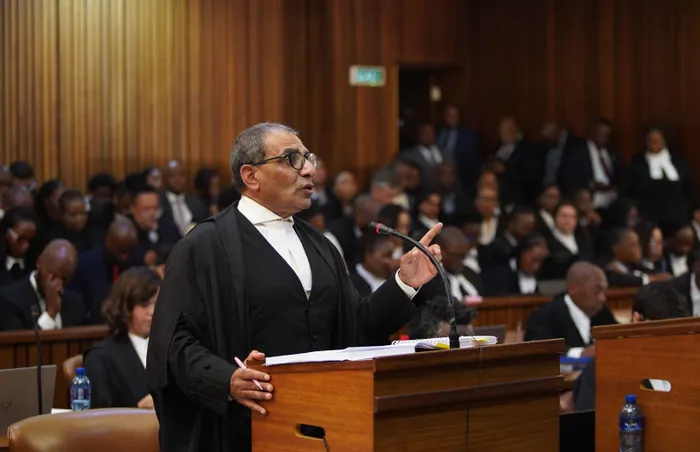
Advocate Azhar Bham during his arguments in the Pretoria High Court against the Legal Sector Code.
Image: Oupa Mokoena/Independent Newspapers
The “flawed” Legal Sector Code (LSC) risks harming broad-based transformation in the legal fraternity, rather than enhancing it, the Gauteng High Court, Pretoria, was told on Tuesday during the legal challenge to the B-BBEE LSC.
Four of the country’s top law firms are asking the court to review the sector-specific B-BBEE framework for the South African legal profession gazetted by the Minister of Trade, Industry and Competition Parks Tau in September 2024. The application was brought by Deneys (formerly Norton Rose Fulbright), Bowmans, Webber Wentzel and Werksmans. A host of legal bodies are opposing the application.
Advocate Azhar Bham argued on behalf of Deneys that the law firm welcomes the idea of a lawfully issued code, which applies to the sector as a whole and which imposes realistic targets in an equitable manner.
But as the LSC stands, it is not a lawful, rational and reasonable tool to achieve transformation. It omits key elements, such as socio-economic development and it is an unworkable regulatory instrument. Bham added that there are some things which should change in the generic BEE code policy, under which firms have been operating in the past, but this LSC is not the answer.
Advocate Tembeka Ngcukaitobi, on behalf of the other three law firms, also argued that the current LSC is fundamentally misconceived in design and effect, and that it will hinder rather than advance meaningful broad-based transformation.
He pointed out that it exempts more than 95% of legal practices from its requirements. Legal entities with between one and three partners make up 95.07% of legal practices, yet the LSC does not apply to them because they fall below the turnover threshold for compliance.
The firms argue that a code that applies to less than 5% of the profession cannot credibly transform the sector as a whole. Ngcukaitobi said if the LSC is allowed to stand, those most likely to lose are the people and institutions that rely on practical, broad-based pathways into the legal sector, including black law students, young graduates, black professionals in management, persons with disabilities, and the public-interest organisations that expand access to justice.
At the heart of the problem, he said, is that the LSC removes recognition for several proven transformation mechanisms under the generic codes. These include bursaries for black students and skills development for employees.
The firms also challenge the LSC’s treatment of management and ownership. They argue that it wrongly excludes black non-lawyers from management control scoring, even though black non-lawyers serve in critical senior management and leadership roles in law firms.
On ownership, Ngcukaitobi said the LSC imposes steep increases over a short timeframe that are not justified by the evidence before the minister and are practically unachievable. The ministry previously declined to promulgate the draft LSC, raising substantive concerns, including whether several deviations from the generic codes were justified.
It was argued that these concerns were not properly addressed before the LSC was promulgated, and the ministry failed to apply the level of scrutiny required before issuing a binding sector code with far-reaching legal and economic consequences.
The B-BBEE Act requires the minister to issue a B-BBEE strategy to guide sector codes. But no such valid strategy was issued in this case, meaning that the LSC was developed and promulgated without the necessary legal foundation, the court was told.
Judge Nicolene Janse van Nieuwenhuizen commented that it's not in dispute that the applicants are compliant with the generic code regarding transformation and the LSC is just a tool for them to move on. The packed public gallery loudly voiced their displeasure about this remark, which in turn sparked the judge to respond that she will not tolerate the disruption. “This case is about the proud law profession…I see so many lawyers sitting there (in the public gallery),” the judge said.
Ngcukaitobi meanwhile concluded that the court must strike the code down, as it cannot rewrite it or try and fix what is wrong.
Cape Times