

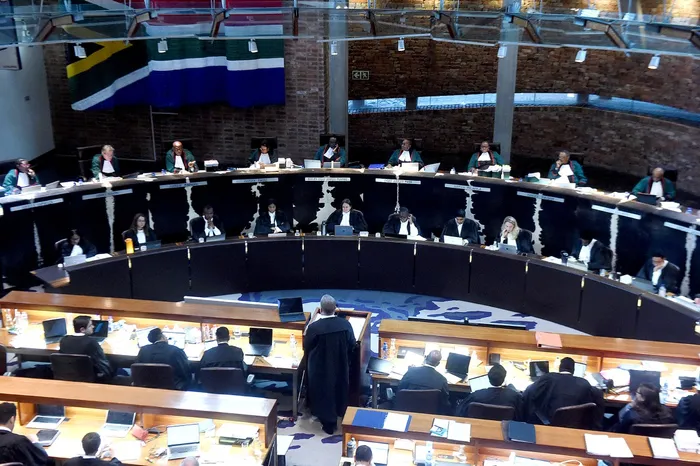
South Africa’s National Health Insurance (NHI) scheme case was heard at the Constitutional Court. The case is being brought by the Western Cape Provincial Government and the Board of Healthcare Funders (BHF), challenging the drafting of the Act.
Image: Itumeleng English/Independent Newspapers
The Board of Healthcare Funders (BHF) and Western Cape Government (WCG) believe Parliament flouted its own processes by not engaging a meaningful public participation process before the creation and passing of the National Health Insurance (NHI) Act.
With the gaping lacuna of a meaningful participation process, Advocate Bruce Leech SC argued before the Constitutional Court that the National Council of Province’s (NCOP) urgency to have the NHI Bill passed should render the Act unconstitutional and invalid, and should be set aside.
Leech SC said the apex court has entrenched principles relating to the “right to speak and to be listened to is part of the right to be a citizen, in the full sense of the word”.
“In a constitutional democracy, dialogue and the right to have a voice on public affairs are constitutive of dignity. This is a case about constitutional rights, dignity, and the right to be heard. It’s a question of the right of meaningful hearing.”
According to Leech SC, Parliament has fallen short of its own processes, and the standards and criteria that it has set for itself were not met when passing the Act.
He added that the NCOP was to show where they had “patched up the shortcomings” but when presenting their replying arguments, Leech SC said they had failed to do so despite putting forward that they had received “thousands of submissions”.
Leech SC said the process of meaningful public participation in this matter was not to be a quantitative exercise but rather a qualitative one.
“We kept saying the emperor has no clothes on, but the NCOP kept saying he does have clothes on. There was a disregard for meaningful public participation,” said Leech SC, adding that the NCOP's urgency in passing the Act in 2023 was premature.
“There was no urgency. The NCOP process was rushed through in eight weeks. The question must be why was it rushed and why could they not wait for information. The weakness in this process was the NCOP’s obligations (which they did not meet).”
Leech SC, answering questions from the full bench, submitted that while there were debate engagements between NCOP and departments, the gap was for debate in Parliament itself.
A parliamentary portfolio committee had afforded the public three months to submit written comments on the Bill. The committee received 338 891 written submissions.
Leech SC argued that the NCOP should go back to the drawing board to correct the gap in the process.
In its arguments, the BHF said: “The legislation was adopted in the absence of updated and reliable financial modelling, notwithstanding that such information was provided in various submissions from the public, raising real questions about affordability, sustainability, and whether the Act meets the constitutional standard of rational lawmaking.”
The objective of the NHI Bill is to provide universal access to quality health care for all South Africans, as enshrined in the Constitution, and is a strategy to achieve universal health coverage.
The BHF had said the NHI Act did not adequately define key elements, such as the scope of benefits, funding mechanisms, and implementation framework, limiting meaningful engagement and raising concerns about legislative certainty.
President Cyril Ramaphosa has agreed to delay the proclamation of key sections of the NHI Act until the Constitutional Court hands down its judgment.
Cape Times