

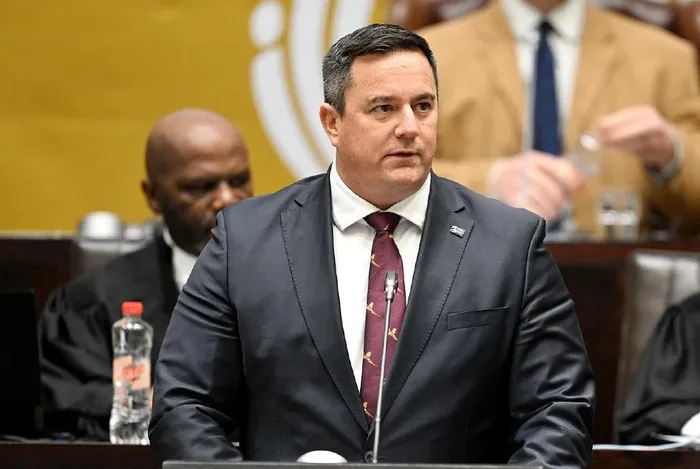
Minister of Agriculture John Steenhuisen.
Image: Phando Jikelo / Parliament of RSA
The rollout of the new Section 10 vaccine scheme in South Africa’s fight against Foot-and-Mouth Disease (FMD), allowing farmers to employ private veterinarians to administer vaccinations, has drawn a lukewarm response from industry stakeholders.
Gazetted on Monday, the scheme has been framed by Agriculture Minister John Steenhuisen as a “fast-track” intervention aimed at placing biosecurity firmly in farmers’ hands.
Addressing Parliament on Tuesday, Steenhuisen said the model is built on a public–private partnership, giving owners of cloven-hoofed animals a mechanism to curb the spread of FMD through voluntary vaccination, under the supervision of state veterinary services.
The added autonomy comes with strict conditions: farmers must ensure full traceability of livestock, capture vaccinations on a digital system, and submit to audits and inspections to demonstrate compliance with biosecurity rules.
The Red Meat Producers Organisation expressed reservations, saying the revised plan shows little meaningful change from earlier proposals.
CEO Frikkie Maré said the department appeared to have overlooked industry submissions.
“We do not feel that the Department considered the inputs made, as was suggested,” he said.
“Very little has changed from the first version. In fact, more was taken away than added, and there is still a lack of clarity on key technical issues, but hopefully it will be in the manual. ”
“The problem is that they now have 90 days to publish the operational manual although the scheme is gazetted as effective immediately,” Maré said.
He also raised concern about uneven vaccine allocation across provinces.
“The most important step now is finalising the Section 9 regulations for FMD, which will determine how vaccinated and positive animals are managed.
“Currently, we are vaccinating, but farmers still lack market access because there are no clear rules on how to deal with these animals,” he said.
Southern African Agricultural Initiative (SAAI) chief executive Francois Rossouw, whose organisation was among those that took the minister to court over vaccination rights, argued the approach runs counter to the strategy used Brazil and Argentina, countries which Steenhuisen recently visited.
“The strategy in Argentina and Brazil is to vaccinate as many animals as possible, in the shortest time, at the lowest cost. That is exactly the inverse of what we are doing,” Rossouw said.
“In South Africa, we are adding layer upon layer of bureaucracy with this latest Section 10, on top of what already exists.”
He also questioned the motives behind the approach.
“(Brazil and Argentina) used private industry. They didn’t centralise the entire value chain. Here, everything is being kept under central control,” he said.
“(The) thing I want to stress is we must measure John by the results on the ground and the results on the ground show that we have failed dismally,” he said.
Cape Times