

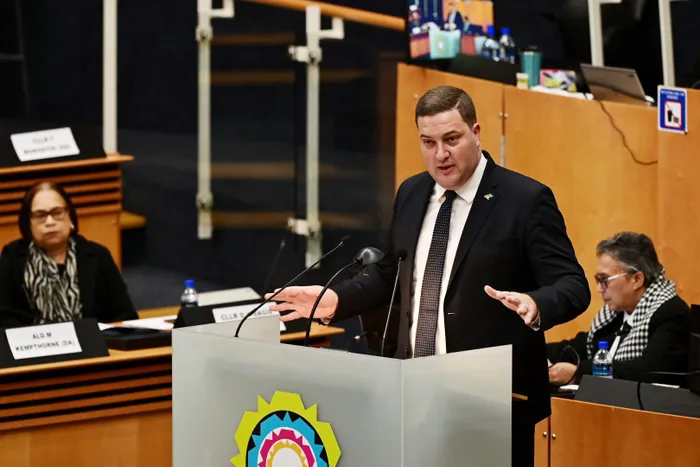
Mayor Geordin Hill-Lewis said the City cannot agree that wealthy property owners should be charged the same as lower-income or middle-class households.
Image: Supplied
The GOOD Party says it is procuring legal advice on steps to force the City to comply with last week’s Western Cape High Court finding that its fixed tariff regime is unlawful – and return over-charges to residents.
The court found the tariffs were inconsistent with the Constitution, national legislation and the City’s own tariff by-law.
The case was brought by the South African Property Owners’ Association (SAPOA) and AfriForum, challenging charges contained in the City’s 2025/2026 budget.
GOOD secretary Brett Herron said that while the court was clear on the unlawfulness of the City’s fixed cleaning, water and sanitation tariffs, setting them aside prospectively from June 30, 2026, the consequences of the ruling remain unresolved.
“A very significant amount of money was collected from residents under the unlawful regime over the past year,” he said.
“By not dealing with this matter, the court left a live issue of unlawful enrichment on the table that must still be addressed.”
Herron said with Mayor Geordin Hill-Lewis indicating that the City may appeal the judgment, GOOD was examining its legal options, including a cross-appeal, a further application for just and equitable relief, or both.
“GOOD is the only political party that took this matter beyond the council chamber to court, at significant cost.
“It did so because the unlawful tariff scheme targeted groups of people for extra payments they simply cannot afford, including those who have inherited property or whose property values have escalated exponentially due to gentrification or development. If the mayor were allowed to charge residents whatever he wishes, it would effectively force members of these groups to consider downgrading their accommodation, the diametric opposite of development.”
According to Herron, the 2025/26 budget showed that the city-wide cleaning charge alone was projected to raise R906 million.
“The fixed water charge and fixed sanitation charge are harder to isolate, but in total it is safe to say the amount is between at least R1.5 billion and R2 billion,” he said.
The SA1st Forum, which was amicus curiae in the case said the City is not necessarily obliged to repay the funds.
Convenor of the forum, advocate Rod Solomons, said the judges were deliberate in not instructing the City to repay the tariffs.
“The judges were very careful not to do something that would create administrative chaos, which would be caused by having to make such repayments.
“The only thing we think the court did not deal with sufficiently was public participation, which the City regards as just a tick-box exercise.
“People were clear that they were unhappy with these tariffs, and the City went ahead anyway. As for the mayor complaining that this will affect infrastructure spending, it just means they may have to delay that R30 billion expenditure until they find another affordable way,” he said.
The City meanwhile said it is analysing the court ruling and assessing legal options.
"The City is also modelling the budget impact of the ruling, especially the potential negative implications for lower- and middle-income households who the budget sought to protect.
"The ruling is prospective in that it sets aside the city-wide cleaning, water and sewerage charges with effect from 30 June 2026. Revenue has gone directly towards funding basic infrastructure and service delivery for all – not enrichment as falsely claimed," the City said.
The municipality added the costs of service delivery and infrastructure do not change or fall away as a result of this ruling.
"Cross-subsidising – where the better off among us help to fund service delivery for the less fortunate – remains the most equitable and sustainable way to ensure a working city of hope for all.
The City will keep striving to protect lower and middle-income households, as well as the crucial basic infrastructure investments necessary for Cape Town to remain a functional and successful city.”
Cape Times