

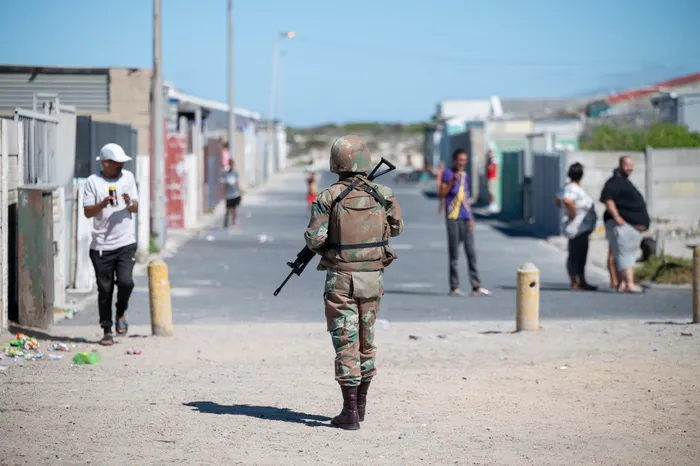
Members of the South African National Defence Force were deployed in Tafelsig to assist the South African Police Service in tackling crime in the area.
Image: Armand Hough / Independent Newspapers
The deployment of the South African National Defence Force (SANDF) has been slammed as a complete failure in Parliament as killings continue unabated on the Cape Flats.
Acting Police Minister Firoz Cachalia appeared before the police portfolio committee on Wednesday facing tough questions over what some MPs said appeared to be a lack of an intelligence-driven strategy underpinning Operation Prosper.
Soldiers have been deployed in the Western Cape and Eastern Cape since April 1 in an effort to stabilise gang violence hotspots, while in Gauteng, North West and Free State troops have been supporting operations targeting illicit mining.
ActionSA MP Dereleen James said the deployments had failed to curb violence, claiming deaths had instead worsened on the Cape Flats.
“If anything, since the deployment of the SANDF, there’s been more deaths on the Cape Flats,” she said
James raised concerns that there was no report on the operation’s progress.
The SAPS top brass, including newly appointed acting national commissioner Lieutenant General Puleng Dimpane, were at the committee to brief the annual performance plans for the 2026/27 financial year.
“Your presentation speaks to a whole-of-government approach. Why don’t we have that when it comes to this intervention? What are the challenges? Because it has clearly fallen flat on its back.
“Why haven’t we included forensics in this operation? It’s not there. There’s no intelligence. We speak to members involved in these operations — there’s absolutely no intelligence.”
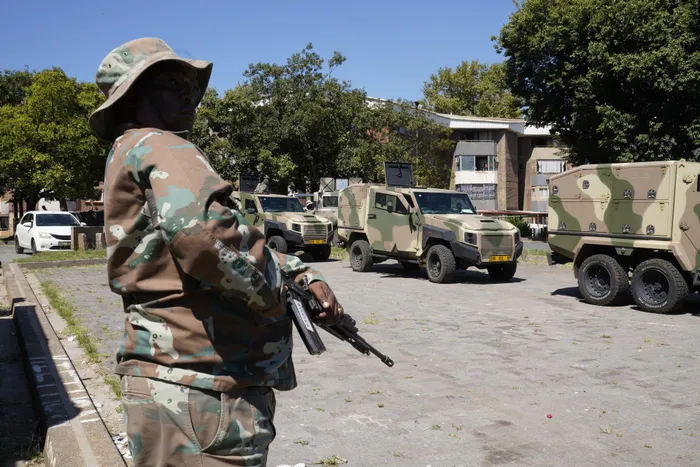
MPs have slammed operation prosper as a failure
Image: Timothy Bernard / Independent Newspapers
She said her own observations of deployments raised serious concerns.
“I was driving behind three of these operations in different areas for over an hour, and not a single time did SAPS or SANDF stop to actually conduct any operation.
“They drove through the community, they smiled, they waved, and then went to park, and that was the end. What is happening? We have allocated billions, yet we see only one SANDF van with eight members and four SAPS vehicles in our communities.”
An amount of R823 million has been set aside in the SANDF budget for the deployments.
Earlier this month, eight people were killed in a single afternoon in Mitchells Plain in separate incidents. In another case, a six-year-old girl was struck in the head by a stray bullet after being caught in crossfire between rival gangs in Valhalla Park.
Cachalia, however, cautioned against declaring the year-long deployment a failure at this stage.
“The deployment has just started. We as the ministry are also working on how to monitor the implementation of the soldiers, who are not directly under the command of General Dimpane.
“It is certainly premature to make the highly generalised observation that it is not working. The deployment is for an annual period.”
He said the intervention was intended to create space for a broader strategy to tackle organised crime.
“The critical question for police is how we use this period to improve the level of policing in relation to organised crime.
“The deployment of the SANDF was necessitated by the recognition that we were not succeeding in dealing with gangs and illegal mining at the level required. The deployment is supposed to give us the space to develop and implement a strategy to deal with organised crime.”
Acting national commissioner Lieutenant General Puleng Dimpane said specialised units were being prioritised, with R200 million allocated across the Western Cape, Eastern Cape, Free State and Gauteng to strengthen capacity.
“The conversation I am having with management is that we need to use these units as an exit strategy for the ongoing operation. We must ensure they are properly capacitated, particularly in the Western Cape,” she said.
Fadiel Adams said the violence spike had been anticipated.
“Those of us who live in the reality of the Cape Flats warned that despite the fanfare, the violence would spike,” he said.
Cape Times