

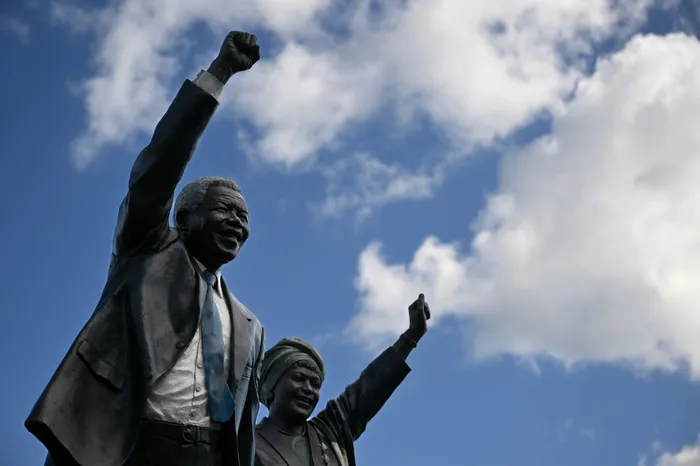
Nelson and Winnie Mandela statues at the "The Long March to Freedom" exhibition of life size statues at Century City's Canal Walk as the nation observes Freedom Day. The installation features 100 figures representing South African liberation heroes and the 350-year struggle against colonialism and apartheid, highlighting the sacrifices that led to the country's first democratic elections 32 years ago.
Image: Henk Kruger / Independent Media
Thirty-two years into South Africa’s democracy, the promise of constitutional equality continues to clash with lived experience, as millions remain shut out of the economic freedom that was meant to follow political liberation, a gap that, in many communities, is still widening.
The country marked Freedom Day on Monday, honoring the sacrifices made to end apartheid while reflecting on the challenges that remain.
BOSA spokesperson Roger Solomons warned that freedom is undermined when 57% of children live in poverty and youth unemployment remains high.
The warning reflects a broader national concern; apartheid’s legal structures may have fallen, but its economic footprint remains deeply entrenched.
Amnesty International South Africa Executive Director Shenilla Mohamed noted that the promise of dignity remains unfulfilled for the five million people living in informal settlements without access to adequate housing, water, or sanitation.
''Thirty-two years on, we honour those who paid the ultimate price for our freedom and those who led the nation through the turbulence. Their legacy lives on in our constitution, in the institutions that safeguard our rights, and in the democratic freedoms we exercise today.
''But Freedom Day must also be a moment of honest reflection. While political freedom has been secured, too many South Africans remain excluded from its full promise. Freedom is undermined when millions are trapped in poverty and when opportunity remains out of reach for most. Today, 57% of South Africa’s children live in multidimensional poverty. Unemployment, particularly among the youth, continues to rob a generation of hope and possibility.''
A recent Amnesty International South Africa report, Flooded and Forgotten: Informal Settlements and the Right to Housing in South Africa, highlights how families are being pushed into flood-prone areas due to a shortage of affordable housing.
It warns that more than five million people remain at risk, with many living in unsafe conditions due to systemic failures in service delivery.
The report shows that many settlements are built on low-lying floodplains, where seasonal flooding worsened by climate change destroys homes and livelihoods.
“Informal settlements and temporary relocation areas in South Africa starkly reflect the racial injustice of colonialism and apartheid. Yet, we must also recognise the ongoing housing crisis and the failure of successive governments to uphold the right to have access to adequate housing, among other human rights and basic services,” Mohamed said.
1976 student activist Seth Mazibuko said that while apartheid laws such as pass controls and segregation have been dismantled, the benefits of freedom have not fully reached ordinary citizens.
“We have been able to do away with so many things, (the) dompass, we have been able to do away with segregation, but we have not let this freedom benefit our people. We still have our children unemployed, we still have our women being molested, we still have the very country being exposed and vulnerable because of crime and because of corruption.”
The government, however, maintains that progress continues.
In Bloemfontein, President Cyril Ramaphosa stood before the nation to honour the ideals of 1994, invoking unity, dignity and the enduring promise of freedom.
“Today, we recall the words of our first democratic President Nelson Rolihlahla Mandela at his inauguration, when he said: ‘The time for the healing of wounds has come. The moment to bridge the chasms that divide us has come. The time to build is upon us.’ On that first day of our freedom, as a nation, we entered into a social contract to build a society anchored in human dignity, equal rights and freedom for all.”
Ramaphosa highlighted land reform and service delivery, arguing that dignity begins with access to basic needs.
“Dignity starts with the most basic things: a roof over one's head, clean running water, reliable electricity. Freedom is about the ability to go to a clinic when one is sick, to have a school for one's children, and being provided for in old age,” he said.
Cape Times