

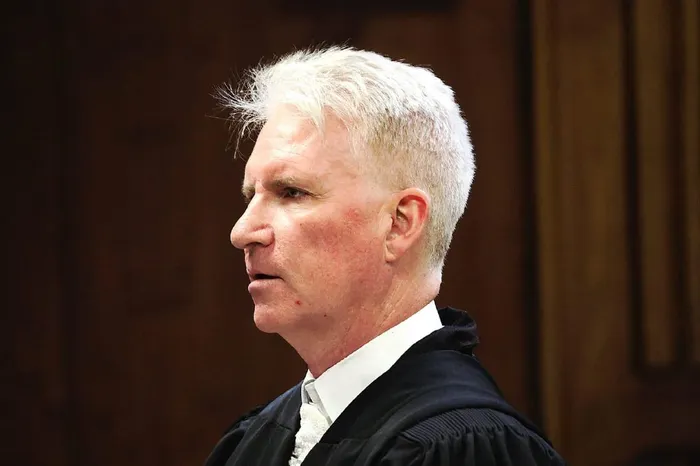
Lawyer Douglas Shaw, who previously represented the hundreds of applicants in the R60 billion class action against banks, has officially had his mandate cancelled.
Image: Timothy Bernard Independent Newspapers
While the R60 billion class action against four of the country’s major banks has been stalled, the Legal Practice Council (LPC) is expected to turn to court this week to have lawyer Douglas Shaw suspended.
Shaw has been driving the case on behalf of previous homeowners who initiated the action against the banks.
The LPC - the watchdog organisation over the South African legal profession - is turning to the Gauteng High Court, Pretoria, for an urgent order after it had emerged that Shaw appeared for the homeowners earlier this year in the Johannesburg High Court without a Fidelity Fund Certificate.
The certificate, which is issued by the LPC, is a vital document for an attorney and certain advocates to have. If they appear in court on behalf of clients without it, it could be regarded as a criminal offence.
As Judge Leonie Windell was preparing to hear the long-awaited application, one of the banks dropped a proverbial bombshell that Shaw did not have a Fidelity Fund Certificate. This, the court was told, was divulged by a whistleblower.
Shaw explained that he had the certificate last year, but it was not renewed for this year. He explained that due to work pressure and being "overwhelmed", he simply did not get around to renewing it. He, however, assured the court that he is on the brink of receiving it and that only a few documents required by the LPC were still outstanding.
But Judge Windell was adamant that without it, he would be off this case. She also requested the LPC to investigate the matter and to report back to court. The Gauteng arm of the LPC, in its report, stated that Shaw not only brought the legal profession into disrepute but committed a criminal offence when he appeared without a Fidelity Fund Certificate. The Investigating Committee of the LPC recommended that an urgent application be brought to suspend Shaw from the roll of legal practitioners.
While the LPC has remained mum regarding the application, Shaw yesterday confirmed that he will be hauled to court this week. He declined to comment on the issue at this stage, other than to say that he will vigorously oppose it.
The class action hearing was set down in February after nearly six years of preparation for the case, in which the applicants claim that they had previously lost their homes at the hands of the banks in cases where this drastic step was not necessary.
Others complained that they were severely shortchanged as their homes were sold for far below their market price to recover outstanding debt. The banks are contesting the application and in lengthy court papers stated that they do everything possible to protect default homeowners.
The LPC has set out in its report that Shaw, who was admitted as an advocate in 2010, was given permission in 2024 to convert to an attorney. He held a Fidelity Fund Certificate, according to the LPC, until the end of 2025.
Shaw told the court that his certificate was extended for a month, thus until the end of January. The LPC disputed this and said in terms of the law, it cannot be extended as a new one has to be issued each year. It acknowledged that Shaw had submitted an audit report for his practice, as required, but said there were outstanding documents.
Shaw has, meanwhile, reassured all the applicants in the certification application that a new “top” legal team has been appointed to continue with the case. Another judge is expected to hear the class action certification application after Judge Windell was earlier this month recommended by the Judicial Service Commission to fill one of the three vacancies at the Supreme Court of Appeal.
Cape Times