

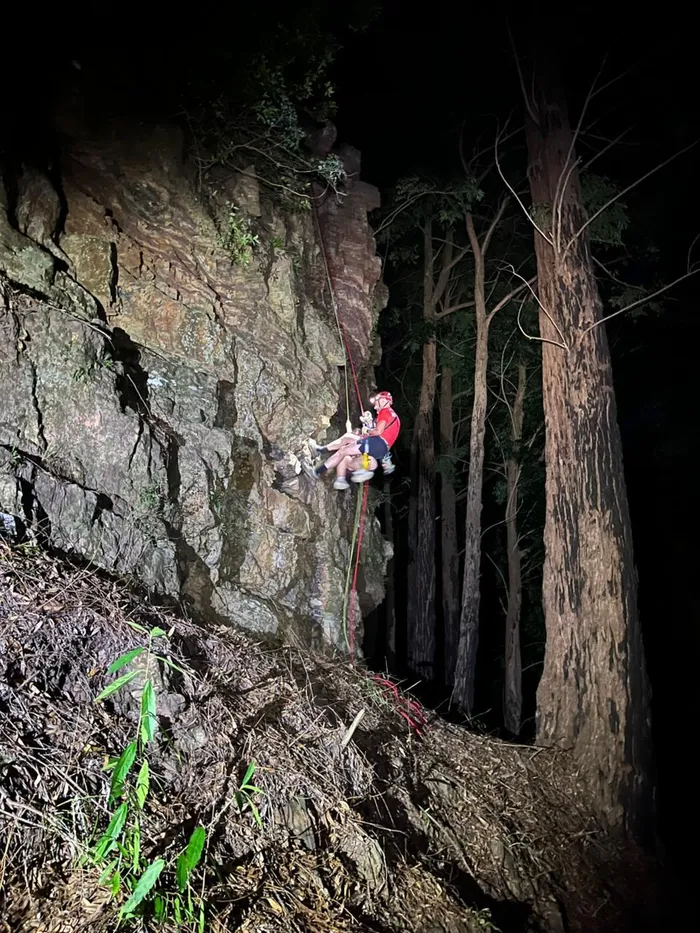
WSAR teams were called into action on Friday night after two hikers became stranded on cliffs above the contour path on Devil’s Peak, part of the Table Mountain range.
Image: Naadirah te Water Naude/WSAR/Supplied
Wilderness Search and Rescue (WSAR) teams came to the rescue of hikers near Devil’s Peak as the cold and wet weather hit Cape Town over the weekend.
WSAR was called into action on Friday night after two hikers were reported stranded on cliffs above the contour path on Devil’s Peak, part of the Table Mountain range.
WSAR spokesperson David Nel said the pair, aged 22 and 20, had set out from Rhodes Memorial at approximately 1pm, intending to ascend First Waterfall Ravine, a steep and challenging route that climbs from the eastern slopes of the mountain toward the plateau.
“At some point during their ascent, the hikers decided to abandon their attempt. Instead of retreating the way they had come, they attempted to traverse out of the ravine onto the neighbouring buttress, before trying to down-climb a sheer cliff face, a decision that quickly placed them in extreme danger,” Nel said.
“The first hiker managed to reach a ledge approximately one metre wide, where she wisely stopped. Her companion, however, slipped while attempting to find a route down, coming to rest on an extremely narrow ledge estimated to be just 10cm wide, smaller than the length of a foot.”
He said that with no safe route up or down and exposed to a potentially fatal fall, they contacted the WSAR emergency number requesting assistance.
He added that rescue teams, including Metro EMS, High Angle Rescue, Delta SAR, TrailSAR and a dozen MSAR rescue volunteers, were rapidly mobilised.
“However, deteriorating conditions and the complexity of the terrain made access to the stranded hikers exceptionally challenging. Teams made multiple attempts to approach from above and below in an effort to establish a safe rescue line.”
A technical rescuer and rock climber from the Mountain Club of SA - Search and Rescue, Brent Russell, said when they arrived, the situation was desperate.
"It looked like the male hiker was minutes from falling; he looked unstable and was already shaking.
“The rock face is made up of mud shale, a soft, brittle material that breaks easily and does not allow for safe anchor placement. It makes technical climbing and rescue extremely challenging.”
In a carefully coordinated technical operation, a rescue climber was able to climb above and abseil down to the stranded male hiker, where he was swiftly secured into a harness and assisted down the remainder of the cliff to safety.
“The rescuer then climbed back up the rope and repeated the process for the female hiker, safely bringing her down from the ledge. Rescuers reported that the male hiker was unstable after standing in place on the small ledge for nearly four hours, and both individuals were cold following their prolonged exposure on the cliff.
“They carefully and quickly assisted to waiting vehicles for further assessment.”
Nel said that the incident was concluded at 10:37 pm, with everyone safely off the mountain. The hikers sustained no injuries.
“This incident underscores the serious risks of taking shortcuts, making route-finding errors, and attempting to descend unfamiliar or exposed terrain. First Waterfall Ravine is not a casual hiking route. It requires experience, careful route selection, and a willingness to turn back early,” he said.
“Considered one of the more serious and treacherous trails on Devil’s Peak, it features a stream with waterfalls, narrow ledges with dangerous drops and steep scrambles that connect to the 700‑metre traverse near Minor Peak.