

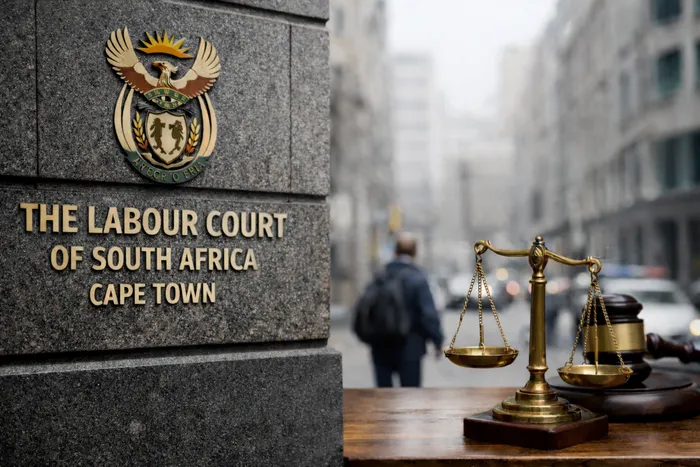
Cape Town Labour Court upholds dismissal of health department worker for disrespectful emails.
Image: AI Generated
The Labour Court in Cape Town has dismissed an application by a former Western Cape Department of Health employee seeking to overturn an arbitration award that upheld his dismissal, ruling that the arbitrator acted reasonably and that the dismissal was both procedurally and substantively fair.
Judge Robert Lagrange found that Nqaba Albertus Mphalwa, who worked as a Central Processing Operator at Red Cross Hospital, failed to show any irregularity in the arbitration proceedings that would justify setting aside the award.
Mphalwa had worked for the department since 2015 before being dismissed in April 2023 after an internal disciplinary process and unsuccessful appeal. He later approached the Labour Court to review the arbitration ruling that confirmed his dismissal.
Initially, Mphalwa was facing six charges, however, by the time the matter reached arbitration, one of the charges had been withdrawn because it had previously been addressed in an earlier disciplinary process.
The arbitrator therefore considered five remaining allegations, including prolonged absence from work without permission, repeated failure to follow instructions relating to medical certificates, sending disrespectful emails to management, and leaving the workplace despite direct instructions not to do so.
Central to the dispute were emails Mphalwa sent to his supervisor, T Itumeleng, which the department said were disrespectful and offensive.
In one message sent on August 10, 2021, Mphalwa wrote: “Don’t get frustrated I have responded but not with a (fist emoji). Let’s pray they don’t hit you again!”
The comment referred to a prior incident in which other staff had assaulted the supervisor. Evidence before the arbitrator was that the email deeply upset Itumeleng and contributed to a deteriorating working relationship.
The supervisor testified that Mphalwa had previously compared dealing with him to dealing with an elephant rather than a lizard and said the relationship had become so strained that he felt fearful, reduced to tears, and ultimately applied to transfer to another hospital.
In another email sent in December 2021 concerning incapacity leave forms, Mphalwa warned his supervisor “to refrain from taking unlawful instructions from so called nursing management.”
The department argued that the communications formed part of a broader pattern of disrespect, absenteeism and refusal to follow instructions that ultimately destroyed the employment relationship.
A major issue in the review application was Mphalwa’s claim that it was unfair for the disciplinary hearing to proceed in his absence due to illness. The court noted that the hearing had already been postponed multiple times at his request, and that he had been clearly warned that further postponements would require objective medical confirmation or testimony from his doctor.
When he neither attended nor provided the requested medical evidence, the hearing proceeded without him and resulted in his dismissal.
Judge Lagrange agreed with the arbitrator that the employer had “bent over backwards” to accommodate him and that proceeding with the hearing was reasonable and necessary to bring the matter to finality.
One of the most serious findings against Mphalwa was that he had attempted to mislead the arbitrator by relying on documents that were found to be unauthentic. Among these was a purported agreement stating that a supervisor had authorised him to leave work for annual leave to attend a psychiatric appointment. The supervisor denied drafting or signing the document.
Mphalwa argued that the arbitrator should not have questioned the authenticity of the documents without expert evidence. The court rejected this argument, emphasising that the burden rests on the person relying on a document to prove its authenticity.
Furthermore, the judge found that the arbitrator was entitled to conclude, on the probabilities, that the document was fabricated. The court noted the unusual wording in the document, which stated that it could be used as evidence in the future, as a factor supporting the inference that it was created in anticipation of a dispute.
Mphalwa also argued that the arbitrator committed an irregularity by refusing to allow him to call a doctor to testify about his illness during arbitration. The court held that he should have raised and put such evidence to the employer’s witnesses earlier in the proceedings. Introducing it later would have been unfair and, in any event, would not have affected whether the disciplinary chairperson acted fairly based on the information available at the time.
After reviewing all the grounds raised, the Labour Court concluded that the arbitrator had handled the evidence properly and reached a decision that a reasonable arbitrator could have made.
The court dismissed the review application, condoned the late filing of the employer’s answering affidavit, and made no order as to costs.
Cape Times