

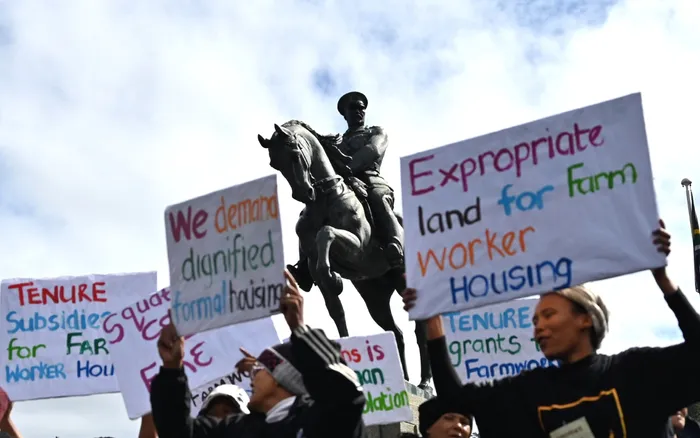
Women farmworkers are demanding the acceleration of land expropriation and land redress.
Image: Ayanda Ndamane/ Independent Media
Women on Farms Project has called on Land Reform and Rural Development Minister Mzwanele Nyhontso to strengthen the Extension of Security of Tenure Act (ESTA) to better protect vulnerable communities facing evictions on farms.
Women working on farms in the Cape Winelands area protested outside Parliament on Tuesday where they handed a memorandum to the department's acting chief director Nyameko Mgoqi.
Director Carmen Louw said the Act, amended in 2024, empowers the Department of Rural Development and Land Reform to develop housing for farm dwellers, but the department has failed to provide statistics on how many people have benefited.
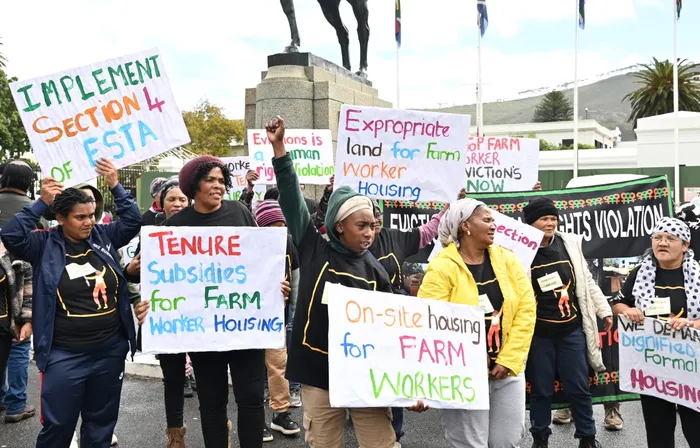
farmwomen Women farmworkers are demanding the acceleration of land expropriation and land redress.
Image: Ayanda Ndamane/ Independent Media
“Although there is an Act, dwellers still face continuous evictions and its negative impact,” she said.
Louw pointed to Section 4 of ESTA, which provides long-term grants that can be used to purchase land and develop housing for farm dwellers at risk of eviction.
“We’ve asked for statistics on how the tenure grant has been applied. They don’t have any, so we assume it has not been implemented,” she said.
The organisation argues that the eviction crisis is rooted in historic land dispossession and inequality, and has called for accelerated land redistribution, including expropriation of unused farmland.
It also raised concerns about the rezoning of agricultural land in high-value areas such as Stellenbosch, Paarl and Franschhoek for luxury estates.
“The department says farmers are unwilling to make land available. That is why we are saying the state must expropriate,” Louw said.
The memorandum, directed to the departments of rural development, agriculture and public works, calls on the ministers to engage with the demands of women farm workers and dwellers, particularly on the intersecting challenges of land redistribution, evictions, food insecurity, spatial planning and inclusive infrastructure development, with a focus on women and small-scale producers.
Key demands include the development and implementation of land redistribution legislation that prioritises farm women, including access to developmental grants and the registration of land in the names of farm dwellers.
It further calls for transparency, including data on the number of Section 4 applications received and finalised, and for the effective implementation of the Expropriation Act 13 of 2024 to facilitate land redistribution to farm workers and dwellers who have worked the land for generations.
Janie Pietersen, 50, who lives with her husband and four children on a farm in Wellington said they were being offered poultry amounts to relocate from a farm she has lived her whole life.
"I have been living there for 38-years. My parents also lived there," she said.
"The owner of the farm has started trying to evict people but its illegal because there are no court papers. She is offering R38 000 to some but that is unfair because we have lived there all our lives and that is not enough to start a new life," she said.
Roos van Niekerk, 57, said they did not trust they would have a fair hearing in court.
“We are facing eviction. There are 13 of us living in one house, including children, and we are worried about where we will go if we lose the court case," she said.
"We want to be given a portion of land where we can build homes or grow food to support ourselves. We have not received any assistance from the government," she said.
Mgoqi said the memorandum would be forwarded to the department’s director-general, with a formal response to be provided to the organisation.
Cape Times