

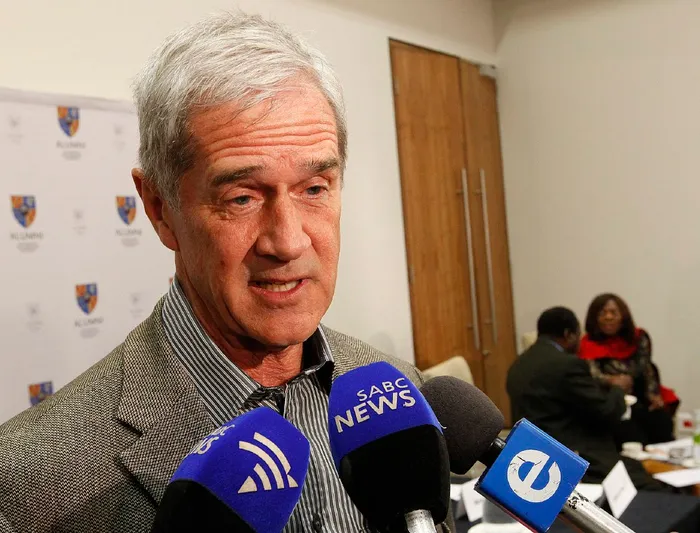
President Cyril Ramaphosa has pushed back against public criticism of his appointment of apartheid era minister, Roelf Meyer as the country’s next ambassador to the United States.
Image: FILE
Lee Rondganger and Ntsikelelo Qoyo
President Cyril Ramaphosa has pushed back against criticism of his appointment of apartheid era minister, Roelf Meyer as the country’s next ambassador to the United States.
Speaking on the sidelines of the National Local Economic Development Summit on Wednesday, Ramaphosa said that any ambassador who does not toe the South African government line will be recalled.
“One of the criticisms that has been levelled against Mr Meyer's appointment is that he joined the ANC. Now, you join the ANC, knowing well that you are embracing the policies that the ANC has articulated,” Ramaphosa told reporters.
“Now, I'm not putting emphasis on his political affiliation, and as a diplomat, he obviously needs to be as neutral as possible... Mr Roelf Meyer is well attuned with the policies of this country, of this government, and every ambassador who represents me, because as president, they represent the president and the country. Every ambassador who represents South Africa, in foreign missions, must comply and articulate the policies of the government that has sent him or her. If he doesn't, he must come back,” he said.
Ramaphosa’s remarks come amid criticism of the appointment with many citing Meyer’s role in propping up the apartheid regime and later negotiating a settlement that did not benefit the majority of South Africans.
The Economic Freedom Fighters on Wednesday called Meyer’s appointment “tone deaf” and an affront to the country’s democratic history.
In a statement, the EFF said Meyer’s record in the apartheid government disqualifies him from representing South Africa. It pointed to his roles as a National Party MP and later as deputy minister of law and order and minister of defence, positions it says placed him at the centre of state repression.
The party argued the move is especially offensive as it coincides with commemorations of Chris Hani, warning against the rehabilitation of apartheid era figures who later repositioned themselves as democrats.
The ambassadorial post in Washington has remained vacant since March 2025, when US President Donald Trump expelled then envoy, Ebrahim Rasool.
The move followed criticism Rasool made about the Make America Great Again movement during an academic discussion.
Political analyst and director of Surgetower Associates Management Consultancy Siseko Maposa said Meyer’s appointment as US ambassador is significant on multiple fronts.
“On the first front, symbolically, as an Afrikaner who navigated the CODESA negotiations alongside Ramaphosa, his appointment signals to Washington that South Africa continues to foster cross-racial cooperative leadership, countering persistent US narratives that Afrikaners face undue persecution,” he said.
“That said, while business and the GNU coalition partners broadly support Meyer, certain Afrikaner circles have already voiced concerns that he will not represent their interests in the US. We can therefore anticipate a counter-narrative framing Meyer’s appointment as an attempt to whitewash alleged genocide against white Afrikaners, a claim that, while unsubstantiated, may gain traction in specific quarters and convince a very ignorant Trump administration.”
On the second front, he said strategically, Meyer’s negotiating credentials are well-suited to manage current turbulence between Pretoria and the Trump administration.
“His primary utility will be to bring both parties back to the table, a basic but essential element absent for over a year in high intensity foreign policy engagement.
“Nevertheless, Meyer’s capabilities are not the core issue: South Africa’s broader foreign policy agenda is.
“Regardless of who serves as ambassador, Washington will press Pretoria on domestic policies such as BEE, its continued support for Palestine to Israel’s detriment, and its growing ties with US adversaries like Iran and Russia.
“These are fundamental ideological and/or policy questions – whether South Africa will pursue genuine non-alignment or double down on its current foreign policy trajectory. Ultimately, that choice will determine whether bilateral relations improve or deteriorate further,” he said.
Wits Professor Mcebisi Ndletyana said: “(Ramaphosa) needs someone with a lot of credibility, especially to dispel all the lies that the president of America is spreading. Donald Trump knows he is spreading lies, he is not being misled. He believes in using misinformation.
“In this case, success would be restoring diplomatic relations between SA and the United States. Reopen that channel.”
During the early 1990s negotiations, Meyer was the National Party’s chief negotiator and worked closely with Ramaphosa ultimately leading to the country’s first democratic elections in 1994.
Meyer formally joined the ANC in 2006.
The Presidency said Meyer will assume his duties in Washington once standard diplomatic procedures with US authorities have been finalised.
Cape Times