

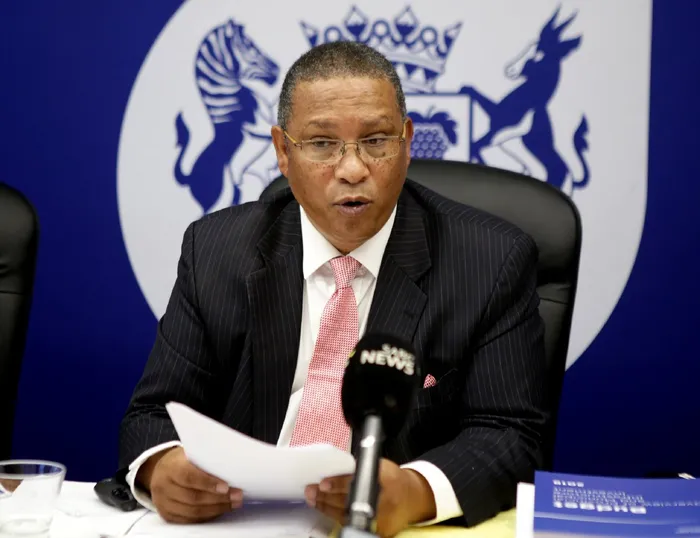
Agriculture MEC Ivan Meyer was defeated by Solly Msimanga in the race for DA federal chairperson.
Image: Supplied
After more than a decade in the DA’s top leadership structures, Agriculture, Economic Development and Tourism MEC Ivan Meyer has been left in the cold following a bruising defeat to Solly Msimanga in the race for federal chairperson at the party’s congress over the weekend.
The two-day congress, attended by more than 2000 delegates, concluded on Sunday with Cape Town mayor Geordin Hill-Lewis emerging as the party’s new leader.
It was reported that following the announcement of the results, Meyer stormed out of the plenary hall shortly afterwards.
When contacted on Monday, Meyer referred the Cape Times to a social media post on Sunday in which he pledged to support Msimanga.
“Congratulations to our newly elected federal leadership,” he wrote.
“Democracy is the winner. Thank you to all the candidates. We all fought a hard and clean campaign. When democracy wins, South Africa wins.
“I have already reached out to the new federal chairperson and we will meet soon to assist and support him. Together, we will work side by side during LGE2026.
“We must navigate this path together, win more municipalities and rescue those in distress across South Africa. That is now my next mission.”
Meyer was first elected in 2015 as one of the DA’s three deputy federal chairpersons. He was elevated to federal chairperson in 2019 following the resignation of Athol Trollip, and went on to retain the post in subsequent elections.
Political analyst and director at Surgetower Associates Management Consultancy Siseko Maposa said Msimanga’s election was unexpected.
While Meyer brought extensive experience and long service within the party, Maposa argued this was not what the DA was prioritising at this stage.
“Heading into the conference, Ivan Meyer appeared the more predictable, conventional choice, given his extensive tenure across multiple senior leadership roles within the DA.
"Yet those very credentials, while impressive on paper, are not what the party prioritises at this juncture. Simply put, the DA is no longer competing on experience alone.
“It is competing to win the minds of voters and to reshape deeply entrenched negative perceptions, particularly those of a generational divide and a persistent representational imbalance.
“When viewed alongside the profiles of other winning candidates such as Hill-Lewis, (Siviwe) Gwarube, (Solly) Malatsi, (Ashor) Sarupen and (Mark) Burke, a clear strategic reorganisation emerges.
“Three critical imperatives shed more light on this reorganisation.”
He said the first was the urgent need to win key metros in the upcoming local government elections, “which requires securing the support of youth voters and, crucially, black voters”.
“The second is the necessity of elevating qualified younger leaders into senior office.
“Third, the imperative to confront the party’s longstanding representational imbalance.
“Seen through this lens, Msimanga’s election is not only surprising, it is a deeply political and highly functional decision,” he said.
Dirk Kotze, a Unisa professor, said the outcome should also be understood through the lens of internal provincial dynamics, particularly the long-standing contest between Gauteng and the Western Cape.
“In the DA, throughout its history, but especially in recent years, there has been quite intense competition between the Western Cape and Gauteng for key positions in the party.
“The two candidates represented that dynamic.
“There was some resurgence from Gauteng, but four out of the ten leadership positions went to the Western Cape, while three went to the north.
“I would place it within that context — it was not so much about the individuals per se, but rather about broader internal dynamics,” he said.
He added that Meyer’s continued presence in leadership would not necessarily have undermined the party’s renewal agenda.
“There is, therefore, a mix in terms of generations,” he said.
Cape Times