

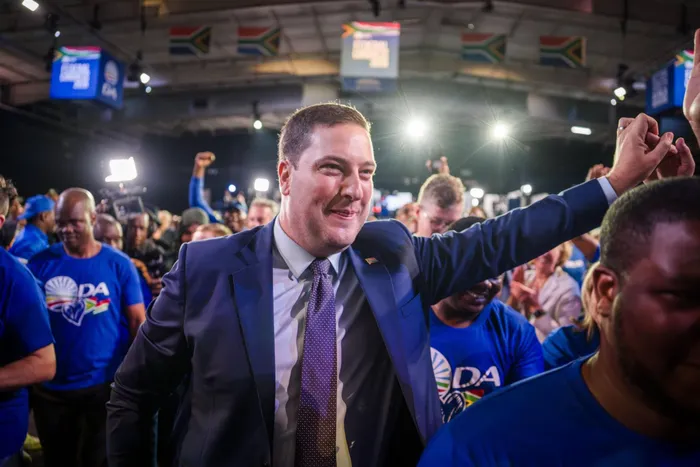
Cape Town Mayor Geordin Hill-Lewis was elected leader of the DA during the party's Federal Congress at the Gallagher Convention Centre in Midrand on Sunday.
Image: DA/Facebook
Newly elected DA leader Geordin Hill-Lewis says his leadership will be defined by a singular mission: expanding the DA’s electoral base and positioning it to take control of national government in the coming years.
Speaking shortly after his election at the DA’s Federal Congress on Sunday, Hill-Lewis said the party was entering a “new chapter”, shifting its focus from opposition and governance at the local level to competing for national power.
“The question is whether the DA can lead the country… whether we can become the largest party in national government,” he said. “My answer is a resounding yes.”
Central to his address was a four-part strategy aimed at strengthening the party’s electoral prospects.
First, Hill-Lewis emphasised the need for the DA to continue demonstrating governance capacity where it is already in power. He said the party’s track record in municipalities, including his tenure as Cape Town mayor, shows that “the basics work” under DA leadership, citing functioning institutions, responsible budgeting, and service delivery.
“When we do the basics well, it is the poor who benefit the most,” he said, pointing to improvements in sanitation, public transport, and community infrastructure in DA-run areas.
Second, he acknowledged the need to broaden the party’s support base by connecting with voters who have not previously backed the DA. This, he said, would require a more grounded and community-driven approach.
“We must earn trust the old-fashioned way, community by community, street by street, conversation by conversation,” Hill-Lewis said, adding that the party must listen more and be more visible in local communities.
Third, Hill-Lewis addressed the DA’s role within South Africa’s Government of National Unity (GNU), describing it as a “complex and fraught” arrangement, but one that reflects voters’ rejection of instability.
He said the DA would remain a “strong and principled partner” in government, while continuing to oppose policies it believes undermine economic growth or constitutional principles. This includes opposition to what he described as “crony enrichment schemes” and policies that threaten property rights or merit-based appointments.
Finally, Hill-Lewis stressed the importance of political messaging rooted in optimism and belief in the country’s future.
“We will not listen to the naysayers… I believe deeply in [South Africa’s] future,” he said, positioning the DA as a party of action rather than rhetoric.
Hill-Lewis identified crime as the country’s most urgent crisis, placing law and order at the centre of his policy agenda.
Describing widespread fear among ordinary South Africans, he said restoring safety and rebuilding the criminal justice system would be his top priority.
“Bringing law and order to South Africa must be our top priority. Not one priority among many,” he said.
He called for sweeping changes to policing, including tackling corruption within the South African Police Service and dismantling criminal syndicates.
Hill-Lewis also used his speech to rally party structures ahead of the upcoming local government elections, identifying key metros such as Johannesburg, Tshwane, Ekurhuleni, Cape Town, Nelson Mandela Bay and Durban as battlegrounds.
He said success at the local level would be a critical stepping stone towards the 2029 national elections, where the DA aims to transition from a coalition partner to leading government.
“I am not satisfied with being a junior partner in a government of national unity. Our ambition must be to lead the national government,” he said.
While acknowledging the challenges ahead, Hill-Lewis called on party members to intensify their efforts, stressing discipline, organisation, and grassroots engagement as key to winning voter support.
Hill-Lewis succeeds John Steenhuisen, who led the party through its transition into the GNU.
In a clean sweep for a "new generation" of leadership, Hill-Lewis is joined by Gauteng leader Solly Msimanga, who was elected Federal Chairperson, taking over from Helen Zille.
The elected leaders are:
Cape Times