

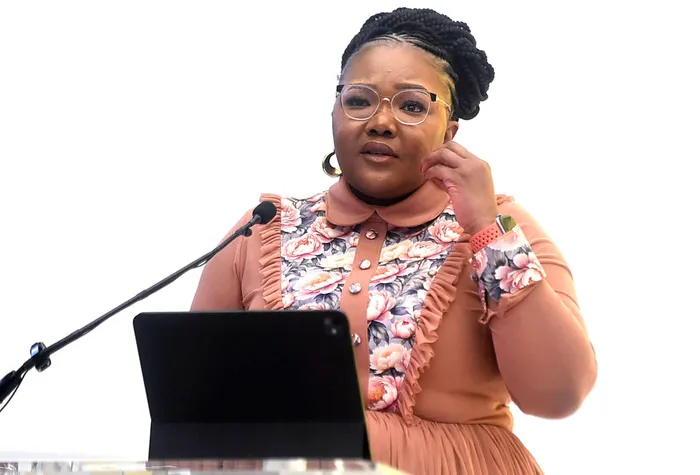
Basic Education Minister Siviwe Gwarube has gazetted the new proposed curriculum for history
Image: Itumeleng English / Independent Newspapers
“We have been here before. South Africa has a painful history of curriculum reforms that were great on paper and hollow in practice.”
These were the words of University of Pretoria head of department (HOD) for History, Heritage and Cultural Tourism Professor Siona O'Connell in reaction to the proposed overhaul of South Africa’s school History curriculum which could redefine how future generations understand identity and knowledge.
Experts however warned that the project may be too ambitious for the overstretched conditions in which most teachers currently operate.
Draft revisions to the History Curriculum and Assessment Policy Statement (CAPS) for grades 4 to 12 is now open for public comment after being gazetted by Basic Education Minister Siviwe Gwarube on March 20.
The new curriculum seeks to place Africa at the centre of the historical narrative, moving away from a long-standing Eurocentric framing that often began with the arrival of colonial figures in 1652.
According to schedules that have been made public through the department website, an African-centred approach makes the effort to explore, use various forms of archives and sources such as oral, archaeological, written and visual, linguistic to investigate historical questions about Africa and its interactions with the rest of the world.
In addition to recognising a broad range of sources of evidence, it also embraces a wide range of technologies and techniques such as remote sensing, DNA analysis or chemical analysis of bone and dating techniques.
University of Pretoria head of department (HOD) for History, Heritage and Cultural Tourism Professor Siona O'Connell stated that defending the direction of this curriculum does not mean pretending it has no problems.
“It has real ones,” she said.
“The curriculum is extraordinarily ambitious - possibly too ambitious for the conditions in which most South African teachers are currently working.
“Asking teachers to facilitate oral history projects, engage with archaeological evidence, and draw on multilingual sources is asking a great deal of people who are already overstretched, in under-resourced schools, with large classes and inadequate support.
“Without serious and sustained investment in teacher training and classroom materials, the most important ideas in this curriculum will simply not reach the children who most need them.
Despite these challenges, O'Connell said the fixing of the curriculum is overdue.
Generation after generation of South African children – including many of today's parents – left school without knowing that the city of Timbuktu was a global centre of learning while Europe was in its medieval period.
“That is what this new curriculum is trying to fix. And that project is long overdue. The new curriculum starts with Africa. Children will learn about ancient African civilisations not as curiosities but as the main story. They will learn to read oral traditions, praise poetry, and clan histories as legitimate historical sources alongside written documents. They will be taught to ask hard questions about the past rather than simply memorise a received account."
According to the department by the end of Term 4 in Grade 6, learners should be able to answer the key question: “What was the nature of society in the Kingdom of Mali?"
And by the end of term 1 in Grade 12 they should be able to engage, “How did imperialism and industrialisation affect South Africa in the late 19th and 20th century?”.
“A child who grows up knowing that African societies were sophisticated, innovative, and globally connected long before colonialism carries a fundamentally different understanding of what Africa is and what Africans are capable of.
“That is not a small thing. Identity, dignity, and a sense of what is possible are all shaped by the stories we are told - and the stories we are not told - about our own past,” said O’Connell.
Sadtu has also welcomed the change in the curriculum.
Spokesperson Nomusa Cembi said it had long advocated for the subject to be compulsory in schools.
“History has been taught from a colonial perspective, which has ignored African values.
“We have been advocating to make it compulsory in schools to foster a national identity, social cohesion, encourage the understanding of different cultures and traditions and societies to help students understand and appreciate the world around them and provide a sense of identity and critical thinking,” she said.
She said the union will make comments on the draft and ensure the final curriculum is responsive, balanced and reflective of an African society.
Cape Times