

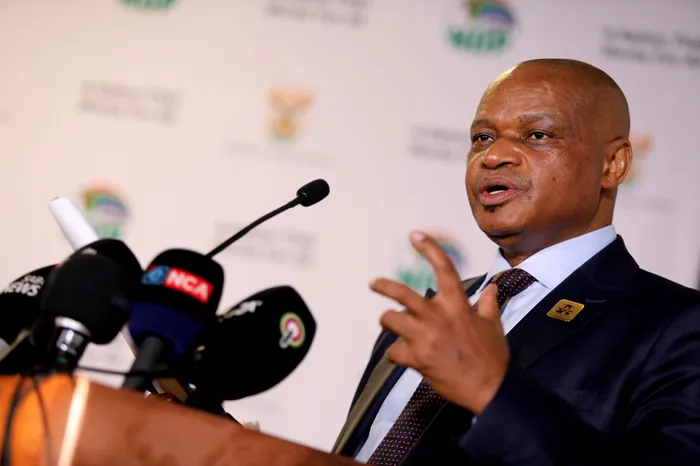
National Director of Public Prosecutions (NDPP) Advocate Andy Mothibi.
Image: Oupa Mokoena / Independent Newspapers
The Gauteng High Court, Pretoria, has turned down the legal bid to overturn the appointment of Andy Mothibi as the National Director of Public Prosecutions.
B Xulu and Partners Incorporated (BXI) had launched an urgent court application to halt the appointment of Mothibi, arguing that serious procedural flaws undermined the fairness and transparency of the selection process.
The move came after President Cyril Ramaphosa appointed Mothibi, head of the Special Investigating Unit (SIU), as the country’s new NDPP. He took over from Shamila Batohi on February 1.
On Tuesday the court stated that the applicant lacked the legal standing to pursue the application. It was also found that the president, in selecting Mothibi as the head of the National Prosecuting Authority (NPA), did not act irrationally.
“The fact that the president appointed a person whose fitness is not being questioned speaks of a rational decision,” the court said.
Mothibi was appointed despite not being initially shortlisted or publicly interviewed for the position. Ramaphosa had appointed an advisory panel to assist with the appointment. The panel interviewed seven shortlisted candidates, in live interviews, however they recommended that they found none of them suitable for the position.
Mothibi was later announced as the new NDPP.
The applicant clarified that their objection was not against Mothibi's appointment itself, but rather the manner in which it was conducted.
They argued that the other failed candidates were subjected to an interview process. President Ramaphosa subsequently elected to appoint Mothibi without him being subjected to the same process.
In its judgment, the court said: “It is arguably unfair to appoint the 10th respondent (Mothibi) without him being screened by an advisory panel. The President was, however, not constrained to again use an advisory panel to appoint the 10th respondent. Time was running out as the incumbent would vacate her position at the end of January.”
The court also said the president was within his rights to appoint Mothibi without a public screening process.
“That process has been concluded and has failed to identify a suitable candidate. The president was acting in a procedurally rational manner in changing track.”
When Ramaphosa appointed Mothibi in December, he noted that the advocate brings decades of legal experience, having served as a public prosecutor, magistrate, and senior legal executive.
He began his career as a public prosecutor in the Johannesburg and Soweto magistrates’ and regional courts, later becoming a magistrate in those same courts.
His public and private sector experience includes serving at the South African Revenue Service (SARS) as head of corporate legal services and governance.
Mothibi, meanwhile, held his first official media briefing earlier this month, in which he outlined his vision for the prosecuting authority.
These included that all criminal referrals arising from investigations into the alleged R900 million Tembisa Hospital scandal will receive attention.
Soon afterwards, 12 top police officials were arrested and appeared in court on fraud and other charges linked to the Tembisa Hospital tenders.
Cape Times