

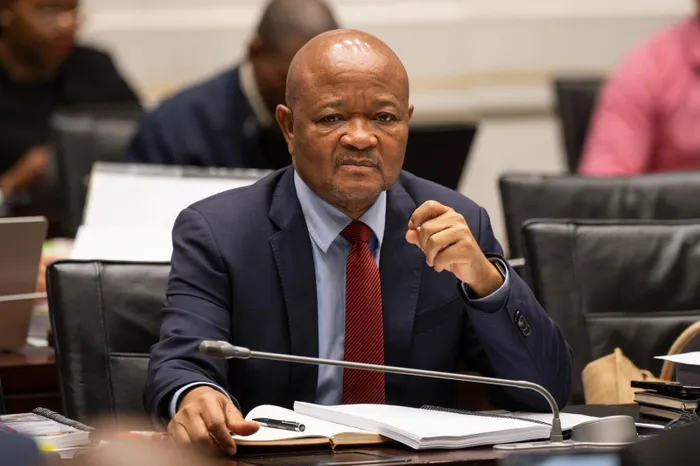
Suspended Police Minister Senzo Mchunu has resumed his work as an ANC NEC member.
Image: ARMAND HOUGH Independent Newspapers
Suspended Police Minister Senzo Mchunu has officially resumed his duties as an ANC National Executive Committee member.
In his first public appearance as an NEC member, five months after stepping aside, Mchunu delivered a eulogy at the funeral of ANC member, Bhekabathethwa Mthethwa in Richards Bay yesterday.
Mchunu appeared before the Ad Hoc Committee and the Madlanga Commission to justify his decision to disband the Political Killings Task Team (PKTT) and respond to allegations of corruption, specifically regarding ties to controversial businessman Vusumusi ‘Cat’ Matlala and interfering with police operations.
This was after KwaZulu-Natal Police Commissioner Lieutenant-General Nhlanhla Mkhwanazi accused Mchunu of instructing the disbandment of the PKTT on December 31, 2024 without consulting national police leadership, allegedly to protect politically connected individuals.
Last week, Mchunu wrote to the ANC asking to resume his duties as an NEC member - this was confirmed by his spokesperson Sithembiso Mshengu.
"He voluntarily stepped aside, he wrote to the party to inform the leadership that he was returning to his position, not necessarily seeking permission, You remember that he is not facing any criminal charges to be forced to step-aside. He asked to be excused to protect the image of the ANC after Lieutenant-General Nhlanhla Mkhwanazi’s accusations,” said Mshengu.
In terms of the ANC’s step-aside policy, once a member is criminally charged, he or she must stop representing the party both in government and political platforms.
Mchunu was placed on special leave in July following Mkhwanazi’s explosive claims.
Meanwhile, President Cyril Ramaphosa reiterated his decision not to dismiss Mchunu from his Cabinet when responding to parliamentary questions from MK Party MP Vusi Shongwe.
Ramaphosa said he placed Mchunu on special leave so that the allegations made by Mkhwanazi can be examined.
Shongwe said serious allegations and evidence presented before the Ad Hoc Committee implicated Mchunu.
He asked whether the threshold for executive accountability was only triggered after criminal convictions, and whether political and ethical standards expected of members of the executive were no longer required to take decisive action when Parliament uncovers serious governance failures.
In response, Ramaphosa underscored the gravity of Mkhwanazi's allegations, which he stated could have significant consequences for national security and public safety.
“Following the publication of these allegations, I took the decision to place the Minister of Police on special leave to have the allegations properly ventilated and their veracity determined. I established a Commission of Inquiry into Criminality, Political Interference and Corruption in the Criminal Justice System to investigate the allegations made by General Lieutenant Mkhwanazi.”
“Executive accountability is sourced from the Constitution. Members of the executive are constitutionally obligated not to act in any way inconsistent with the Constitution. This includes not exposing themselves to any situation involving the risk of conflict between their official responsibilities and private interests or using their position or any information entrusted to them to enrich themselves or improperly benefit any other person.”
He said he was enjoined to act in line with his oath of office to protect the Constitution.
“How I choose to fulfil these obligations is subject to the principle of legality. In this case, I have done so by appointing the Acting Minister of Police, putting the minister on special leave, and establishing the Commission of Inquiry,” Ramaphosa said.