

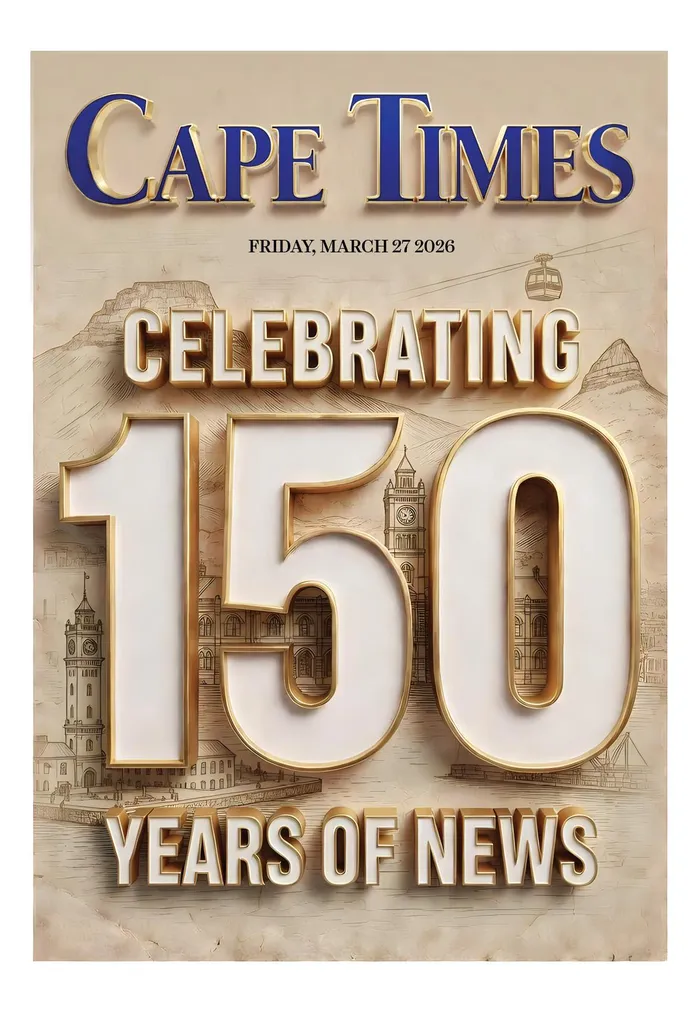
March 27, 2026 marks 150 years since the Cape Times' first publication reached hundreds of thousands of homes.
Image: Mallory Munien
VERY few news organisations in South Africa have been fortunate to be in existence for more than 100 years.
Those that reach this milestone can no longer be regarded as mere news platforms. They have demonstrated that they are institutions of knowledge, information sharing and public education.
The Cape Times undoubtedly falls within this category. Today, March 27, marks 150 years since our first publication reached hundreds of thousands of homes. That historic moment may have been more than a century and a half ago, but what followed was something rather special.
For 150 years, we have had the privilege of telling stories of people from all walks of life. For 150 years, the pages of this great institution called the Cape Times have reflected the hopes, aspirations and dreams of millions of ordinary South Africans.
We were there when South Africa became a democracy after years of a brutal apartheid system that violated the human rights of the majority population of this country.
Our archives are filled with pictures of the moment Nelson Mandela walked out of prison and made his first public address on the balcony of the City City Hall in front of thousands of people gathered on the Grand Parade.
We were also there when Struggle icon Oliver Tambo opened up, in a ground-breaking interview with then Cape Times editor Tony Heard, about the ANC’s vision in opposing the apartheid regime.
At the time, it was illegal to quote Tambo or other ANC officials without specific government permission.
Before that, we had the honour of featuring the medical team behind the world’s first heart transplant led by Dr Christiaan Barnard.
It was also a significant moment for us to have the first black African editor and perhaps the youngest on the continent Siyavuya Mzantsi, at just 26.
These are but a few of the many historical moments that we had the honour of publishing. Each one of them made the Cape Times what it is today - a publication that has undergone and survived significant changes, but still maintained its place in many households.
A publication that now prides itself on fearlessly reflecting the views of all South Africans; rich and poor, black and white, male and female, and young and old.
To us this is not just a job, we consider this weighty responsibility as a service we owe to the public. Of course, we will be the first to admit we have not been perfect at times. After all, we are only humans.
However, through your support dear reader, we have found reason to dust ourselves off and get on with it.
We now find ourselves in a time where publications have to go beyond just being newspapers. Sadly a significant number of our peers have had to close shop. The digital era is forcing us to be creative and innovate if we are to survive the next 50 years.
We have embraced this challenge despite the many hurdles it presents. We therefore ask that you too join us in this exciting journey, which is filled with endless possibilities.
Over the coming months we will share reflections from past editors, contributors and some of the significant moments in South Africa's history captured by the Cape Times.
You have carried us for 150 years and for that we say thank you. Thank you for allowing us to tell your stories, to share your joy and pain. Thank you for welcoming us into your homes and hearts.
Thank you for entrusting us with sensitive information even when lives were at risk. Lastly, we thank you for being part of this journey.
CAPE TIMES EDITORIAL TEAM