

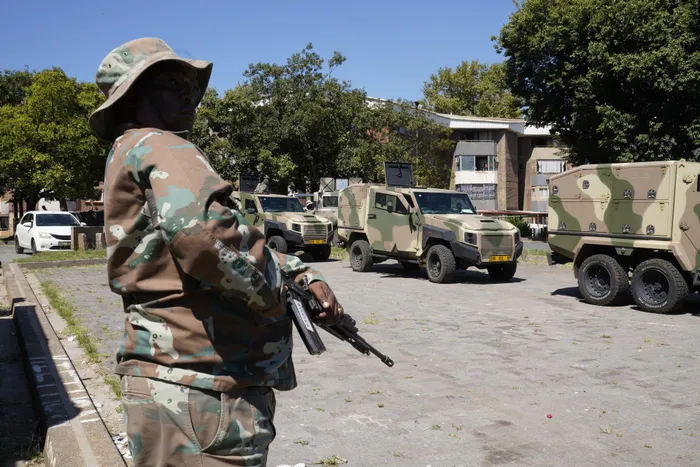
SANDF chief General Maphwanya reassured communities that the soldiers are there to protect them, not to cause harm.
Image: Timothy Bernard / Independent Newspapers
Portfolio Committee on Defence and Military Veterans chairperson, Dakota Legoete, has likened South Africa’s crime crisis to active conflict zones, with more than 26 000 people killed in a single year.
Legoete made the stark assessment during a Peace and Security Cluster media briefing, describing the scale of violence as a direct threat to the country’s sovereignty.
Parliament’s security cluster has backed the deployment of the military while warning it is no long-term solution.
“We are at a point where over 26 000 South Africans have died in a year at the hands of the criminal element,” Legoete said.
“These numbers are comparable to those in conflict zones such as Gaza, Ukraine, yet in our country, we normalise it.”
He argued that the scale of killings effectively places South Africa in a “war-like” situation, even though it is not formally at war, and said the burden can no longer be carried by police alone.
“That is why we support the President’s initiative to deploy the SANDF to collaborate and cooperate with the SAPS in fighting crime,” he said, stressing that criminals are increasingly well-armed and organised.
Chairperson of the Portfolio Committee on Police, Ian Cameron, warned that the intervention of the SANDF risks masking deeper systemic failures.
“While such deployment may provide a necessary force multiplier, a military deployment is not a long-term solution,” Cameron said.
“There is a real risk that it becomes a temporary measure, a plaster on a wound that requires surgery.”
Chairperson of the Joint Standing Committee on Defence, Piroane Phala, said Parliament had intensified oversight of the SANDF deployment to ensure it is properly coordinated and legally compliant.
“The SANDF deployment serves as an important force multiplier,” Phala said, adding that lawmakers had raised concerns about initial “lack of clarity and alignment” between the military and police, including command structures and operational readiness.
While those issues have begun to improve, Phala emphasised that long-term solutions must go beyond security interventions.
“It is equally important that clear exit strategies are developed and that the long-term response to crime also includes stronger socio-economic interventions,” he said.
Meanwhile, police in the province said Saps and the SANDF are engaging in an ‘operational scanning exercise” in the Cape Flats’ gang-infested hotspots this week.
Police spokesperson Novela Potelwa said they cannot confirm the estimated time for the full deployment or which areas have been identified as hotspots to prevent the targets from preparing for the actual deployment.
“The exercise, which should not be mistaken for the actual commencement of deployment of the SANDF, comprises air and ground presence of limited forces at various identified locations,” Potelwa said.
Chairperson for the Cape Flats Safety Forum Abie Isaacs said that the deployment of the SANDF will give government and civil society an opportunity to go back to the drawing board.
“As the Cape Flats Safety Forum, we have noted with concern the current escalation in shootings on the Cape Flats. We call for the immediate deployment of the SANDF to stabilise the affected areas that have seen gang-related shootings.
“While the SANDF will be deployed, this will also give us an opportunity as civil society to go back to the drawing board and look at intervention programmes, and also in vain for the government to go back and relook at their strategy.”
Cape Times