

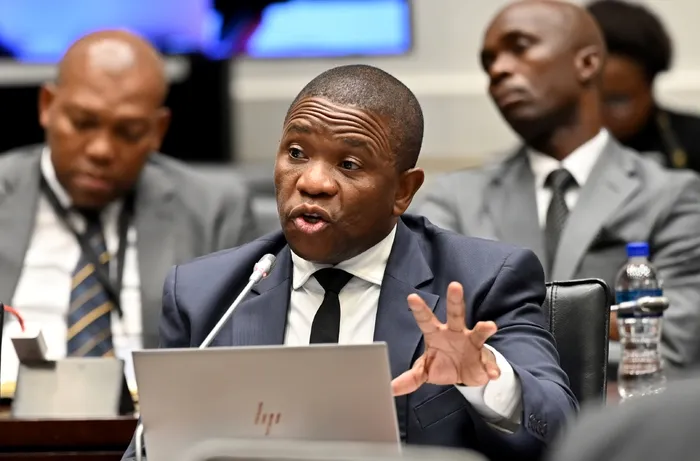
KwaZulu-Natal police Commissioner Nhlanhla Mkhwanazi returns to face the Ad Hoc Committee.
Image: Ayanda Ndamane/ Independent Newspapers
KwaZulu-Natal police commissioner Lieutenant-General Nhlanhla Mkhwanazi, whose security clearance expired in 2018, said if he had the power to, he would dismiss the entire vetting unit, starting with head Major-General Feroz Khan.
Mkhwanazi made the remarks during what was expected to be his final appearance before Parliament’s ad hoc committee.
His testimony follows his explosive media briefing on July 6, 2025, which triggered the parliamentary inquiry into alleged corruption, political interference and institutional capture within the South African Police Service (SAPS).
During that briefing, Mkhwanazi implicated several senior officials, including Police Minister Senzo Mchunu, who is currently on special leave, and suspended deputy national commissioner for crime detection, Lieutenant-General Shadrack Sibiya.
Mkhwanazi told the committee he still does not have security clearance.
This comes after controversial private investigator Paul O’Sullivan told the committee that the top cop does not have the clearance.
“The answer is no, I still do not have one,” he said.
Evidence leader Advocate Bongiwe Mkhize asked when he last had clearance and what its current status was.
Mkhwanazi said his last top-secret clearance expired in 2018.
He had applied for renewal in 2013 through the State Security Agency (SSA).
“In the vetting process, you have to disclose everything - where you were born, where you grew up, your schooling, friends, family, bank accounts, assets and more,” he said.
He claimed the SSA completed its process, including a polygraph test, but did not issue clearance due to allegations raised by an Independent Police Investigative Directorate (IPID) official in KwaZulu-Natal.
“I was told there was a case involving a so-called hit squad in 2013 in KwaZulu-Natal, in which I was implicated. At the time, I was working in Pretoria and had never worked in KwaZulu-Natal,” he said.
Mkhwanazi said he received no feedback on the matter.
A subsequent application to Crime Intelligence also remained unresolved as of 2022.
He alleged that further delays were caused by unverified claims, including media reports and cases he said he was never informed about.
“One allegation relates to a case investigated by IDAC. Another involves a case opened in Pretoria, where I was accused of interfering in an investigation involving (former acting national commissioner Khomotso) Phahlane and his wife,” he said.
He added that he was also named as a suspect in a hijacking case in Brooklyn, Pretoria, despite not being present.
“These allegations are used to justify not finalising my clearance. From what I know, I have no case. My name was simply included,” he said.
Mkhwanazi accused the vetting section, under Khan, of deliberately obstructing the process.
“If I were in charge, I would remove everyone in that section, starting with Khan,” he said.
He further alleged that sensitive files had been compromised, referencing the investigation into Phahlane’s property, which he claimed originated from stolen documents.
“It is a dirty office,” he said.
“Parliament must ask how honest the vetting process is across the police and other institutions.”
Mkhize said that the issues appeared to date back to 2022 and asked whether anything could be done to resolve them.
Mkhwanazi responded that the delays were unjustified and suggested oversight bodies, including IPID, should account for their role.
Mkhize also asked whether he could access secret funds without security clearance, citing O’Sullivan’s statement.
Mkhwanazi dismissed the claim, saying he has no role in Crime Intelligence operations.
“I do not work in Crime Intelligence. I have zero involvement with the secret fund,” he said.
Mkhwanazi on Wednesday also explained why he retracted serious allegations he made against former police minister Bheki Cele.
Mkhwanazi previously testified before the Ad Hoc Committee that Cele allegedly sent attempted murder-accused tenderpreneur Vusimuzi “Cat” Matlala a bank account, and money was deposited into that account.
He had indicated at the time that they were going to look into the flow of the deposited funds.
However, when Cele appeared before the committee four months ago, Mkhwanazi sent evidence leader, Advocate Norman Arendse, a message withdrawing the allegation.
He had stated that the team working on the data analysis got the bank account wrong, and the reference regarding Cele was incorrect.
This had prompted the Ad Hoc Committee to demand an affidavit because it had felt that the allegation could not be withdrawn merely by sending a message.
On his return to give evidence before the committee on Wednesday, Mkhwanazi said he had shared with the committee information from the data analysis performed by colleagues on Matlala’s two cellphones.
He explained that the data analysts had found a contact saved as “Bab Ndosi”, which is a clan name of Cele, and the number differed from the former minister’s number by one digit.
“At a glance, the two numbers are almost similar, with a difference of one digit right in the middle. In analysing and tracing the communication, the system drew a different number because of the confusion.”
He also said the data analyst had submitted affidavits to the Ad Hoc Committee and the IPID, which is investigating a perjury charge opened by National Coloured Congress leader and MP Fadiel Adams, explaining how the error between the numbers occurred.
Cape Times