

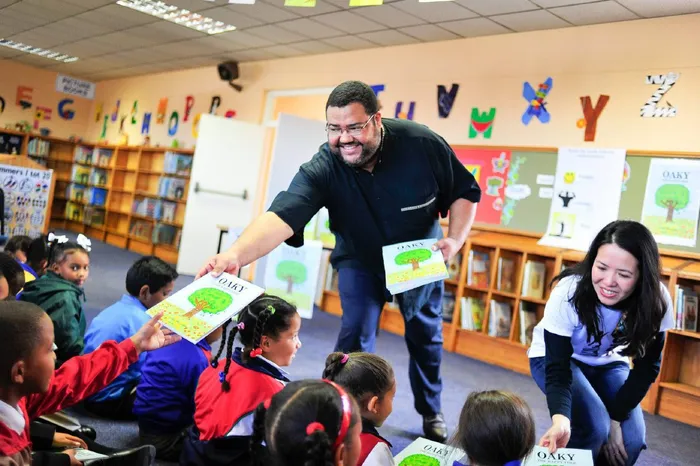
Athol Williams, from Mitchells Plain, handing out his book to school children at the Westridge Library.
Image: Henk Kruger/FILE
The appointment of Athol Williams as Poet Laureate at Saïd Business School, University of Oxford marks a global first, while behind the academic milestone lies a story of courage, exile and an unyielding commitment to truth.
Williams, a whistleblower who exposed state capture before the Zondo Commission, was forced to leave the country in 2021 after receiving threats to his life. Today, he is based at the University of Oxford, using poetry as a tool to reshape how future leaders think about ethics and responsibility.
"Being appointed as the Poet Laureate for the business school at Oxford is an even greater honour," Williams said.
"My main role is research and teaching in the areas of strategy, leadership and ethics. I’m also the Academic Director of the Oxford Advanced Management and Leadership Programme. Being Poet Laureate offers me an additional platform for my poetry and enables me to bring poetry into the leadership development curriculum."
His appointment signals a shift in how institutions are responding to a more complex and uncertain world.
"I think the complexity in the world demands new thinking and new approaches, especially in developing business leaders," he said. "Business plays a profound role in modern societies and so business leaders need to be equipped to deal with this broader role and its complexities."
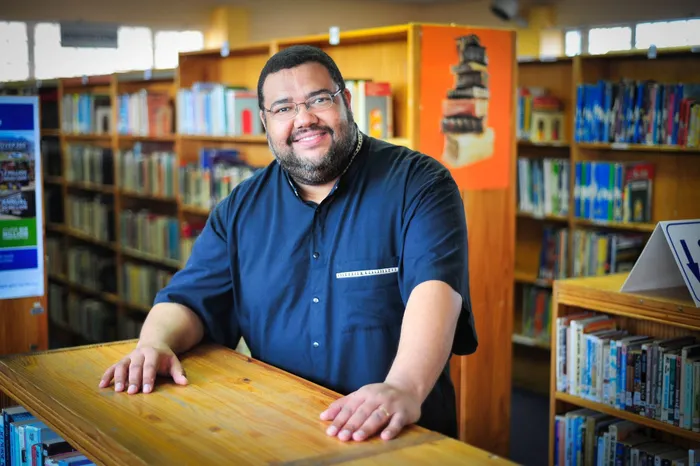
Athol Williams, continues to invest in South African communities through literacy and education initiatives, including Read to Rise and the Cape Flats Book Festival.
Image: Henk Kruger/African News Agency (ANA)
Williams believes poetry can play a transformative role in that process.
"While most view poetry narrowly as entertainment or something burdensome because of their experiences at school, there’s significant research and experience that shows, used wisely, poetry has the ability to play a profound role in education and in advancing critical thinking," he said.
He added that Oxford’s decision reflects both this growing awareness and his ability to work across disciplines.
"I also think there are very few poets able to bridge poetry, business and philosophy as I can, given my academic background and experience, so there’s also an element of the University seeing in me the right candidate to enable it to take this pioneering leap."
Williams emphasised that poetry is deeply practical in shaping leadership.
"Poetry opens leaders to possibility," he said. "Where most systems around us limit imagination and close off options, poetry reminds us of the possibility of our humanity and our collective ability to remedy the many social and political ills we face."
He describes reading poetry as “similar to solving a puzzle”, helping leaders navigate ambiguity, while writing poetry fosters deeper connection between individuals and the world around them.
Despite the prestige of his appointment, Williams’ daily work remains rooted in teaching and research, with poetry integrated into the life of the school.
"Most of my time is as a usual professor, teaching strategy, leadership and ethics across the many degrees and diplomas Oxford offers," he said.
"As the Poet Laureate I will engage in activities such as reading events where I will invite prominent poets and have Oxford poets read, I will convene writing workshops, I will seek to publish the writings of colleagues and students and arrange public poetry events."
He also plans to expand his research into the impact of poetry and use Oxford’s global platform to advocate for its broader role.
"The incredible thing about Oxford University is that it gives you an influential global stage which I intend to use," he said.
“My theme is: the possibility of poetry.”
Yet it is his journey from South Africa that gives his work its urgency and depth.
"The journey has sharpened my realisation that there’s a very high cost to being ethical in an unethical world," he said.
His recent book, End & Beginning, reflects on the trauma of exile following his whistleblowing.
"I wrote it to capture the abandonment, agony but ultimate overcoming of my traumatic experience since leaving South Africa in 2021," he said.
Williams is candid about the personal cost of speaking out, and the lack of institutional support that followed.
"My whistleblower experience came at a huge personal cost to me. That is tragic and still remains tragic because no institutions in South Africa offer me any support or are working to help re-establish links to my home country,” he said.
While he has found recognition and a platform abroad, the separation from South Africa continues to weigh heavily on him.
"I am less concerned about my own experience now. I am sad that I can’t be teaching students in South Africa who I believe would benefit from the new frontier work I do," he said. "I am sad that my tragic story discourages others from speaking up."
Even so, he continues to invest in South African communities through literacy and education initiatives, including Read to Rise and the Cape Flats Book Festival.
"My story could change dramatically if a South African corporation had the courage to partner with me,” he said. “In the meantime I will continue personally supporting students at university, ensuring hundreds of thousands of children have access to books."
Now, from Oxford, Williams is focused on a broader mission shaped by both scholarship and sacrifice.
Cape Times
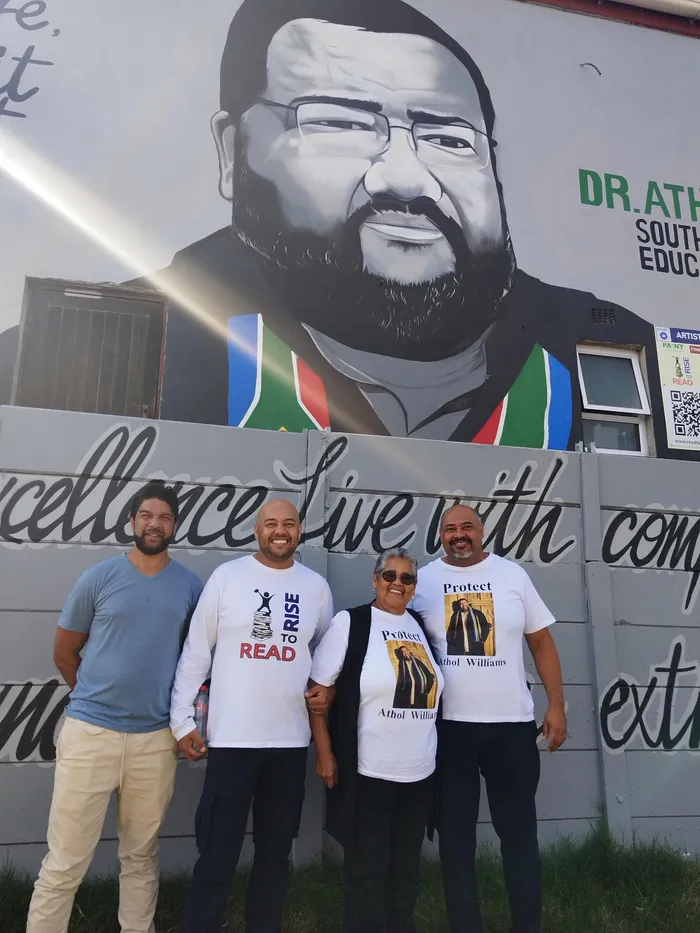
From left: Artist Rizah Potgieter, Read to Rise programme director Roscoe Williams, Athol Williams' mother, Mavis, and Read to Rise board chairperson Nicholas Williams at the official unveiling of the Athol Williams mural along Eisleben Drive in Portland.
Image: Alicia English