

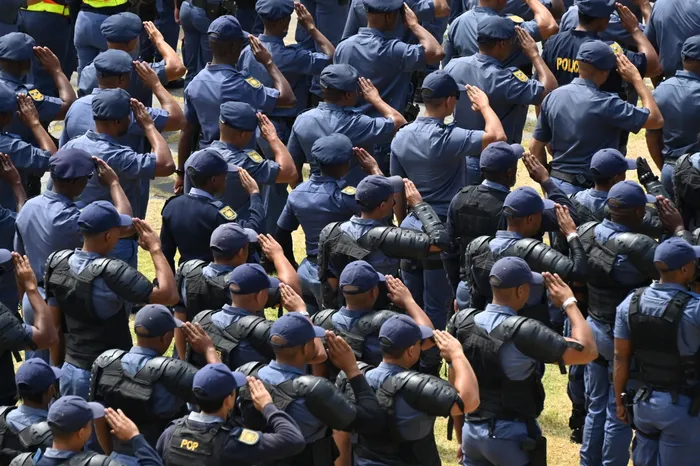
The Institute for Security Studies (ISS) says the responsibility for curbing police corruption lies with SAPS leadership, not external agencies such as the Independent Police Investigative Directorate (IPID).
Image: Ayanda Ndamane/ Independent Newspapers
Low levels of reporting of police corruption, linked to a police culture that discourages internal reporting of corruption, highlight the fact that police corruption cannot be addressed only by responding to reported cases.
A recently released Institute for Security Studies (ISS) report notes that a more proactive investigative response to tackling police corruption is required, which relies on information and intelligence gathering.
The report also states that officers responsible for rooting out corruption are not being given the information they need by their own colleagues, even in units where corruption is known to be common.
The ISS suggested that, with strong evidence of ongoing widespread corruption in the SAPS, the Madlanga Commission of Inquiry must affirm that tackling corruption within the SAPS should be the primary responsibility of police leaders.
The research institute argued that the Independent Police Investigative Directorate (IPID) was not created to address police corruption, adding that its main focus is on crimes of violence committed by police officers.
ISS also stated that a range of agencies and mechanisms are tasked with investigating police corruption, but no agency has overall responsibility, and that coordination between agencies is limited.
The organisation said corrupt police officers are typically serial offenders who collude with other officers and shield each other from accountability. They also work with gangs or organised crime groups, and investigating these networks requires organised crime-focused techniques that currently fall outside IPID's repertoire.
The Madlanga Commission, chaired by retired Constitutional Court Justice Mbuyiseli Madlanga, was established in July 2025 to investigate systemic corruption, criminal infiltration, and political interference within the SAPS and the broader justice system.
The commission was a direct response to explosive allegations made on 6 July 2025 by Lieutenant-General Nhlanhla Mkhwanazi, the KwaZulu-Natal Provincial Police Commissioner. Mkhwanazi claimed that a sophisticated criminal syndicate, involving high-ranking politicians and law enforcement officials, had infiltrated South Africa's criminal justice system.
So far, witnesses revealed that controversial businessman Vusimusi ‘Cat’ Matlala is an underworld figure who effectively acted as a “deputy national commissioner”, allegedly directing police operations and “pampering” senior officers with money and gifts.
Suspended National Head of Organised Crime, Richard Shibiri, was grilled over a R70,000 “loan” from Matlala. While Shibiri claimed the money was for car repairs due to “dire straits”, bank records showed he had over R100,000 available and spent thousands on luxury items at Gucci and Louis Vuitton shortly after receiving the payment.
It was also revealed that a Hawks helicopter was allegedly deployed to stop the arrest of murder suspect and cartel leader Katiso Molefe.
Senior officers allegedly shared sensitive case information and arrest warrants with suspects.
IPID’s acting national head, Thuso Keefelakae, testified that the directorate faces severe shortages in manpower and expertise, often having to rely on the SAPS to collect evidence for its own investigations.
The commissioners indicated through their interventions that they would likely recommend increased resources for IPID.
However, the report recommended that dedicated disciplinary units, with requisite expertise and resources, should be established to deal fairly and effectively with serious misconduct cases.
Governance expert Sandile Swana said the SAPS must have a proper risk management unit that empowers unit heads and station commanders to be able to manage risk.
Swana said the corruption and fraud prevention plan should be included in this unit.
“People should know that they are being watched and monitored independently for all the things they are doing and whistleblowers have a chance to trigger investigations that could get police officers fired,” he said.
Swana added that it was also important to have anonymous whistleblower facilities for the public and police officers to report suspicious activities.
Another analyst, Professor Andre Duvenhage said the testimonies that have been presented before the Madlanga Commission and Ad Hoc Committee justify the claims of widespread corruption in the SAPS.
However, Duvenhage said the heads of police are also implicated in corruption activities, which makes it difficult to deal with corruption.
He suggested that the whole police service should be overhauled.
Cape Times