

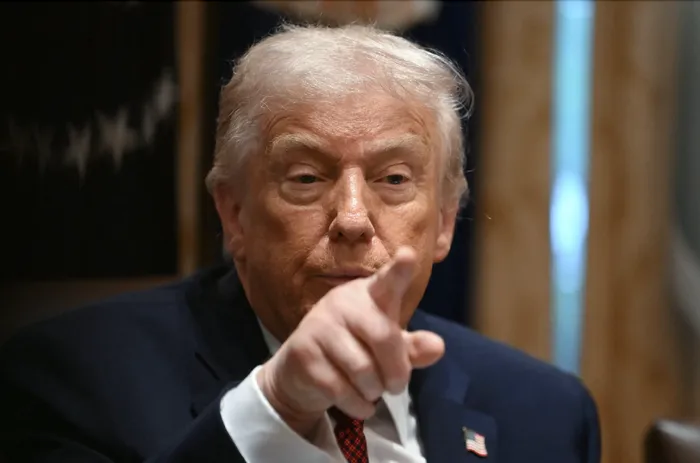
US President Donald Trump.
Image: Andrew Caballero Reynolds/AFP
The US probe into 60 economies over alleged failures to ban the importation of goods produced with forced labour has been described as a strategy to impose tariffs on other countries and to return manufacturing to the world's leading economy.
This is after the US launched a Section 301 investigation into 60 economies, including South Africa, to determine if they are effectively preventing goods produced with forced labour from entering their markets.
The probe was announced by the Office of the US Trade Representative (USTR) earlier this week.
This investigation, according to the USTR, serves as a “Plan B” to rebuild trade pressure after the US Supreme Court struck down global tariffs previously imposed under the International Emergency Economic Powers Act (IEEPA).
The probe targets countries that allegedly fail to enforce prohibitions on importing goods made with forced labour, which the US argues creates an uneven playing field for American producers.
If the investigation finds these practices “unreasonable or discriminatory”, it could lead to new tariffs or trade restrictions. This is particularly urgent as current temporary 10% global tariffs are set to expire on 24 July 2026.
Public hearings linked to the probe have been scheduled for April 28, while interested parties have until April 15 to submit written comments or request to appear at the hearing.
Along with South Africa, the list includes major partners such as China, the European Union, Israel, India, Japan, Brazil, Canada and Mexico.
Several other African and Middle Eastern economies, including Nigeria, Egypt and Saudi Arabia, had also been included in the probe.
The probe specifically targets industries like agriculture, automotive manufacturing, and mining.
The move comes amid deteriorating ties due to South Africa's foreign policy positions, including its BRICS alliance and the International Court of Justice (ICJ) genocide case.
The investigation also scrutinises whether South Africa is complying with labour standards. If found to be in violation, South Africa could lose its AGOA eligibility, which is already under pressure due to 'reckless' foreign policies and nonalignment views in Washington.
Asked for comment on the matter, the Department of International Relations and Cooperation (DIRCO) spokesperson, Chrispin Phiri, did not respond by deadline.
The Department of Trade, Industry and Competition spokesperson, Kaamil Alli, said the department would not comment on the matter at this stage.
International relations expert, Professor Theo Neethling, said one of Trump’s strategies after he was elected the US President was to impose tariffs in order to enhance American manufacturing, and lower the country’s dependence on farm goods and manufacturing, and bring jobs back to the US.
“That is part of the MAGA idea, 'Make America Great Again’. The idea is to impose tariffs on other countries across the world. The whole idea is that this will bring manufacturing back to the US,” said Neethling, adding that this will also bring a halt to foreign companies exporting to the US.
Neethling added that it is uncertain whether this will be successful.
“I don’t think anyone can tell whether this will be a success at this stage. But I do think that this will be a futile exercise,” he said.
Professor Kgothatso Shai also shared similar sentiments, saying the investigation is to validate future commercial bans against the economies whose countries are not receptive to the global US foreign policy.
Shai added that it is difficult to predict whether South Africa will survive, saying the US engagement with SA is largely based on 'concocted lies to advance a particular political cause'.
Cape Times