

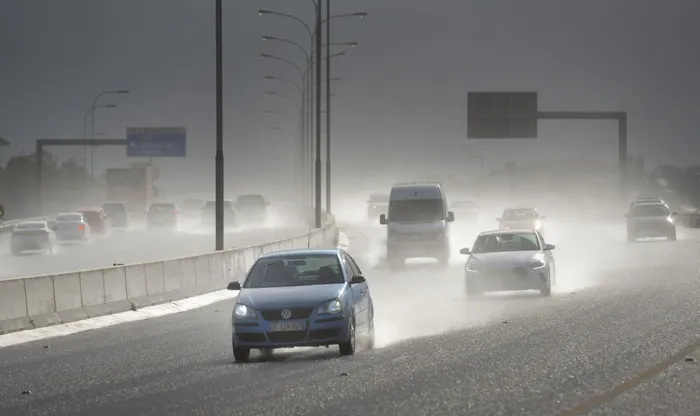
Sanral and two contractors were held liable for the damages occurred by a motorist whose vehicle aquaplaned when it hit a water pool on the N1 in the Western Cape.
Image: Armand Hough/African News Agency(ANA)
The South African National Roads Agency (Sanral) and two contractors have been found jointly liable for the damages suffered by a motorist who aquaplaned on pooled water on the N1 near the Okavango interchange in the Western Cape.
The incident occurred during the early hours of the morning when Anton Hesse was travelling along the carriageway of the N1. While driving towards Cape Town in heavy rain and darkness, his vehicle encountered a substantial pool of accumulated water in the right-hand lane, causing it to aquaplane, rotate, and leave the roadway, ultimately colliding with wooden poles and vegetation on the median of the highway.
Hesse turned to the Western Cape High Court, as he claimed that Sanral and the two contractors - Kayad Consulting Engineering and MD Civils were negligent in maintaining the national road. The cause of the accident was the fact that water had ponded in the right-hand lane at the time of the incident and that this ponding caused the vehicle to skid and collide with the median barrier, resulting in physical injuries.
Hesse argued that Sanral and its contractors had a legal duty to keep the freeway in a condition which would not allow dangerous water to accumulate. According to him, they failed to remove the edge build-up that blocked the drainage. He testified that while travelling inbound on the N1 near the Okavango interchange, he unexpectedly struck a deep body of water in the right-hand lane.
The heavy rain and darkness prevented him from seeing the water beforehand. Upon impact, the vehicle lifted more on the right side, aquaplaned, rotated clockwise, and came to rest in the median after colliding with wooden poles and vegetation. He stepped out into ankle-deep water on both the roadway and the median. He maintained that he was travelling at a slow speed.
A civil engineer called by Hesse explained that vegetation and soil had accumulated along the median edge, creating an “edge build-up” that impeded the natural drainage of water off the road and effectively acted as a dam wall. In his opinion, this obstruction caused water to pond in the right-hand lane during the rainfall.
The contracts manager for MD Civils confirmed that the company held the routine maintenance contract for this section of the N1 and conceded that edge build-up is capable of obstructing drainage and poses a danger to motorists. Sanral, meanwhile, admitted it was legally responsible for the road, but denied any wrongdoing. It argued that maintenance duties were afforded to the two contracting companies.
The court, however, found Sanral could not escape liability by appointing contractors, as it still had a duty to monitor the work being done. According to the court, the harm suffered by Hesse was the direct result of the very danger that the defendants were supposed to prevent through proper maintenance and supervision.
Legal expert advocate Francois Botes, meanwhile, said while each case must be evaluated on its own merits, the findings of the Western Cape High Court regarding negligence will be binding on all other jurisdictions, unless challenged on appeal. He explained that in this case the court found that Sanral and the contractors failed in their duty to ensure that the road surface was not dangerous and this amounted to negligence.
“Negligence is a universal concept when it comes to the duty of authorities and this concept is applicable everywhere in the country,” Botes said.
Cape Times