

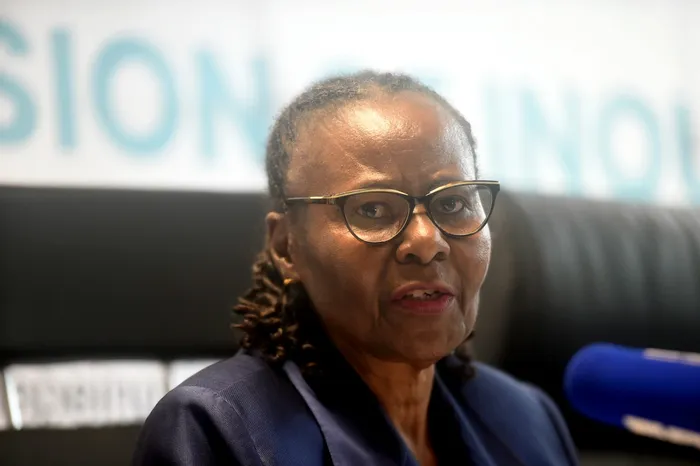
Zuma and Mbeki have applied for the recusal of retired justice Sisi Khampepe from chairing the Truth and Reconciliation Commission.
Image: Itumeleng English/Independent Media
Families of victims linked to unresolved Truth and Reconciliation Commission (TRC) cases have criticised President Cyril Ramaphosa for supporting legal efforts that could effectively collapse the commission chaired by retired Constitutional Court judge Sisi Khampepe.
The families addressed the media on Sunday following calls by former presidents Thabo Mbeki and Jacob Zuma for Khampepe to recuse herself as chair of the commission of inquiry.
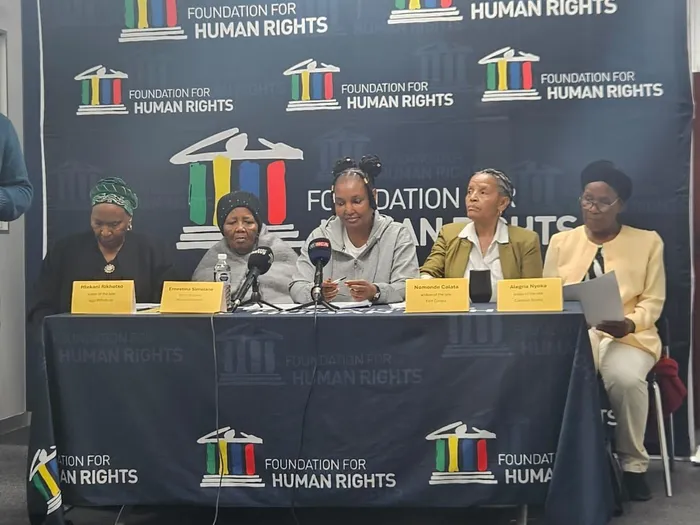
From left to right: Hlekani Rikhotoso, Ernestina Simelane, Thembi Simelane, Nomonde Calata and Alegria Nyoka during Sunday's press briefing in Johannesburg.
Image: Karabo Ngoepe
Reading a statement on behalf of the families, Thembi Simelane said they were deeply concerned after learning that Ramaphosa had entered the legal dispute by filing his own affidavit and heads of argument in the review application.
“In his submissions, President Ramaphosa actively advances the demise of the very commission he himself established. He does not oppose the relief sought by former presidents Zuma and Mbeki. More disturbingly, he claims that no due diligence was carried out regarding Khampepe’s previous roles. He admits that if he had known she served on the TRC as a commissioner and at the National Prosecuting Authority as deputy national director of public prosecutions, he would not have appointed her,” Simelane said.
The Khampepe Commission, formally known as the Judicial Commission of Inquiry into Allegations Regarding Efforts to Stop the Investigation or Prosecution of TRC Cases, is tasked with investigating why numerous apartheid-era crimes recommended for prosecution by the original TRC were never pursued.
Chaired by Khampepe, the commission was established by Ramaphosa in May 2025 after litigation brought by victims’ families and the Foundation for Human Rights. Its mandate is to determine whether political interference or other efforts were made to halt investigations and prosecutions related to TRC cases.
Public hearings began in late 2025. However, Mbeki and Zuma later challenged Khampepe’s impartiality, arguing that her past roles could compromise her ability to preside over the inquiry. Khampepe dismissed those challenges in January 2026, but the matter has since moved into ongoing legal proceedings. Ramaphosa has indicated he would comply with any court order requiring her removal.
Simelane said that although the president filed a notice indicating he would abide by the court’s ruling, his submissions appear to support the relief sought by the former presidents.
“Despite the notice to abide, the president is effectively encouraging the court to grant the orders requested by his predecessors,” she said.
According to Simelane, the order sought in the review application could force families to relive decades-old trauma if the commission is nullified and restarted.
“The order of nullification sought in this review risks forcing families to relive their trauma repeatedly through prolonged and duplicate processes. For people like Lukhanyo Calata and me, who have testified before the commission, and for other survivors and families who have long advocated for justice, this process is deeply personal,” she said.
“It requires them to recount painful memories and speak publicly about the suffering their families endured. The emotional burden is immense.”
Simelane said the actions of Mbeki and Zuma, together with Ramaphosa’s stance, raised concerns that the process could be deliberately undermined. She cited an affidavit from Lukhanyo Calata, arguing that the legal challenge formed part of a broader attempt to derail the inquiry.
“What is truly remarkable is that the president appears to support the collapse of an inquiry that has been running for more than nine months, held about four weeks of hearings and has cost at least R55 million to date. By the time the litigation is concluded, the cost will probably exceed R100 million,” she said.
“Why would the president be so willing to go down such a wasteful and reckless path? In my respectful view, the likely explanation is that it was a political decision aimed at damage control.”
Cape Times