

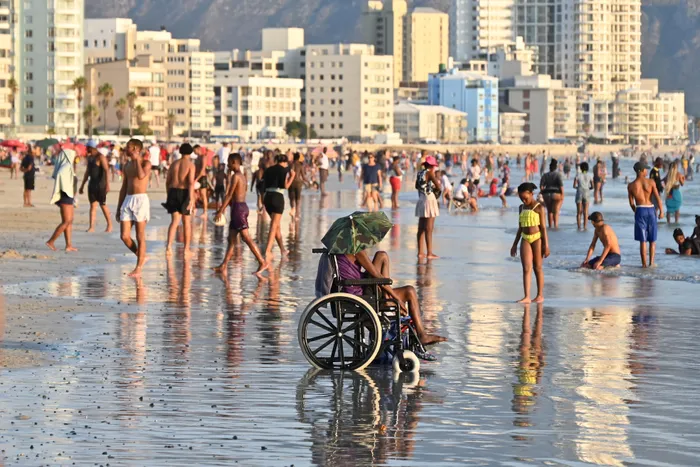
EXTREME heat wave drives record-breaking March temperatures across the Western Cape.
Image: AYANDA NDAMANE Independent Newspapers
Several weather stations across the Western Cape and Namakwa District have officially broken their long-standing maximum temperature records for March amid a severe heat wave.
Preliminary data from the South African Weather Service (SAWS) show that a number of stations in the Western Cape recorded their highest maximum temperatures in at least 11 years.
“The presence of a strong, slow-moving high-pressure weather system in the upper levels of the atmosphere has resulted in extremely hot conditions,” the SAWS said.
This follows a heat wave advisory issued on March 8.
“These temperatures exceed those recorded during a similar extreme heat event on March 3, 2015, when parts of the province, particularly the Cape Metropole, broke long-standing temperature records,” the SAWS said.
Alexander Bay in Namakwa reached 44,8°C, breaking the nine year record of 43,4°C.
Garies in Namakwa recorded temperatures of 43,5°C, higher than the 42,9°C recorded nine years ago.
The Cape Metropole reached 42,1°C, smashing the 39,8°C recorded 11 years ago.
Kirstenbosch Cape in the Metropole reached 42,1°C, up from the 41,3°C recorded 11 years ago.
Worcester and Ceres in the Cape Winelands recorded temperatures of 42,7°C and 41,3°C respectively, up from 41.4°C and 40,5°C recorded 11 years ago.
The SAWS also clarified that the temperature reading of 46,6°C recorded at the Royal Cape Yacht Club (RCYC) has since been removed from the official records.
“This specific station was installed primarily for wind monitoring to assist with maritime activities and regattas. The sensor is located on a rooftop to ensure proper wind exposure, at a placement that does not meet WMO standards for temperature measurements. Consequently, temperature readings from this station are not representative of the actual ambient air conditions in the area, and the temperature sensor at this station has since been disabled.”
According to the SAWS, current meteorological models indicate that the high-pressure system responsible for the heat will begin to weaken and shift away from the region towards the end of the week.
Friday is expected to see a gradual cooling trend starting along the coast.
A drop in temperatures is anticipated on Saturday as the weather system moves out, bringing cooler, more seasonal conditions to the region.
Cape Times